When sourcing heavy-duty textiles for bags, luggage, or industrial covers, choosing between general canvas and duck canvas determines your product’s tear strength, production cost, and sewing efficiency. At Radhey Krishna Cotweaving, we manufacture both plain-weave cotton canvas and dense duck fabrics at our Kishangarh weaving mill. Here is the direct answer: duck canvas is a specific, more tightly woven, denser subset of canvas. While all duck cloth is canvas, not all canvas qualifies as duck. The real buying decision comes down to required weight, yarn construction, and seam load rather than the label alone.
Table of Contents (Click to Expand / Collapse)
- What Is Canvas Fabric?
- What Is Duck Canvas Fabric?
- Single Fill Duck Fabric
- Numbered Duck (Heavy Natural Canvas) Fabric
- Army Duck Canvas Fabric
- Canvas vs Duck Canvas: How Do They Compare Side by Side?
- Single Fill vs Numbered Duck: What Is the Difference?
- How Do Ounces, GSM and Duck Numbers Relate?
- Which Is Better for Industrial Applications: Canvas or Duck?
- How Do Sewing, Dyeing and Finishing Change the Choice?
- How Should a Bag or Luggage Manufacturer Choose? (Decision Checklist)
- Why Source Canvas and Duck Mill-Direct from Kishangarh?
- Frequently Asked Questions About Canvas and Duck Fabric
- Sourcing Reliable Canvas and Duck for Your Production Line
What Is Canvas Fabric?
Canvas is a broad category of heavy-duty, plain-weave fabric traditionally woven from 100% cotton, hemp, or blended yarns. Woven with an over-under grid structure, general canvas spans medium to heavy fabric weights ranging from 170 GSM to 470 GSM, providing reliable durability, breathability, and structure across utility bags, casual totes, apparel, and basic protective covers.
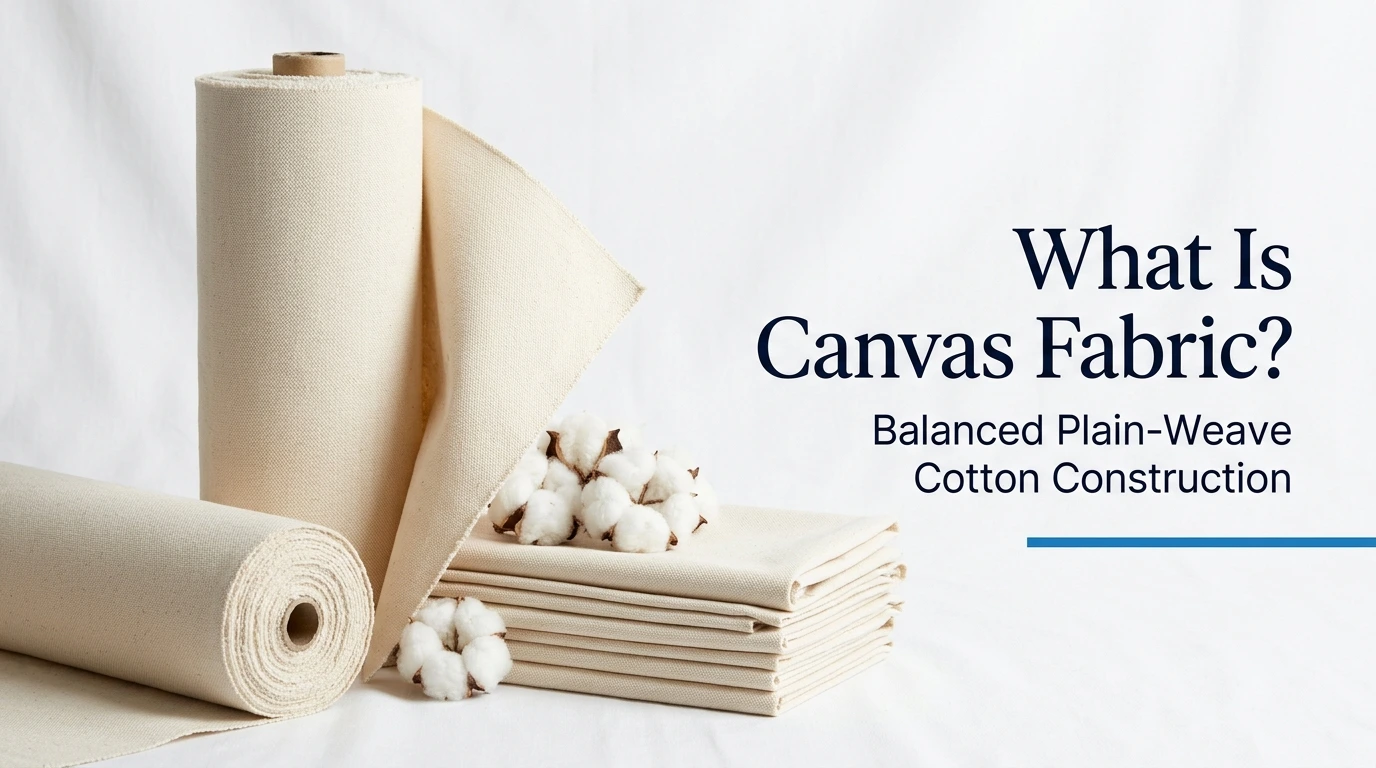
Canvas represents one of the oldest and most versatile industrial textiles in commercial manufacturing. Historically derived from hemp (Cannabis sativa), modern commercial canvas produced in Indian textile hubs like Kishangarh is primarily woven from pure cotton or cotton-synthetic blends.
The structural hallmark of general canvas is its balanced plain-weave construction. In this weave, warp (lengthwise) and weft (crosswise) yarns cross over and under one another in a simple alternating pattern. Because general canvas can be woven with varying thread counts and yarn diameters, it provides fabric engineers with immense flexibility.
At Radhey Krishna Cotweaving, our standard cotton canvas spectrum spans from lighter 170 GSM and 200 GSM variants up to heavy 390 GSM and 470 GSM qualities. This range serves commercial converters who require a dependable, flexible surface for screen printing, digital roll-to-roll printing, and standard lockstitch sewing. General canvas excels in products where moderate structural rigidity and high surface printability matter more than extreme hydrostatic resistance or ballistic abrasion durability.
What Is Duck Canvas Fabric?
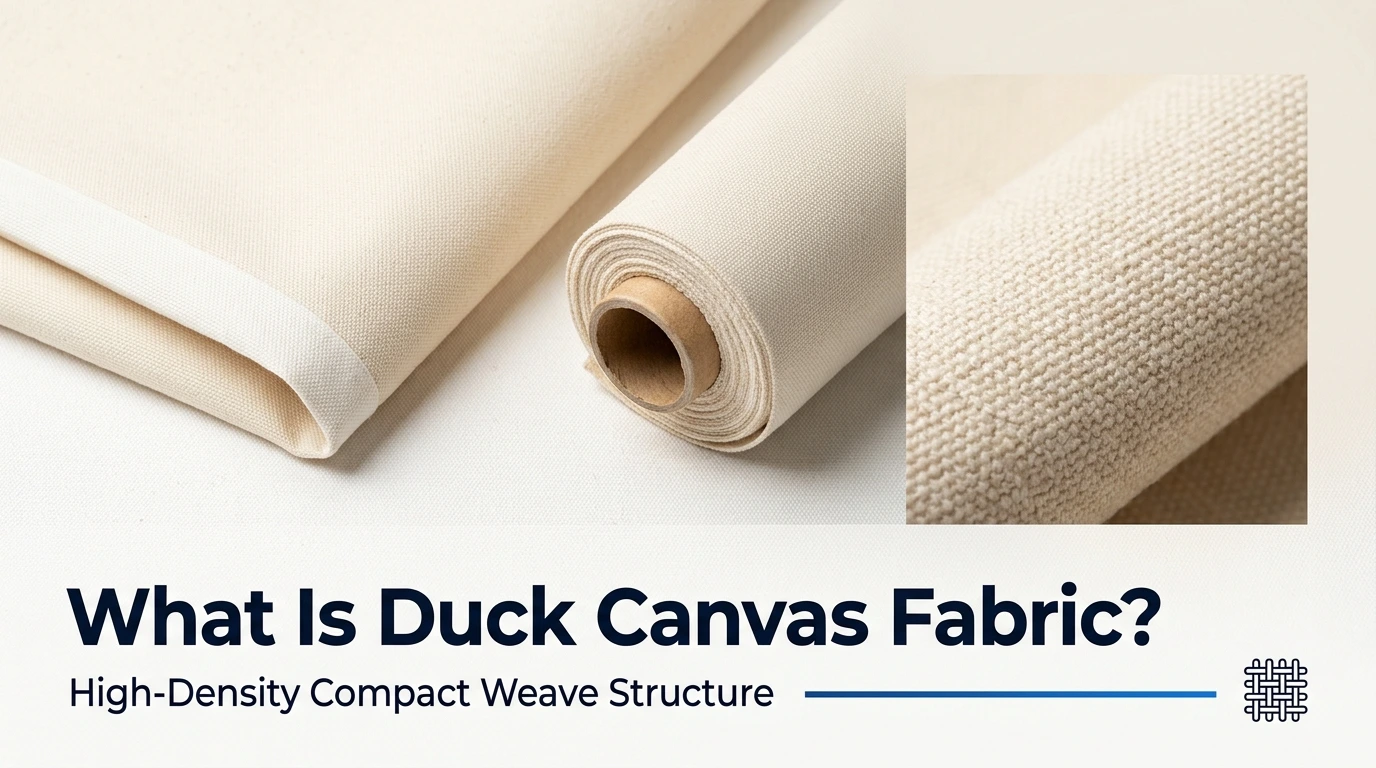
Duck canvas, also known as duck cloth, is a specialised subset of canvas distinguished by its significantly tighter weave density and compact structure. Woven with high-tension yarns packed closely together, duck canvas delivers superior tensile strength, smooth surface flatness, and heightened wind and puncture resistance for heavy-duty commercial luggage, utility workwear, tool wraps, and tarpaulins.
The term “duck” has nothing to do with waterfowl. It originates from the Dutch word doek, which historically referred to linen or cotton canvas cloths used for sailors’ trousers, maritime sails, and protective outer garments. Over generations of industrial standardization, duck cloth became synonymous with a specific tight-weave specification that sets it apart from looser utility canvases.
What fundamentally separates duck canvas from regular canvas is yarn geometry and packing density. While standard canvas allows minor spacing between intersecting threads, duck canvas looms pack the weft threads tightly against one another under high warp tension. This compaction creates an exceptionally smooth, uniform surface that resists snags, punctures, and surface fraying.
In commercial manufacturing, duck canvas divides into three primary trade classifications: single fill duck, numbered duck, and army duck.
Single Fill Duck Fabric
Single fill duck is a lightweight to midweight duck fabric constructed using single yarns in both the warp and weft directions. Characterised by a soft handfeel, easy machine sewability, and an accessible price point, single fill duck typically ranges from 7 oz to 10 oz for commercial retail bags, linings, and lightweight utility covers.
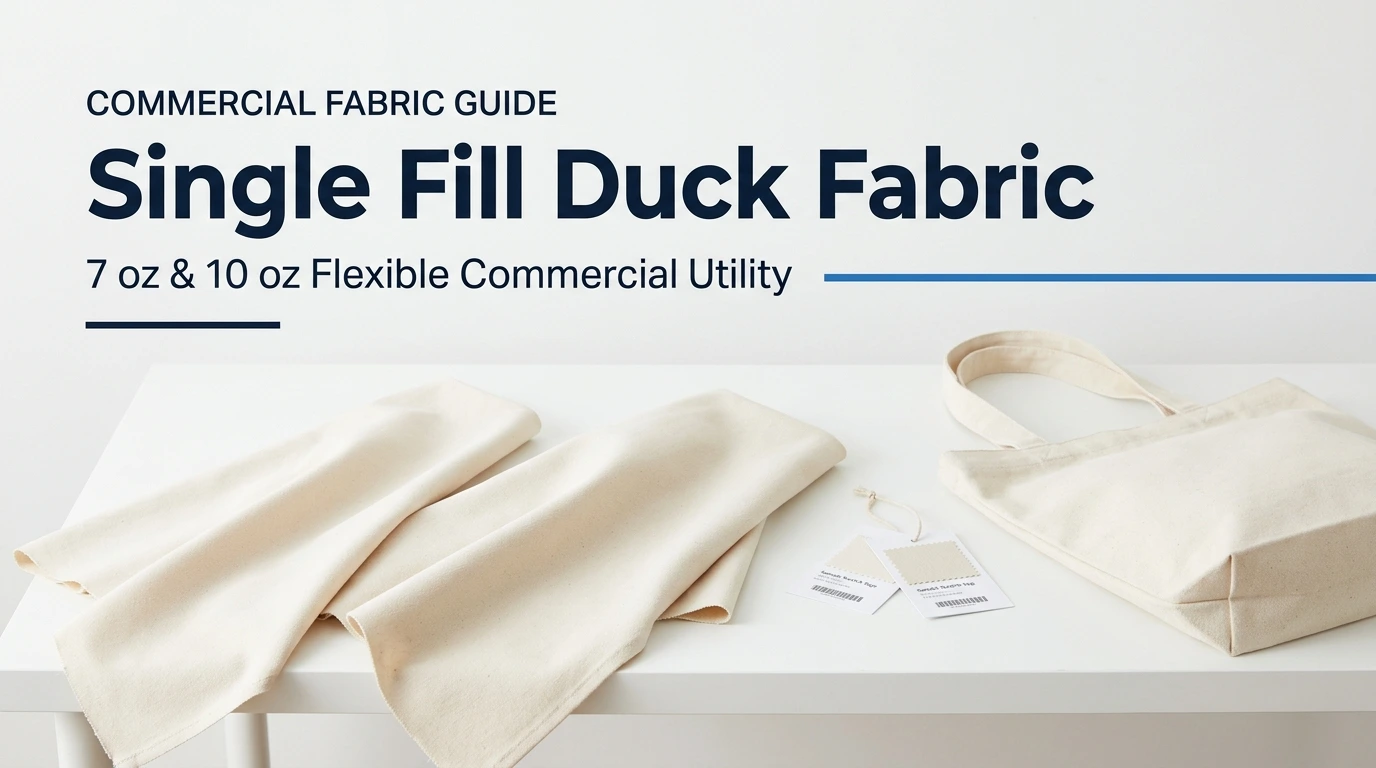
Single fill duck represents the entry point into the duck family. Because it utilizes single-ply cotton yarns rather than plied yarns, the fabric remains pliable and flexible. This drape allows bag makers to cut multi-layer patterns quickly without causing excessive blade drag or thread slippage on automated cutting tables.
At Radhey Krishna Cotweaving, our single fill duck production focuses on two core commercial weights: 7 oz (approximately 237 GSM) and 10 oz (approximately 339 GSM). These weights are widely sourced by apparel and bag factories in Mumbai and Delhi for promotional tote bodies, shopping bags, utility aprons, and structured jacket linings where rigid bulk would hinder product ergonomics.
Numbered Duck (Heavy Natural Canvas) Fabric
Numbered duck is an industrial-grade, plied-yarn heavy canvas manufactured according to a traditional classification system where lower numbers indicate heavier, denser cloths. Woven with two or more folded yarns in both warp and weft, numbered duck delivers maximum structural rigidity and tear resistance for heavy equipment bags, tool rolls, and industrial wall panels.
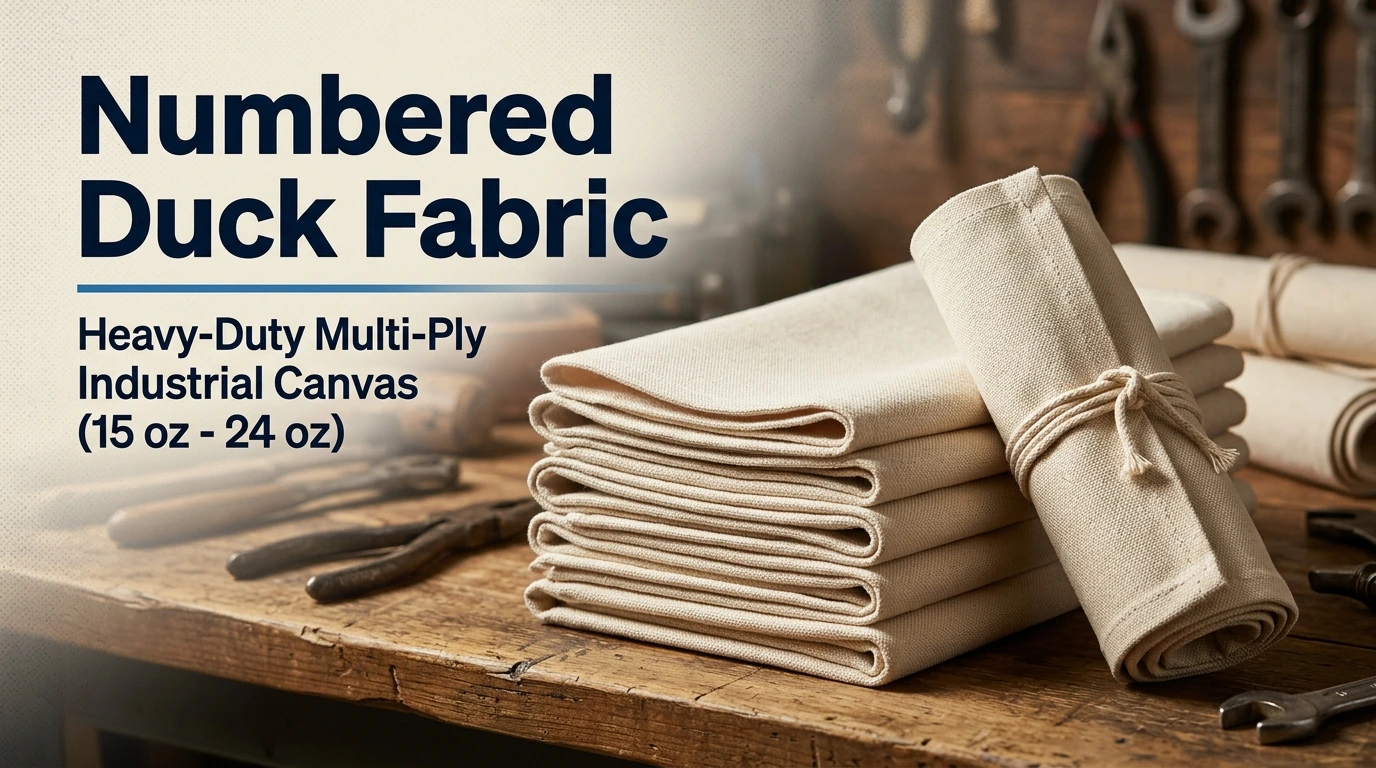
Numbered duck represents the heaviest category of woven cotton textiles. Unlike single fill duck, numbered duck uses plied yarns (two or more yarn strands twisted together before weaving) in both the warp and filling directions. This plied architecture yields exceptional tensile strength under static and dynamic loading.
The traditional numbering system operates on an inverse scale running from No. 1 (the heaviest, traditionally around 30 oz per square yard) down to No. 12 (the lightest numbered grade, traditionally around 11.5 oz). However, industrial buyers must note that number-to-ounce conversion standards vary across international regions, military specifications, and individual weaving mills. To provide absolute clarity for commercial procurement, Radhey Krishna Cotweaving lists its heavy numbered duck collection strictly by verified ounce weight: 15 oz, 16 oz, 18 oz, 20 oz, and 24 oz natural canvas.
Army Duck Canvas Fabric
Army duck canvas is a premium, tightly packed plain-weave fabric constructed with two-ply yarns in both warp and weft directions. Engineered with exceptionally high thread counts, army duck provides a smooth, firm face that naturally repels water and wind penetration, making it the premier choice for expedition duffels, tactical gear, tool rolls, and outdoor equipment.
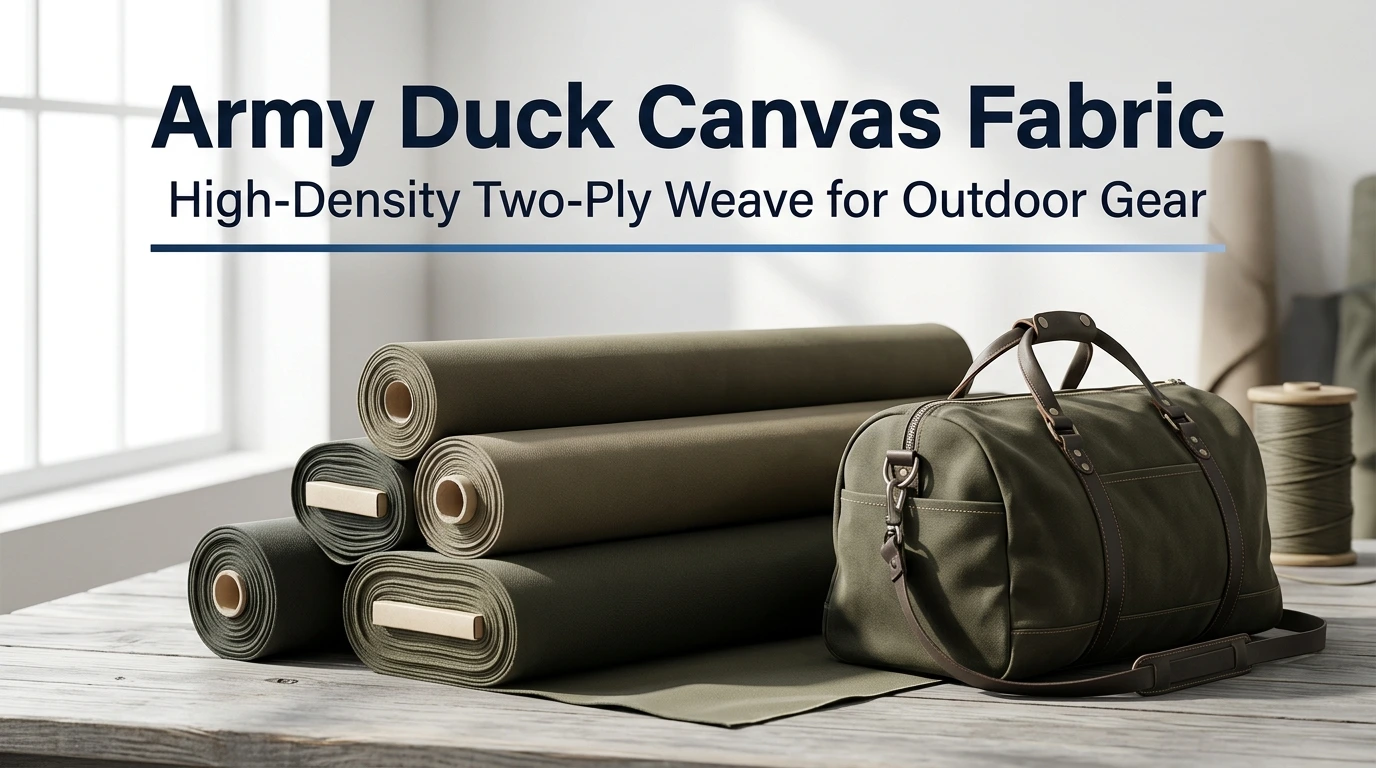
Originating from historical military field tent and equipment specifications, army duck is renowned for its dense, firm hand. Unlike standard numbered ducks that achieve high weight by using thick, coarse yarns, army duck uses finer two-ply yarns woven at a remarkably high picks-per-inch density.
The resulting textile is compact, wind-resistant, and extraordinarily durable while remaining noticeably smoother to the touch than coarse numbered canvas. At RK Cotweaving, our mill produces army duck in three volume weights: 8 oz (approximately 271 GSM), 10.10 oz (approximately 342 GSM), and 12 oz (approximately 407 GSM). Bag manufacturers specifically specify 10.10 oz army duck when building rugged outdoor backpacks and heritage travel duffels that require long-term abrasion endurance without an unyielding, wooden feel.
Canvas vs Duck Canvas: How Do They Compare Side by Side?
Comparing canvas versus duck canvas reveals that duck features tighter thread counts, higher warp tension, and smoother surface topography than general canvas. While regular canvas offers superior flexibility and cost efficiency for lightweight totes, duck canvas delivers significantly greater tensile strength, puncture resistance, and seam integrity for heavy industrial applications.
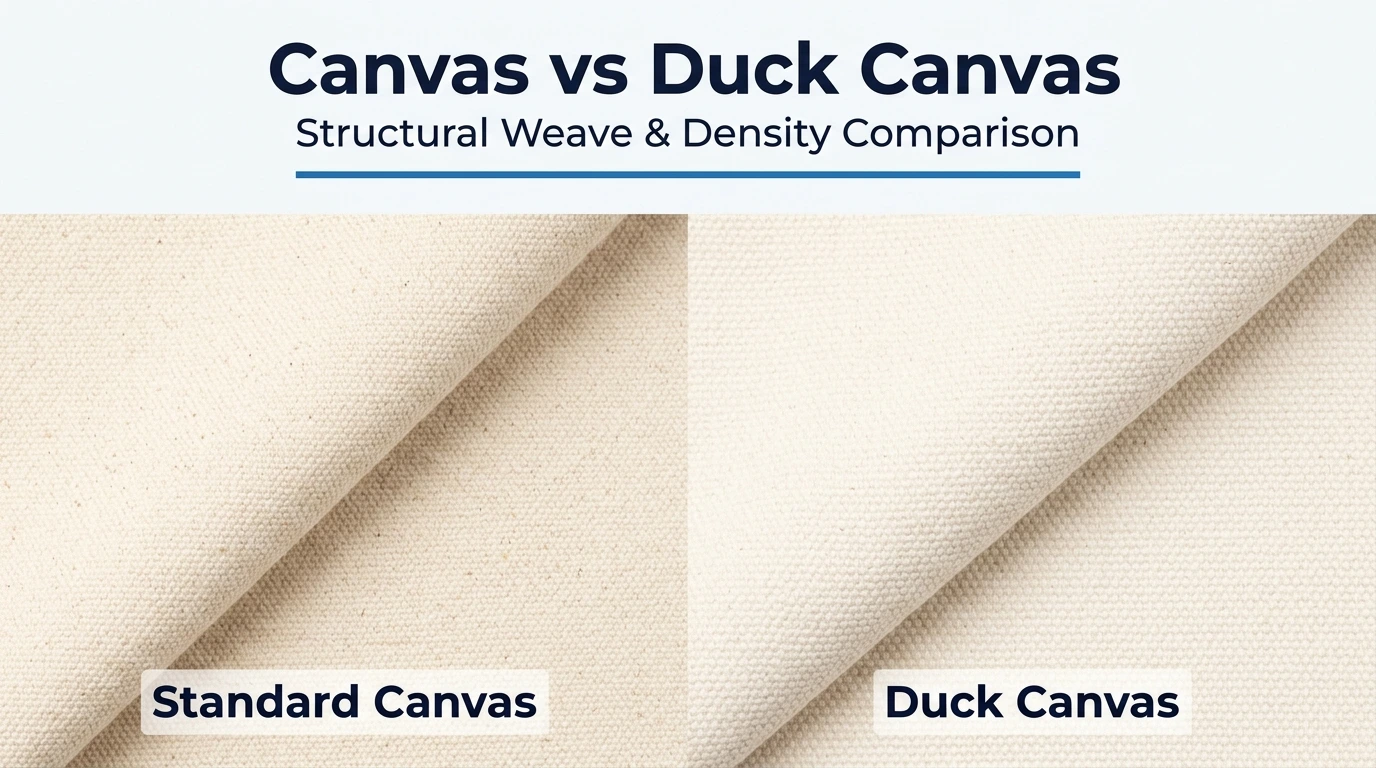
When procuring fabric across multi-thousand-metre production schedules, choosing between regular canvas and duck canvas directly influences material yield, stitching speed, and field performance.
The side-by-side comparison table below outlines the mechanical and commercial parameters between the two fabric categories:
| Parameter | Standard Cotton Canvas | Cotton Duck Canvas |
|---|---|---|
| Weave Structure | Open to balanced plain weave | Dense, high-tension compact plain weave |
| Yarn Construction | Predominantly single yarns; selected plied options | Single yarns (single fill) or multi-ply yarns (army/numbered) |
| Weave Density | Moderate picks and ends per inch | Very high picks and ends per inch; tight thread packing |
| RK Cot Weight Range | 170 GSM to 470 GSM (approx. 5 oz to 13.9 oz) | 7 oz to 24 oz (approx. 237 GSM to 814 GSM) |
| Handfeel & Drape | Pliable, softer hand, easy folding | Firm, structured, rigid in heavier numbered brackets |
| Strength & Abrasion | Standard commercial tear resistance | Substantially higher tensile, burst, and abrasion resistance |
| Sewing Line Speed | High throughput on standard industrial machines | Moderate to slow; heavy duck requires walking-foot machines |
| Finishing Options | Natural greige, RFD, piece-dyed, printed | Natural greige, water-repellent, wax-coated [CONFIRM WITH RK Cotweaving] |
| Relative Cost Position | Cost-effective for high-volume consumer goods | Higher cost due to heavier yarn mass and slower loom speeds |
| Best-Fit Applications | Promotional totes, casual bags, cushions, curtains | Tool rolls, travel luggage, work aprons, equipment covers |
Which Fabric Wins When?
Standard cotton canvas wins when your commercial margins require an economical fabric cost, when bags need lightweight folding capability, or when fine screen printing requires a receptive, softer surface. Conversely, duck canvas wins decisively whenever your product encounters rigorous physical friction, heavy carrying weights exceeding 15 kilograms, or harsh field conditions where seam slippage would result in end-user warranty claims.
Single Fill vs Numbered Duck: What Is the Difference?
The difference between single fill duck and numbered duck centers on yarn construction and weight density. Single fill duck employs single yarns in warp and weft across 7 oz to 10 oz weights for accessible, flexible utility, whereas numbered duck uses dense multi-ply yarns across 15 oz to 24 oz weights for extreme industrial resistance.
Procurement managers often encounter confusion when evaluating single fill versus numbered duck. While both belong to the duck family, their structural engineering targets entirely different operational environments.
The detailed table below clarifies the distinctions across RK Cotweaving’s duck offerings:
| Duck Category | Ounce Range | Nominal GSM | Yarn Construction | Handfeel | Typical Commercial Use | RK Cot Listing |
|---|---|---|---|---|---|---|
| Single Fill Duck | 7 oz – 10 oz | 237 – 339 GSM | Single warp, single weft | Pliable, smooth, medium stiffness | Retail totes, utility aprons, duffel linings | 7 oz, 10 oz |
| Army Duck | 8 oz – 12 oz | 271 – 407 GSM | Two-ply warp, two-ply weft | Very compact, firm, smooth face | Expedition luggage, tactical gear, tool rolls | 8 oz, 10.10 oz, 12 oz |
| Numbered Duck | 15 oz – 24 oz | 509 – 814 GSM | Multi-ply heavy folded yarns | Rigid, board-like, extreme heft | Heavy machinery wraps, industrial tool bins | 15, 16, 18, 20, 24 oz |
Understanding the Inverse Numbering Rule
Traditional cotton duck conventions follow an inverse numbering rule: the smaller the number, the heavier the fabric. A No. 1 duck is massively heavier and thicker than a No. 10 or No. 12 duck.
However, because specific yarn counts and reed-pick configurations vary across global standards, relying solely on arbitrary number designations can cause expensive procurement errors. Radhey Krishna Cotweaving recommends specifying fabrics by nominal ounce weight and GSM target [CONFIRM WITH RK Cotweaving: RK Cotweaving’s numbered duck construction and numbering convention].
How Do Ounces, GSM and Duck Numbers Relate?
Ounces per square yard and grams per square metre relate through a fixed mathematical conversion factor: 1 oz/yd² equals 33.906 GSM. While international bag buyers frequently quote fabric weight in ounces, domestic mills in India calculate yarn consumption in GSM, requiring precise conversion to avoid specification discrepancies across bulk orders.
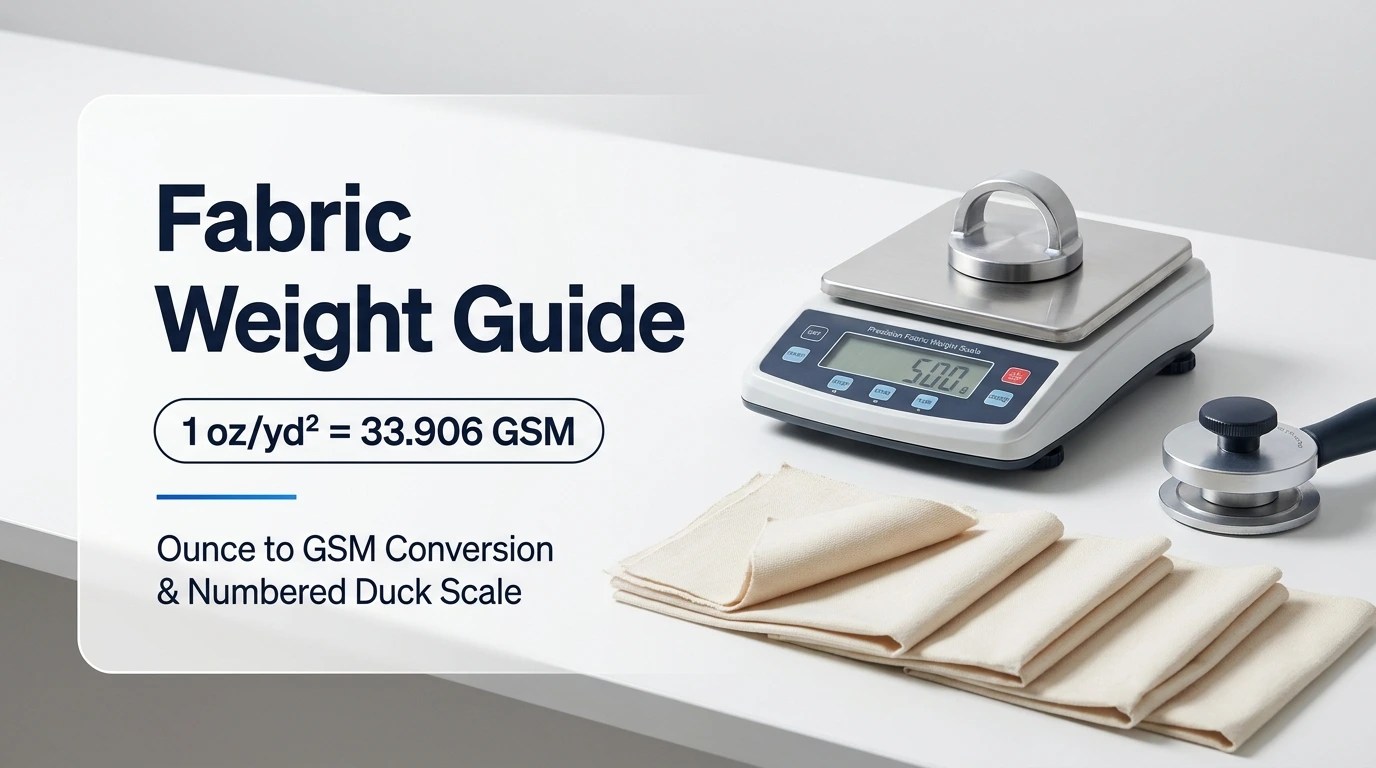
In textile trade across India and export markets, misunderstanding weight metrics causes frequent production delays. American and British buyers routinely specify “10 oz canvas” or “18 oz duck,” while Indian production supervisors manage dye houses and loom allocations in GSM (grams per square metre).
The exact conversion formulas are:
- Formula 1 (Ounces to GSM): GSM = Ounces per Square Yard × 33.906
- Formula 2 (GSM to Ounces): Ounces per Square Yard = GSM ÷ 33.906
Quick Voice Search Fact: One ounce per square yard equals 33.906 GSM; therefore, a standard 10 oz duck canvas has a nominal weight of approximately 339 GSM.
The table below provides the mathematically verified nominal GSM values for RK Cotweaving’s commercial duck lineup:
| Product Classification | Ounce Weight | Nominal Metric GSM |
|---|---|---|
| Single Fill Duck | 7 oz | approx. 237 GSM |
| Single Fill Duck | 10 oz | approx. 339 GSM |
| Army Duck | 8 oz | approx. 271 GSM |
| Army Duck | 10.10 oz | approx. 342 GSM |
| Army Duck | 12 oz | approx. 407 GSM |
| Numbered Duck (Natural Canvas) | 15 oz | approx. 509 GSM |
| Numbered Duck (Natural Canvas) | 16 oz | approx. 543 GSM |
| Numbered Duck (Natural Canvas) | 18 oz | approx. 610 GSM |
| Numbered Duck (Natural Canvas) | 20 oz | approx. 678 GSM |
| Numbered Duck (Natural Canvas) | 24 oz | approx. 814 GSM |
Tolerance and Ounce Basis Caveats
Notice the structural shift in the table: RK Cotweaving’s standard cotton canvas line tops out at 470 GSM (about 13.9 oz). When a buyer requires heavier construction, our numbered duck line (509 GSM to 814 GSM) takes production into the heavy-duty bracket. All stated weights represent commercial nominal targets subject to standard textile trade tolerances, typically plus or minus 5% depending on moisture regain and finishing processes. Sourcing teams should explicitly confirm whether ounce metrics are calculated per square yard or per linear yard [CONFIRM WITH RK Cotweaving].
For complete guidance on GSM calculations across plain and twill weaves, explore our dedicated fabric GSM guide.
Which Is Better for Industrial Applications: Canvas or Duck?
Determining whether canvas or duck is superior depends on product mechanics. Standard canvas excels in consumer-facing tote bags, lightweight aprons, and display furnishings, whereas duck canvas proves distinctly superior for load-bearing tool rolls, heavy travel luggage, protective workwear, and outdoor equipment covers where puncture resistance is non-negotiable.
Industrial converters in Delhi, Mumbai, Kolkata, and Surat must match fabric selection against product stress points. Selecting a fabric that is too light leads to seam failure under load; choosing one that is unnecessarily heavy inflates raw material costs and slows assembly lines.
The operational application matrix below outlines recommended fabric selections:
| Industrial Application | Recommended Fabric & Weight | Technical Rationale | Procurement Note |
|---|---|---|---|
| Tool Bags & Heavy Tool Rolls | Numbered Duck (18 oz – 24 oz) or 12 oz Army Duck | Sharp tool edges require tight yarn compaction to prevent fabric puncture and corner blowout. | Requires heavy-gauge needles (#21–#23) and bonded nylon thread. |
| Heavy Duffels & Travel Luggage | Army Duck (10.10 oz – 12 oz) or 15 oz Numbered Duck | Smooth face resists baggage handling abrasion while retaining sufficient flexibility for turning seams. | Commonly combined with leather or webbing trim reinforcements. |
| Retail Backpacks & Structured Totes | Single Fill Duck (10 oz) or Canvas (375 – 390 GSM) | Balances standalone body structure with comfortable consumer carry weight and vibrant dye uptake. | Excellent substrate for screen printing and brand embroidery. |
| Equipment & Machinery Covers | Army Duck (10.10 oz) or Numbered Duck (16 oz) | Dense weave shields equipment from particulate dust, workshop metal shavings, and grease penetration. | Specify water-repellent finish for outdoor storage applications [CONFIRM WITH RK Cotweaving]. |
| Tarpaulins & Glamping Tents | Army Duck (10.10 oz – 12 oz) | Tight two-ply construction swells naturally upon initial dampening, sealing pores against wind and rain. | Must be finished with rot-proof and water-repellent chemistry for outdoor exposure. |
| Heavy Protective Aprons & Workwear | Single Fill Duck (10 oz) or Canvas (295 – 375 GSM) | Provides thermal and physical protection for workshops while draping comfortably around the operator. | Washes cleaner than loose-weave fabrics because dirt stays on the compact surface. |
| Upholstery & Commercial Seating | Canvas (390 – 470 GSM) or 12 oz Duck | High cycle abrasion resistance prevents seat sagging and fabric thinning across high-traffic commercial spaces. | Confirm crocking fastness (wet and dry rub) before upholstery installation. |
Need Custom Weight or Width Specifications?
Speak directly with our technical weaving engineers in Kishangarh for tailored roll configurations.
How Do Sewing, Dyeing and Finishing Change the Choice?
Fabric weight and weave density dictate manufacturing throughput across cutting, stitching, and dyeing operations. While lighter canvases sew rapidly using standard needles on lockstitch lines, high-density numbered ducks demand heavy-gauge walking-foot machines, bonded polyester threads, and specialised chemical penetration protocols during dye finishing.
A common failure mode in bag and luggage factories occurs when production managers order dense numbered duck without auditing their machine capacity. Moving from a 10 oz single fill duck to a 20 oz numbered duck changes factory floor mechanics:
- Needle Gauge and Machine Setup: Standard single fill duck (7 oz to 10 oz) sews cleanly with needle sizes 16/100 to 18/110 on standard industrial lockstitch machines. Conversely, multi-layer assemblies of 16 oz to 24 oz numbered duck demand walking-foot compound feed machines using heavy needle gauges (21/130 to 24/180) to avoid needle deflection, skipped stitches, and thread shearing.
- Thread Selection: Industrial duck products require continuous filament bonded polyester or bonded nylon threads (Metric 40 to Metric 20). Standard spun polyester threads lack the tensile strength required to match duck canvas longevity.
- Dye Penetration and Colorfastness: Because duck canvas fibers are packed tightly under high loom tension, dye liquor penetrates more slowly than in open canvas. Achieving deep, level shades across navy, olive, and black requires pressurized jig or beam dyeing vessels.
- Protective Finishes: Depending on product specifications, duck canvas can receive water-repellent, anti-fungal, or flame-retardant chemical finishes. Buyers must note that untreated cotton duck canvas is water-resistant due to fiber swelling, but is not waterproof unless a continuous barrier coating or wax treatment is applied [CONFIRM WITH RK Cotweaving].
How Should a Bag or Luggage Manufacturer Choose? (Decision Checklist)
Bag and luggage manufacturers should select between canvas and duck by systematically auditing load demand, ergonomic carry weight, seam stress distribution, sewing equipment, and export compliance. An eight-step decision checklist ensures production runs achieve optimal material strength without inflating bill-of-materials costs or causing manufacturing downtime.
Follow this eight-step engineering protocol when specifying cotton textiles for new product collections:
- Calculate Static and Dynamic Load Demand: If the finished bag carries under 5 kg (e.g., standard shopping totes, casual beach bags), specify 200 GSM to 295 GSM cotton canvas. For loads between 5 kg and 15 kg (e.g., weekenders, student backpacks), move to 10 oz single fill duck or 375 GSM canvas. For loads exceeding 15 kg (e.g., industrial tool totes, expedition packs), specify 12 oz army duck or 18 oz to 24 oz numbered duck.
- Audit Total Product Weight: Heavy numbered duck adds significant tare weight to a bag. If your end consumer prioritises lightweight travel ergonomics, opt for high-tenacity army duck (such as 10.10 oz), which provides maximum burst strength at a moderate physical mass.
- Deploy a Hybrid Panel Strategy: High-end luggage brands rarely build an entire bag from a single fabric weight. Use heavy 18 oz numbered duck on the base panel and lower gussets where floor abrasion occurs, paired with lighter 10 oz army duck or 315 GSM canvas on side walls to reduce total weight and lower material costs.
- Audit Factory Stitching Capabilities: Verify your sub-contractors’ equipment. Multi-panel corner seams on a 20 oz numbered duck fold into six or eight fabric plies. Ensure your line operates heavy walking-foot machines before issuing purchase orders.
- Determine Surface Finish Requirements: Decide whether the fabric will run in natural unbleached greige, custom piece-dyed shades, or waxed finishes. Tighter duck surfaces yield cleaner, crisper wax distribution than open-weave canvas.
- Verify Export Certifications: Exporting finished bags to the European Union, the UK, or North America increasingly requires verified chain-of-custody documentation. Sourcing Fairtrade, GOTS (Global Organic Textile Standard), or GRS (Global Recycled Standard) certified canvas prevents customs delays and satisfies brand sustainability criteria.
- Inspect Technical Verification Standards: Request mill test certificates verifying mass per unit area under ASTM D3776, warp and weft yarn density under ASTM D3775, and grab/strip tensile strength under ISO 13934-1 or ASTM D5034.
- Test Pre-Production Swatch Bundles: Never commit to multi-thousand-metre production without running physical yardage through your factory’s automated spreading, cutting, and sewing sequence.
Why Source Canvas and Duck Mill-Direct from Kishangarh?
Sourcing canvas and duck mill-direct from Radhey Krishna Cotweaving in Kishangarh eliminates middleman margins while guaranteeing consistent GSM across high-volume production. Operating on 100% solar and wind renewable energy with full GOTS, Fairtrade, and Oeko-Tex certifications, RK Cotweaving delivers reliable supply for domestic brands and global exporters.
In competitive B2B manufacturing, working through fabric traders often introduces inconsistent lot-to-lot GSM, unexpected lead-time spikes, and unverified certification claims. Sourcing mill-direct from our production facility in the Kishangarh Hi-Tech Textile Park in Rajasthan provides distinct operational advantages:
- Complete Canvas and Duck Range Under One Roof: From 170 GSM plain canvas to 24 oz numbered duck, our unified weaving mill allows converters to consolidate their entire textile bill-of-materials with a single manufacturing partner.
- Consistent Quality and Batch Tracking: With an annual capacity exceeding 10 million metres and a skilled team of over 120 textile professionals, we maintain precise warp tension and density control, preventing the weight fluctuations that disrupt automated sewing lines.
- 100% Renewable Energy Manufacturing: Our entire weaving mill operates on dedicated solar and wind power installations, reducing over 450 tons of carbon emissions annually. This clean manufacturing footprint directly bolsters your brand’s Scope 3 sustainability disclosures.
- Recognised Global Certifications: We maintain active certifications including GOTS, Oeko-Tex Standard 100, Fairtrade, Organic Content Standard (OCS), Global Recycled Standard (GRS), Recycled Claim Standard (RCS), and Better Cotton Initiative (BCI). Sourcing Fairtrade and GOTS certified canvas gives bag manufacturers a critical edge in securing high-margin European and American retail export contracts.
- Transparent Traceability: Every production batch is backed by rigorous documentation and physical supply-chain validation via AWARE traceability technology.
Explore our full commercial collection of cotton canvas fabric and duck fabric directly from the mill.
Frequently Asked Questions About Canvas and Duck Fabric
This frequently asked questions section provides direct answers regarding technical differences, weave densities, structural classifications, ounce to GSM weight calculations, and mill-direct procurement criteria for commercial cotton canvas, single fill duck, army duck, and heavy numbered duck fabrics produced by Radhey Krishna Cotweaving in India.
What is the main difference between canvas and duck canvas?
The main difference is weave tightness and structural density. Canvas is a broad category of plain-weave fabrics across medium to heavy weights, whereas duck canvas is a specific subset woven with tighter thread packing, higher warp tension, and a smoother surface that provides greater tear and puncture resistance.
Is duck canvas stronger than regular canvas?
Yes, duck canvas is significantly stronger than regular canvas of equivalent weight. Because duck cloth packs more warp and weft yarns into every square inch under high loom tension, it delivers substantially higher tensile strength, burst resistance, and resistance to surface snagging and abrasion.
What is single fill duck?
Single fill duck is a commercial cotton duck woven with single-ply yarns in both warp and weft directions. Typically produced in 7 oz and 10 oz weights, it provides an economical balance of smooth surface appearance, flexible drape, and easy machine sewability for retail totes, linings, and aprons.
What is numbered duck canvas, and what does the number mean?
Numbered duck is heavy, plied-yarn industrial canvas categorized under a traditional numbering scale where lower numbers indicate heavier fabrics. A No. 1 duck is the heaviest, while higher numbers designate lighter weights. Numbered duck delivers supreme rigidity and durability for industrial tool rolls and heavy covers.
What is army duck canvas?
Army duck canvas is a tight plain-weave cotton fabric constructed using fine two-ply yarns in both warp and weft directions. Originally engineered for military field tents, its high thread count produces a firm, smooth surface that naturally resists wind and water penetration for expedition luggage and tactical gear.
How many GSM is a 10 oz canvas or duck fabric?
A 10 oz fabric equates to approximately 339 GSM based on standard ounces per square yard calculation (1 oz/yd² = 33.906 GSM). In commercial trade, 10 oz single fill duck sits at approximately 339 GSM nominal weight, subject to standard textile manufacturing tolerances of plus or minus 5%.
Does RK Cot supply canvas and duck fabric in bulk for bag manufacturers?
Yes, Radhey Krishna Cotweaving supplies bulk mill-direct rolls of cotton canvas (170 to 470 GSM), single fill duck (7 oz, 10 oz), army duck (8 to 12 oz), and numbered duck (15 to 24 oz) with GOTS, Fairtrade, and Oeko-Tex certifications from Kishangarh, Rajasthan.
Sourcing Reliable Canvas and Duck for Your Production Line
Successful industrial bag manufacturing depends on aligning textile specifications directly with product stress points, line machinery, and export compliance. By evaluating weave density, plied yarn architecture, and precise GSM tolerances, procurement heads secure consistent production yields and superior end-product durability.
Choosing between cotton canvas and duck canvas is never about finding a generic “best” fabric; it is about engineering the exact balance between structural performance, production efficiency, and material economics. Whether your upcoming production run requires flexible 295 GSM canvas for high-volume promotional totes, compact 10.10 oz army duck for luxury travel gear, or heavy 20 oz numbered duck for indestructible tool storage, sourcing mill-direct ensures your factory operates with predictable lead times and certified quality.
Enquire for Wholesale Pricing & Swatch Books
Partner with Radhey Krishna Cotweaving for GOTS, Fairtrade, and Oeko-Tex certified cotton canvas and duck fabrics delivered directly from our Kishangarh mill.
Direct Factory Phone / WhatsApp: +91 98290 09916 | Kishangarh Hi-Tech Textile Park, Rajasthan

Written by the Radhey Krishna Cotweaving Team. We are India’s leading manufacturer of premium, sustainable cotton and canvas fabrics.