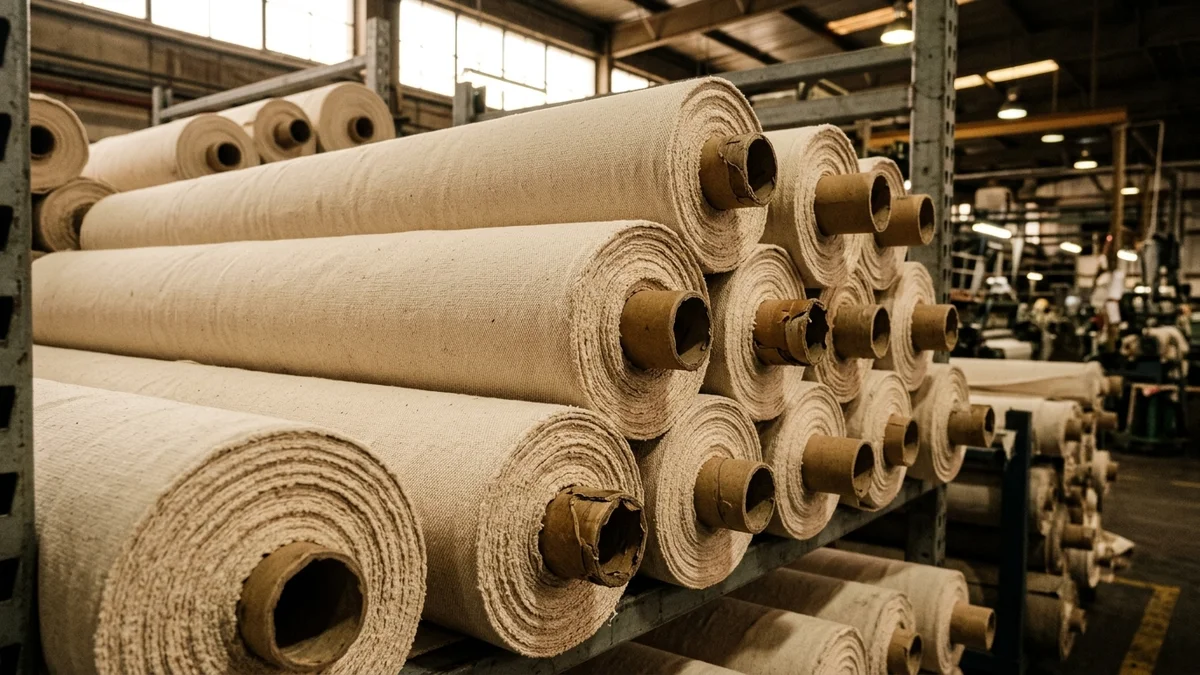
You approved a pristine 470 GSM cotton canvas sample from a Surat or Delhi supplier. Three weeks later, a 5,000-metre bulk consignment arrives at your factory in Okhla or Bhiwandi. You mount the first roll on the cutting table. The weave feels loose, your stitch lines puckering under industrial needle tension. A quick square-metre cut on your digital balance reveals the truth: the fabric weighs barely 410 GSM. The supplier claims it matches the lot tolerance, but your export buyer rejects the entire luggage line.
Learning how to choose canvas fabric wholesale supplier in India protects your manufacturing schedule, margins, and brand reputation. Genuine fabric mills operate differently from trading middlemen. At Radhey Krishna Cotweaving, we see bag manufacturers struggle repeatedly with inconsistent canvas lots sourced through commission brokers. You can eliminate this risk by applying a strict 3-point verification checklist covering entity existence, direct certificate verification, and batch testing data.
To verify a genuine canvas fabric wholesale supplier in India, complete three checks before ordering: verify legal entity registrations against operational weaving facilities, validate GOTS or Oeko-Tex certificate numbers directly within public issuer databases, and demand certified lab test reports confirming nominal GSM, tensile strength, and shrinkage tolerances across consecutive production lots.
Table of Contents (Click to Expand / Collapse)
- What Should a Bag or Luggage Manufacturer Look for in a Canvas Fabric Wholesale Supplier?
- Mill, Trader or Marketplace Listing: Who Are You Actually Buying From?
- The 3-Point Checklist for Verifying a Genuine Indian Canvas Mill
- Which Specs Should You Lock Down Before Requesting Quotes?
- How Do You Compare Canvas Quotes Fairly?
- How Should You Run a Sample and Pilot Order?
- What Are the Red Flags When Choosing an Indian Canvas Supplier?
- How Does RK Cotweaving Measure Up Against This Checklist?
- Frequently Asked Questions About Choosing Canvas Suppliers in India
- What Is Your Next Step in Securing Reliable Canvas Supply?
What Should a Bag or Luggage Manufacturer Look for in a Canvas Fabric Wholesale Supplier?
A bag manufacturer selecting a canvas wholesale supplier must prioritize roll-to-roll GSM consistency, specific weave constructions like army or numbered duck, verifiable testing documentation, transparent minimum order quantities, and reliable production schedules. Consistent yarn tension and certified finishing prevent needle deflection, seam slippage, and structural failure in finished luggage products.
Bag and luggage manufacturing places extreme physical demands on woven textiles. Unlike casual apparel, a heavy-duty tote bag, tool roll, duffle, or outdoor backpack carries substantial static and dynamic loads. If your canvas fabric exhibits uneven density across the width or varies in weight between rolls, your factory faces catastrophic assembly defects.
When sourcing from a wholesale fabric supplier in India, you need to assess suppliers across seven operational criteria:
- GSM and Weight Consistency: Industrial canvas ranges from light 170 GSM plain weaves to dense 470 GSM structures and heavy numbered ducks exceeding 500 GSM. Your supplier must maintain roll-to-roll weight variations within a contractual tolerance (typically plus or minus 3% to 5%).
- Weave Integrity and Construction: Clean plain weaves suit linings and light totes. Heavy luggage demands plied-yarn constructions such as army duck or numbered duck canvas. Looms must maintain uniform warp and weft tension to prevent diagonal skewing during automated cutting.
- Minimum Order Quantity (MOQ) Alignment: A primary mill typically operates high-output rapier or projectile looms. You need clear visibility into standard run requirements versus sampling lots to avoid sudden surcharges.
- Reliable Dispatch Schedules: Textile mills scheduling yarn procurement, warping, sizing, and weaving work on stated production windows. A dependable supplier quotes definite dispatch timelines from receipt of order confirmation.
- Certified Environmental Compliance: Export contracts for Europe and North America mandate certified organic or non-hazardous materials. Having authentic sustainability credentials ensures your finished products enter global retail chains without border rejections.
- Dyeing and Finishing Stability: Coloured canvas requires high colourfastness to light, crocking (rubbing), and washing. Incomplete dye penetration leaves white abrasive marks along folded seams, ruining premium luggage collections.
- Technical Communication: Sourcing managers need rapid answers regarding yarn counts, reed-pick construction, tensile data, and customs codes. A supplier unable to explain their loom specifications cannot solve line defects when stitching starts.
Mill, Trader or Marketplace Listing: Who Are You Actually Buying From?
Fabric buyers in India encounter primary textile mills, secondary traders, and online marketplace intermediaries. Mills provide genuine batch traceability, custom loom setups, and direct pricing, whereas traders offer smaller split quantities from pre-bought inventory. Marketplaces aggregate external listings but lack direct manufacturing control, technical oversight, and accountability for quality defects.
The Indian textile supply network includes diverse supplier formats. Sourcing managers frequently assume that every entity issuing a commercial invoice operates a weaving shed. In reality, thousands of fabric merchants operate purely as regional traders or listing aggregators.
Understanding the operational differences between these suppliers enables you to select the right partner for your current scale:
| Evaluation Metric | Primary Weaving Mill (e.g. RK Cotweaving) | Textile Trader / Commission Agent | B2B Marketplace Listing |
|---|---|---|---|
| Price Position | Direct mill pricing; eliminates intermediary markups (typically 20% to 30% savings according to industry estimates). | Includes trader margins, handling fees, and regional storage warehousing costs. | Varies; often includes platform referral commissions or multiple trader markups. |
| Batch Traceability | Complete; lot tracking from raw cotton fiber sourcing through weaving to finished packaging. | Limited; fabrics are often aggregated from various small powerloom clusters under one label. | Low; actual manufacturing origin is frequently masked behind trading entity profiles. |
| Customisation Flexibility | High; custom widths (up to 3.7 metres), special GSM weaving, custom yarn counts, and technical finishes. | Low; restricted to standard stock articles available in current warehouse inventory. | Minimal; sellers list fixed commercial products with standard specifications. |
| Batch-to-Batch Consistency | High; identical loom configurations, controlled yarn sizing, and stable warp tensions across runs. | Variable; successive lots may originate from different weaving units with shifting yarn counts. | Unpredictable; repeated orders may be fulfilled by entirely different subcontractor mills. |
| MOQ Requirements | Higher production runs required (e.g. 1,000 to 5,000 metres per custom weave construction). | Flexible; can cut and supply 100 to 500-metre rolls from existing stock lots. | Ranges from single-roll stock sales to arbitrary vendor requirements. |
| Defect Accountability | Direct manufacturer resolution; replacements or adjustments backed by loom inspection logs. | Complex; trader must negotiate back-to-back claims with third-party weaving units. | Difficult; platforms disclaim manufacturing liability, leaving disputes to buyer-seller mediation. |
Traders serve an essential role in the Indian market when you need 150 metres of standard canvas overnight for quick prototyping. However, when your factory commits to production runs of 10,000 tote bags or export duffles, relying on traders introduces uncontrolled variability in yarn quality, fabric weight, and roll lengths. Direct mill partnerships provide the consistency essential for industrial manufacturing.
The 3-Point Checklist for Verifying a Genuine Indian Canvas Mill
The 3-point mill verification checklist confirms an Indian textile supplier’s manufacturing authenticity before issuing purchase advances. Buyers must verify legal entity registrations against real weaving assets, cross-examine environmental certifications directly within public issuer databases, and substantiate technical specifications through accredited independent laboratory testing across multiple production batches.
You can avoid trading middlemen posing as primary manufacturers by applying this strict 3-point checklist. Each checkpoint requires concrete evidence that an intermediary cannot fake.
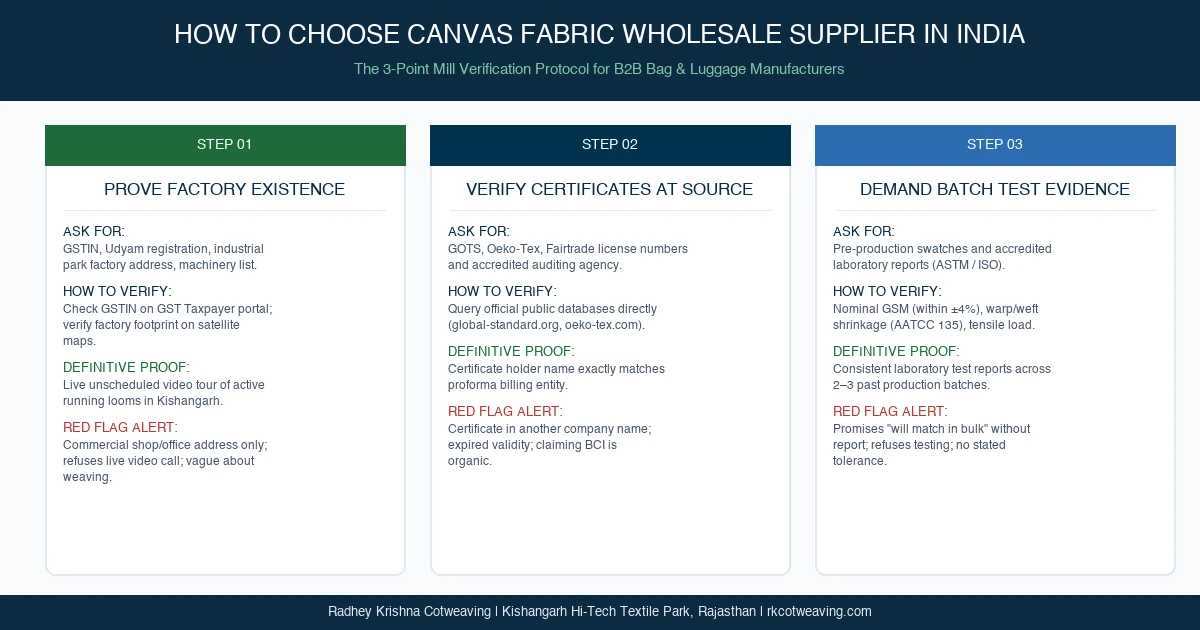
1. Prove the Entity and the Factory Actually Weave Fabric
Proving factory existence requires confirming tax credentials against physical weaving operations. While GSTIN, Udyam, and IEC filings confirm a legal business entity, they do not verify cloth manufacturing. Genuine mills validate operations through registered industrial park addresses, detailed loom inventories, and live real-time video tours of running weaving floors.
Do not rely solely on official-looking letterheads or GST certificates. In India, any commercial trading firm or indenting agent can register a GSTIN, an IEC (Import Export Code), and an MSME Udyam certificate under manufacturing classifications without owning a single shuttle or loom.
- What to ask for:
- Complete legal GSTIN, Udyam registration number, and Director General of Foreign Trade (DGFT) IEC.
- Physical factory address situated within a recognized textile industrial zone (such as RIICO Industrial Area or Kishangarh Hi-Tech Textile Park).
- Machinery and capacity summary detailing loom types (rapier, air-jet, projectile), working widths, and annual output volume.
- An unscheduled, live video walk-through of the running loom floor, or formal permission for a physical factory audit.
- What good looks like:
You run the supplier’s GSTIN on the official GST Taxpayer Search portal (
services.gst.gov.in/services/searchtp). The principal place of business displays an industrial manufacturing address matching their Udyam registration. You verify the factory footprint on satellite maps within an active industrial textile park. When you request a live video call via WhatsApp, the technical manager walks through the weaving shed, showing running looms, automated warping machines, and stacked rolls carrying the mill’s branded packaging tags. - Red flag: The supplier claims to operate a 10-million-metre facility but displays a commercial office or shop address in a commercial trading market. They repeatedly refuse a live video call, offering instead high-gloss marketing videos or pre-recorded promotional reels, and deflect inquiries regarding who weaves the cloth.
2. Verify Certifications at the Source, Not from a PDF
Verifying textile certifications demands cross-referencing certificate identification numbers directly inside public registry databases operated by GOTS, Oeko-Tex, and Fairtrade. Legitimate compliance requires that the invoicing entity name matches the certified holder exactly, the certificate status remains currently active, and the documented scope specifically includes woven cotton canvas.
PDF certificates are frequently manipulated by unscrupulous brokers who paste their commercial entity name over an authentic mill’s document. When you export finished goods, customs authorities and global retail auditors do not accept forwarded PDFs. They verify credentials directly against global accreditation registries.
- What to ask for:
- The exact certificate registration numbers for claimed standards: Global Organic Textile Standard (GOTS), Oeko-Tex Standard 100, Fairtrade (FLOCERT), Organic Content Standard (OCS), or ISO 9001:2015.
- The official accredited certification body that audited the facility (such as Control Union, OneCert, or Hohenstein).
- A sample Transaction Certificate (TC) from a recent commercial shipment showing the chain of custody.
- What good looks like: You access the public GOTS Certified Suppliers Database and input the supplier’s license number. The system returns the exact legal entity name shown on your proforma invoice, confirms active validity dates, and lists “Woven Fabrics” or “Canvas” under product categories. On the Oeko-Tex Label Check portal, entering the certificate number confirms that the fabric passes strict ecological limits for heavy metals and pesticides.
- Red flag: The certificate displays an expired validity date, or the registered company name belongs to a third-party processing mill with which your supplier has no transparent legal relationship. Another major warning sign is claiming that Better Cotton Initiative (BCI) membership equals organic canvas certification. BCI is an agricultural sourcing system supporting sustainable farming practices; it is not a chain-of-custody organic fabric certification and does not replace GOTS.
Summary of Core International Textile Standards:
- GOTS (Global Organic Textile Standard): Verifies at least 70% to 95% certified organic cotton fiber, strict non-toxic chemical inputs, and audited social welfare criteria across processing.
- Oeko-Tex Standard 100: Tests finished woven textiles for hundreds of harmful regulated chemicals, ensuring human skin safety.
- Fairtrade (FLOCERT): Guarantees fair wages, safe working environments, and direct community premiums paid to agricultural and mill workers.
- ISO 9001:2015: Establishes rigorous corporate quality management systems, standardised inspection protocols, and continuous manufacturing improvement.
3. Prove Quality with Samples, Test Reports and Batch Consistency
Proving fabric quality requires securing pre-production swatches alongside certified laboratory test reports covering GSM, dimensional stability, and breaking strength under international standards. Sourcing teams must review historical test logs across past production lots and establish legally binding weight and shrinkage tolerances within the master purchase contract.
A pristine 20-centimetre hand swatch tells you very little about how a 5,000-metre canvas order will behave under heavy industrial sewing machines. Genuine mills routinely test yarn parameters and fabric properties to confirm adherence to engineering specifications.
- What to ask for:
- Pre-production sample swatches cut from current running lots, accompanied by internal mill inspection records.
- Independent, accredited laboratory test reports (issued by an NABL-accredited laboratory certified to ISO/IEC 17025 in India).
- Batch test reports from two or three previous production lots of the same construction to assess historical consistency.
- Contractually agreed tolerance parameters for GSM (nominal weight), total finished width, warp/weft shrinkage, and breaking strength.
- What good looks like:
The supplier provides comprehensive test sheets citing standardized global testing protocols:
- Mass Per Unit Area (GSM): Tested under ASTM D3776 or ISO 3801 confirming that a 375 GSM canvas stays reliably between 360 and 390 GSM (within a plus or minus 4% tolerance).
- Thread Count: Tested under ASTM D3775 defining exact warp ends and weft picks per inch.
- Tensile and Tearing Strength: Tested under ISO 13934-1 or ASTM D5034 (grab test) confirming load resistance suited for luggage handles and stress points.
- Dimensional Stability (Shrinkage): Tested under AATCC 135 ensuring hot washing or finishing will not distort bag dimensions beyond 2% to 3%.
- Red flag: The sales representative states, “We will match your sample in bulk, no test report is needed.” They refuse third-party laboratory verification, decline to declare a nominal GSM tolerance, or provide generic handwritten inspection slips lacking standard testing methods.
Have a Custom Canvas Specification for Your Bags?
Consult our technical weaving team directly from the loom floor. We will review your GSM, yarn count, and finishing requirements.
Which Specs Should You Lock Down Before Requesting Quotes?
Before requesting canvas quotations, buyers must specify fabric weight in GSM or ounces with allowable tolerances, exact usable width, specific weave construction, target shade standards, functional finishes, and packaging roll dimensions. Defining these technical parameters prevents mispriced quotes and eliminates disputes regarding weight discrepancies and cutting losses.
When requesting price quotations for bulk canvas, providing vague descriptions like “heavy cotton canvas for tote bags” guarantees inaccurate estimates. Different weaving configurations yield widely different raw material costs and production efficiencies.
To receive accurate, actionable commercial terms, define the following seven technical specifications:
- Nominal Weight and Acceptable Tolerance: State the fabric weight in Grams per Square Metre (GSM) or standard ounces per square yard (e.g. 10 oz canvas fabric). Specify your acceptable variance: for example, 315 GSM with a contractual tolerance of plus or minus 4% (302 GSM to 328 GSM).
- Usable Cuttable Width: Specify the minimum cuttable width between inner selvedges (e.g. 147 cm on a 152 cm total fabric width). Failing to clarify width leads to pattern placement errors and excessive edge wastage during automated garment cutting.
- Weave Construction: Differentiate between standard plain weave canvas, duck fabric constructions, or dense multi-ply weaves:
- Single Fill Duck: Single warp yarns woven with single or paired weft yarns (e.g. 7 oz or 10 oz canvas), balancing strength and economy.
- Army Duck Canvas: Tightly woven using plied yarns in both warp and weft directions (e.g. 8 oz, 10.10 oz, or 12 oz), offering superior water resistance and smooth tactile surfaces.
- Numbered Duck Canvas: Extremely heavy, dense industrial textiles (#1 to #12) woven with multiple plied yarns (ranging from 15 oz to 24 oz) for heavy luggage bases and military kit bags.
- Colour, Dyeing Method, and Shade Matching: Request greige (unbleached natural cotton with vegetable flecks), prepared-for-dyeing (PFD), or finished piece-dyed shades. Specify Pantone Textile Colour System (TCX) codes or physical lab-dip approval targets under standard D65 illuminants.
- Functional Finishes: Clarify technical post-treatments: water-repellent finishing (DWR), anti-fungal treatments, wax finishes, or standard pre-shrunk sanforized finishes.
- Roll Packaging and Inner Core Dimensions: Bag factories using automated spreading tables require rigid cardboard cores (inner diameter typically 50 mm to 75 mm), sealed waterproof poly-wrap packing, and uniform roll lengths of 100 or 200 metres without inner fabric splices.
- Production Minimums and Staggered Delivery: Define your total project volume alongside your monthly intake schedule to negotiate volume discounts.
For a detailed analysis of how weave architectures perform across industrial applications, consult our technical breakdown of cotton canvas fabric.
How Do You Compare Canvas Quotes Fairly?
Comparing canvas quotes fairly requires standardizing vendor proposals to price per kilogram or price per square metre at equivalent GSM weights. Because raw cotton fiber comprises the primary manufacturing cost, calculating theoretical roll weights reveals hidden price discrepancies caused by underweight weaves, narrow widths, or exaggerated linear metre measurements.
A common mistake sourcing teams make is comparing fabric quotes purely on a “price per linear metre” basis. Linear metre pricing without reference to width and weight is dangerously misleading.
Consider two competing quotes received for a 10,000-metre production order:
- Supplier A (Trader): Quotes ₹180 per linear metre for “heavy canvas”.
- Supplier B (Direct Mill): Quotes ₹195 per linear metre for a certified 375 GSM canvas at 150 cm width.
On the surface, Supplier A appears 8% cheaper. However, upon technical inspection, Supplier A quotes on a 137 cm width at an unverified 320 GSM weight. To evaluate proposals accurately, normalize all bids to price per square metre or effective price per kilogram of woven cotton.
The Mathematical Roll Weight Formula
Woven cotton canvas pricing directly reflects yarn mass. You can calculate the theoretical physical weight of any production roll using this standard engineering equation:
Roll Weight (kg) = (GSM × Width in metres × Length in metres) / 1000
Worked Example: You evaluate a 100-metre roll of our popular 315 GSM cotton canvas fabric woven at a width of 1.50 metres (59 inches):
Roll Weight = (315 × 1.50 × 100) / 1000 = 47,250 / 1000 = 47.25 kg
Adding approximately 0.8 kg to 1.0 kg for the inner heavy-duty cardboard core, this roll must weigh approximately 48.1 kg on your receiving scale. If a supplier delivers rolls weighing only 41 kg, you have been short-changed by nearly 15% of the ordered cotton fiber, resulting in thin, weak fabric prone to tearing.
Canvas Supplier Evaluation Scorecard
Use this structured scorecard to evaluate prospective Indian canvas suppliers objectively. Rate each vendor from 1 (unacceptable) to 5 (excellent) across the six core operational categories:
| Evaluation Parameter | Suggested Weight | Key Verification Focus | Score (1–5) |
|---|---|---|---|
| Entity & Mill Verification | 25% | Confirmed operational factory in industrial park, active loom floor, live video audit completed. | 5 |
| Direct Certification Validity | 20% | GOTS, Oeko-Tex, or Fairtrade certificates verified directly inside official online public databases. | 5 |
| Test Evidence & Batch Consistency | 20% | NABL test reports confirming GSM, shrinkage (AATCC 135), and tensile parameters across past lots. | 5 |
| Product Range & Spec Alignment | 15% | Supplier weaves required weights (170–470 GSM, duck weaves) with matching widths and selvedges. | 5 |
| Commercial Terms & MOQs | 10% | Clear production minimums, transparent payment milestones, and definitive dispatch windows. | 4 |
| Technical Communication | 10% | Rapid, knowledgeable responses regarding yarn counts, reed-picks, dye types, and lead times. | 5 |
| Benchmark Composite Score | 100% | Target threshold for qualified mill partner (minimum qualifying: 3.8 / 5.0) | 4.9 / 5.0 |
Multiply each score by its category weighting to establish a final composite score out of 5.0 (as illustrated in the 4.9 / 5.0 benchmark score above). Do not release substantial advance payments to any supplier scoring below a 3.8 composite rating.
How Should You Run a Sample and Pilot Order?
Executing a structured pilot order mitigates manufacturing risk when qualifying a new canvas mill. Procurement teams must issue detailed technical specification sheets, test pre-production yardage at accredited independent laboratories, run small pilot lots through automated factory assembly lines, and verify repeat batch consistency before authorizing full commercial production runs.
Never move directly from reviewing an A4-sized hand swatch to ordering thousands of metres of canvas. Establishing a structured sampling and pilot protocol safeguards your capital and confirms how the textile behaves under your factory’s specific production machinery.
Follow these six progressive milestones:
- Issue an Unambiguous Technical Spec Sheet: Send your prospective mill a structured purchase specification defining target GSM, width, yarn construction (e.g. 2/20s x 2/10s), target shrinkage limits, colour standards, and packing rules.
- Procure Sample Yardage (10 to 20 Metres): Order sufficient continuous yardage to run sample cutting and assembly tests. Avoid relying on loose swatch cards, which are often hand-picked from premium master batches.
- Conduct Independent Laboratory Audits: Send swatches cut from the sample roll to an independent NABL-accredited textile testing laboratory. Validate that actual mass matches the nominal GSM, check dimensional stability after laundering, and verify warp and weft breaking strength.
- Execute an In-House Pilot Production Run: Feed the pilot fabric through your automated spreading, cutting, and stitching operations. Observe whether the weave causes needle deflection, thread fraying during trimming, or differential shrinkage during screen printing or heat transfers.
- Establish the “Golden Sample” Contractual Standard: Once a pilot lot performs successfully, cut two identical 1-metre reference swatches. Both parties sign and stamp both swatches. One remains with your receiving inspection department, and the other stays with the mill’s loom master as the binding standard of acceptance.
- Authorize Full Commercial Volume with Staggered Dispatch: Release your bulk order with contractual terms specifying that each dispatched lot must be accompanied by internal mill inspection records confirming compliance with your Golden Sample.
What Are the Red Flags When Choosing an Indian Canvas Supplier?
Critical red flags during canvas procurement include reluctance to host live factory audits, certificates registered under secondary company names, quotes lacking explicit GSM tolerances, and refusal to sign pre-agreed defect compensation clauses. Identifying these warning signals early prevents costly supply chain disruptions and substandard fabric deliveries.
When vetting prospective suppliers across textile hubs in Surat, Ahmedabad, Kishangarh, or Coimbatore, watch for these common warning signals:
- Refusing Live Video Calls from the Factory Floor: If a representative claims they cannot answer a live video call because “factory staff are busy” or offers only promotional brochures, they are almost certainly operating as an office-based trading broker.
- Certificate Names Differing from the Billing Company: If the GOTS or Oeko-Tex certificate displays Company A while your commercial proforma invoice originates from Company B, the trader lacks direct chain-of-custody compliance.
- Pricing Framed Purely as “Per Metre” Without Weight Specs: Suppliers who resist stating exact fabric GSM and width parameters often reduce yarn picks in bulk production to shave manufacturing costs.
- Promising Unrealistic Delivery Windows: Weaving genuine high-density canvas requires warping, sizing, weaving, and inspection. A supplier promising 10,000 metres of dyed 470 GSM canvas within 48 hours is either shipping old, rejected stock inventory or misleading you about their capacity.
- Demanding 100% Advance Payment via Unofficial Channels: Professional manufacturing mills operate through formal corporate banking channels, letters of credit (LC), or standard commercial manufacturing terms (e.g. 30% advance with balance against inspection and bill of lading).
- Vague Explanations of Fabric Shrinkage: High-density cotton weaves naturally shrink between 3% and 8% unless properly sanforized. A supplier claiming their 100% untreated cotton canvas exhibits “zero shrinkage” lacks basic technical competency.
How Does RK Cotweaving Measure Up Against This Checklist?
Radhey Krishna Cotweaving operates as a primary cotton fabric mill in Kishangarh, Rajasthan, producing over 10 million metres annually on 100% renewable energy. The mill maintains complete chain-of-custody certifications including GOTS, Fairtrade, and Oeko-Tex Standard 100, providing verified batch testing reports and open factory audit access for domestic and international bag manufacturers.
At Radhey Krishna Cotweaving, we encourage B2B procurement managers to subject our manufacturing operations to the exact 3-point checklist outlined in this guide. We believe transparency is the foundation of long-term industrial partnerships.
- Entity and Factory Verification: Our industrial weaving facility operates at Plot B-12, 13 in the Kishangarh Hi-Tech Textile Park (RIICO Industrial Area, Silora, Rajasthan). We operate high-speed modern looms with an annual weaving capacity exceeding 10 million metres, supported by an experienced production team of over 120 textile professionals. Our entire manufacturing operation is powered by 100% renewable solar and wind energy, eliminating more than 450 tons of carbon emissions each year. Prospective buyers are welcome to schedule a live video walk-through of our running loom floor or visit our Kishangarh facility for an in-person technical audit.
- Direct Verification of Certifications: We maintain an extensive, fully active certification stack covering GOTS (Global Organic Textile Standard), Oeko-Tex Standard 100, Fairtrade, Organic Content Standard (OCS), Global Recycled Standard (GRS), Recycled Claim Standard (RCS), and ISO 9001:2015. We also deploy AWARE digital tracer technology for complete fiber origin traceability. Our registration numbers can be verified directly within public accreditation databases under our legal corporate entity name.
- Documented Quality and Testing Standards: We manufacture an extensive canvas portfolio, including 100% cotton canvas (170, 200, 220, 290, 295, 315, 375, 390, and 470 GSM), single fill duck (7 oz and 10 oz), army duck (8 oz, 10.10 oz, and 12 oz), and heavy numbered duck fabrics (15 oz, 16 oz, 18 oz, 20 oz, and 24 oz). Each production lot is inspected and tested against nominal weight and dimensional stability specifications, with independent laboratory test reports provided upon request.
Frequently Asked Questions About Choosing Canvas Suppliers in India
How do I know if a canvas supplier is a manufacturer or a trader?
You can distinguish a canvas manufacturer from a trader by verifying their industrial factory address on government portals, requesting a live video call of running looms, and auditing machinery inventories. Traders operate commercial offices, lack direct loom control, and cannot provide customized weaving adjustments or primary inspection logs.
A manufacturer owns, operates, and maintains production machinery within a registered industrial zone. When you request a live video call via WhatsApp, an authentic mill can show running looms, warp beams, and fabric inspection tables within minutes. Conversely, trading agents operate out of commercial market shops or shared office suites, rely on third-party sub-contractors for weaving, and frequently evade detailed questions regarding loom types, reed-pick settings, or daily weaving capacity.
How can I verify a GOTS or Oeko-Tex certificate?
Verify textile certificates by querying the supplier’s license number directly within public online registry portals maintained by certification authorities. Check that the registered holder name matches the billing entity, the validity period is active, and the documented product scope explicitly lists woven cotton canvas.
Never rely on emailed PDF attachments. To verify a GOTS claim, access the public GOTS Certified Suppliers Database and enter the unique certification number provided by the vendor. Confirm that the status is listed as “Certified”, the validity dates are current, and the certified products section covers “Woven Fabrics”. For Oeko-Tex Standard 100 credentials, enter the certificate and test report number on the official Oeko-Tex Label Check portal to confirm that the material is certified safe from harmful chemical residues.
What documents should I ask an Indian canvas mill for?
Essential documents to request from an Indian canvas mill include their GSTIN and Udyam manufacturing certificates, public accreditation licenses, comprehensive laboratory test reports, and formal commercial spec sheets declaring nominal GSM, usable width, allowable tolerances, shrinkage limits, and packaging standards.
Before releasing purchase advances, demand five core documents: (1) GSTIN registration certificate verifying manufacturing classification, (2) MSME Udyam registration specifying textile weaving codes, (3) Official certification licenses (GOTS, Oeko-Tex, ISO) with active registration numbers, (4) Certified laboratory test reports covering GSM, tensile strength, and shrinkage for the ordered article, and (5) A formal Proforma Invoice explicitly incorporating agreed technical tolerances and Golden Sample references.
What GSM should a bag manufacturer choose for tote bags and backpacks?
Bag manufacturers should select 200 to 295 GSM canvas for lightweight promotional tote bags, 315 to 390 GSM for premium retail shopper totes and structured duffles, and 470 GSM canvas or heavy 12 to 18 oz duck fabrics for rugged outdoor backpacks, industrial tool rolls, and military luggage.
The appropriate fabric weight depends on the intended mechanical usage and structure of your bag collection. Lightweight, collapsible promotional tote bags perform reliably with 200 GSM to 290 GSM cotton canvas. Premium retail bags, shopping totes, and lifestyle carryalls require the structural body and durability of 315 GSM to 390 GSM canvas. For heavy backpacks, luggage bases, and industrial equipment bags subjected to rough abrasion and heavy payloads, specify 470 GSM canvas, 12 oz army duck, or heavy numbered canvas up to 18 oz.
Is buying canvas directly from a mill cheaper than through a trader?
Buying canvas directly from a primary weaving mill typically reduces purchasing costs by approximately 20% to 30% compared to purchasing through commercial traders, based on industry estimates. Direct procurement eliminates intermediary agent commissions, secondary warehousing fees, and markup costs while ensuring consistent quality.
Direct mill procurement offers substantial cost advantages for commercial production volumes. Traders and regional wholesalers typically add 20% to 30% in markups to cover their administrative overhead, speculative inventory holding costs, and profit margins. By dealing directly with a primary mill, bag manufacturers secure competitive wholesale pricing per metre and eliminate unexpected price fluctuations caused by middleman re-brokering. However, buyers must meet the mill’s minimum production loom runs, which typically range from 1,000 to 5,000 metres depending on the custom construction.
How should I test a canvas fabric sample before bulk ordering?
Test prospective canvas fabric samples by verifying mass per unit area via ASTM D3776, checking warp and weft thread density via ASTM D3775, measuring dimensional shrinkage via AATCC 135 laundering tests, and testing tensile breaking strength on an electronic CRE tensile tester under ISO 13934-1.
Begin by cutting a precision 100 cm² circular swatch using a calibrated GSM cutter and weighing it on an electronic scale accurate to 0.01 grams. Multiply the swatch weight by 100 to determine actual Grams per Square Metre. Next, wash a marked 50 cm x 50 cm fabric square according to AATCC 135 testing methods to measure warp and weft shrinkage percentages. Finally, subject the fabric to tensile pull tests using an accredited NABL laboratory to verify that the breaking load satisfies your bag handle and seam load requirements.
Can I visit RK Cotweaving mill in Kishangarh or arrange a video audit?
Yes, Radhey Krishna Cotweaving welcomes prospective B2B fabric buyers to visit our Kishangarh weaving mill in the RIICO Industrial Area for technical audits, or schedule live WhatsApp video tours to inspect running looms, yarn preparations, and finished canvas packaging operations in real time.
We encourage commercial sourcing directors and quality assurance managers to audit our manufacturing facility. You can schedule an in-person factory inspection at our Kishangarh Hi-Tech Textile Park facility in Rajasthan to examine our weaving operations, quality control lab, and warehouse stock. If traveling is inconvenient, our technical sales managers can host a live video walkthrough showing our active looms, yarn preparation setups, and roll inspection lines, answering technical questions directly from the weaving shed floor.
What Is Your Next Step in Securing Reliable Canvas Supply?
The most effective next step for a bag manufacturer is auditing existing canvas suppliers against the 3-point checklist to uncover hidden quality risks. Sourcing managers should subsequently request pre-production pilot swatches and certified test reports from verified primary mills to establish dependable, high-volume production partnerships.
Quality luggage and bag manufacturing begins with dependable, uniform textiles. Sourcing from unverified middlemen introduces unpredictable variances in fabric weight, structural tearing under load, and severe compliance liabilities when delivering to domestic retailers or international export markets.
Before issuing your next canvas purchase order, run your current supplier through the three checks:
- Validate their GSTIN and confirm their physical factory on industrial maps.
- Cross-check their GOTS or Oeko-Tex numbers directly within public issuer portals.
- Review certified laboratory test reports across consecutive lots to ensure stable GSM tolerances.
If your current supplier hesitates to provide direct evidence, your production pipeline is exposed to unnecessary operational risk. Take control of your fabric supply chain by partnering directly with an authentic primary weaving mill.