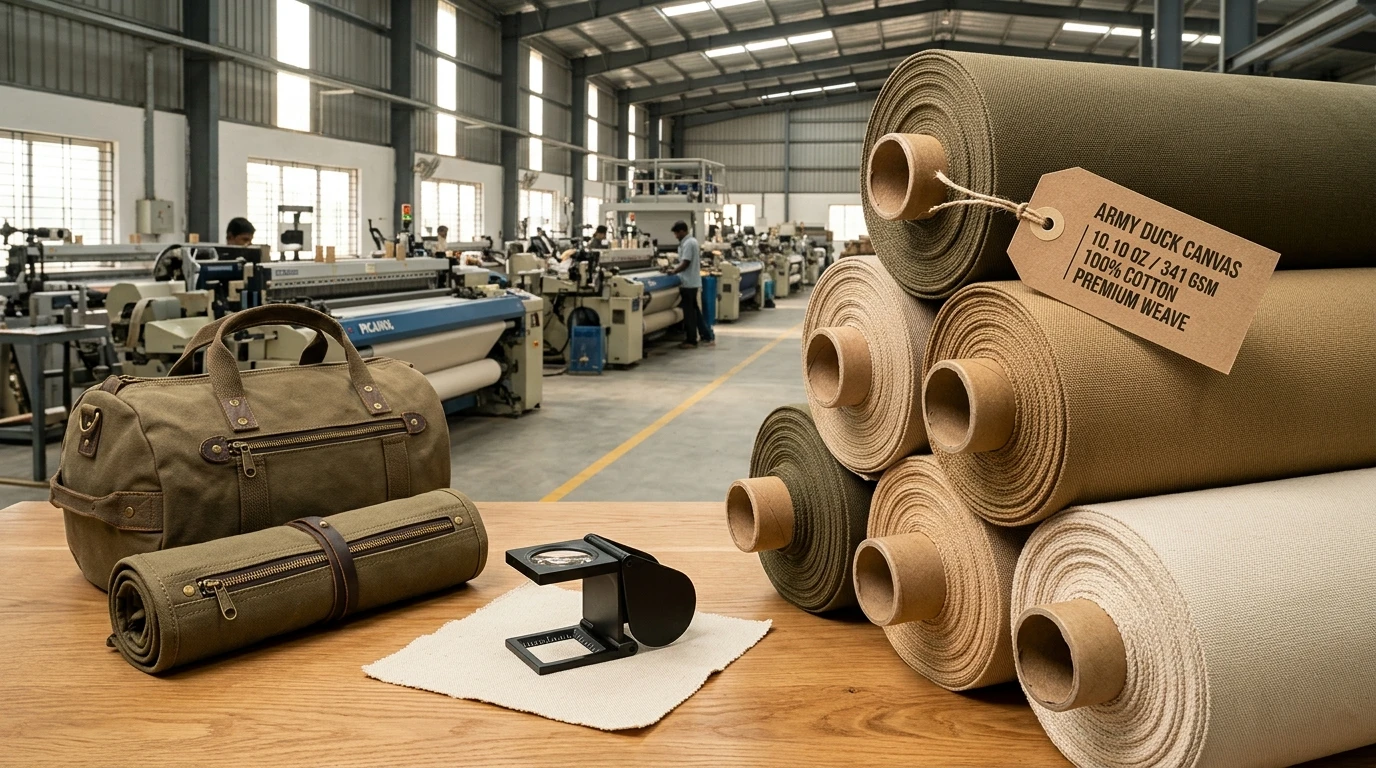
Your stitching floor in Okhla or Bhiwandi just finished 3,000 travel duffel bags for a European outdoor label. The unwashed fabric swatch you approved two months ago felt stiff, thick, and substantial in your hand. Then the export buyer’s inspection agency runs a 20-kilogram dynamic drop test and a monsoon spray test on five random cartons. The brass D-ring bar-tacks rip straight through the warp threads. After a single cold-water rinse, the heavy starch sizing dissolves, leaving the bag shell limp and porous. Your entire shipment sits on hold at Mundra port.
Sourcing from an authentic army duck canvas fabric India supplier prevents this exact manufacturing failure. Many regional fabric traders sell loose, single-yarn plain cotton canvas padded with 12% to 15% starch sizing as heavy bag cloth. Once that starch washes out or flexes under load, the weave opens up. At Radhey Krishna Cotweaving, we weave true plied-yarn army duck on high-tension industrial looms in Kishangarh, Rajasthan. When your production line requires a medium-to-heavy cotton textile that locks stitch lines, repels wind and rain without plastic coatings, and prints with razor-sharp clarity, army duck canvas is the engineering benchmark.
Army duck canvas is a tightly woven, plain-weave 100% cotton fabric constructed using two-ply twisted yarns in both the warp and weft directions. Engineered with high thread density and fine plied yarns, it delivers superior seam retention, natural water repellency, and a smooth surface ideal for backpacks, travel duffels, tool rolls, and military tents.
Table of Contents (Click to Expand / Collapse)
- What Is Army Duck Canvas Fabric? (Loom-Level Definition)
- Why Do Bag and Luggage Manufacturers Prefer the Tight Weave of Army Duck?
- Army Duck vs Single Fill Duck vs Numbered Duck vs Plain Canvas: How Do They Compare?
- Complete Weight and Yarn Breakdown: 8 Oz, 10.10 Oz, and 12 Oz Army Duck
- How Industrial Bag, Luggage and Equipment Makers Use Army Duck Canvas
- How to Specify and Test Army Duck Canvas When Ordering from an Indian Mill
- Why Choose RK Cotweaving as Your Army Duck Canvas Fabric India Supplier?
- Frequently Asked Questions About Army Duck Canvas Fabric
- How to Order Army Duck Swatches and Mill-Direct Wholesale Quotes
What Is Army Duck Canvas Fabric? (Loom-Level Definition)
Army duck canvas is a medium-to-heavy 100% cotton duck cloth woven in a tight 1x1 plain weave using plied yarns in both warp and filling directions. Unlike single-fill duck or coarse numbered canvas, army duck uses finer two-ply yarns packed at high picks per inch, producing a firm, smooth, wind-resistant textile free of artificial sizing fillers.
To understand why industrial procurement teams specify army duck by name, you have to look past commercial trade labels and examine the yarn geometry on the loom. Within the broader cotton duck fabric collection, fabrics are classified into three structural families: single fill duck, numbered duck, and army duck.
Historically developed for military specification field tents, tropical shelters, knapsack harnesses, and cartridge belts, army duck solved a specific textile engineering problem. Military quartermasters needed a cotton fabric that could block wind and driving rain like heavy numbered sailcloth, yet remain flexible and light enough for soldiers to carry on 30-kilometre marches and for garment factories to sew on high-speed industrial lockstitch machines.
Three structural rules define authentic army duck canvas on the weaving floor:
- Two-Ply Twisted Yarns in Both Directions (2-Ply Warp x 2-Ply Weft): Before warping or weaving begins, two single cotton yarn strands are twisted together on a ring-doubling or two-for-one (TFO) twister to form a balanced 2-ply yarn (such as
16/2 O.E,14/2 O.E, or10s/2 O.E). Both the lengthwise warp yarns and the crosswise weft (filling) picks use these 2-ply yarns. - High Reed and Pick Compaction: Instead of using thick, rope-like multi-ply yarns to reach a target weight, the loom master sets a higher reed count and beats the weft picks tightly against one another under elevated warp beam tension. This eliminates open pinholes between thread intersections.
- Zero Filler Sizing Manipulation: In specification-grade army duck, the fabric’s weight and stiffness come entirely from compacted cotton fibre mass. The cloth does not rely on heavy starch, clay, or tallow sizing to fake handfeel.
When you hold a swatch of genuine 10.10 oz army duck fabric up to a factory ceiling light, you will not see daylight grid gaps piercing through the weave. You feel a dense, smooth, almost dry surface that bends cleanly without cracking or shedding chalky residue.
Why Do Bag and Luggage Manufacturers Prefer the Tight Weave of Army Duck?
Industrial bag and luggage manufacturers prefer army duck canvas because its tight 2-ply weave delivers five operational advantages: high seam slippage resistance at stress points, natural water repellency through cotton fibre swelling, high tear strength without excessive seam bulk, a smooth surface for waxing and printing, and permanent post-wash dimensional stability.
When a procurement manager compares quotes per metre, standard single-yarn canvas often looks ₹15 to ₹25 cheaper than plied army duck of a similar GSM. Yet experienced luggage, backpack, and industrial gear manufacturers consistently pay for army duck. Why? Because the cost of a single rejected production run or a batch of torn shoulder straps wipes out any small savings on greige cloth.
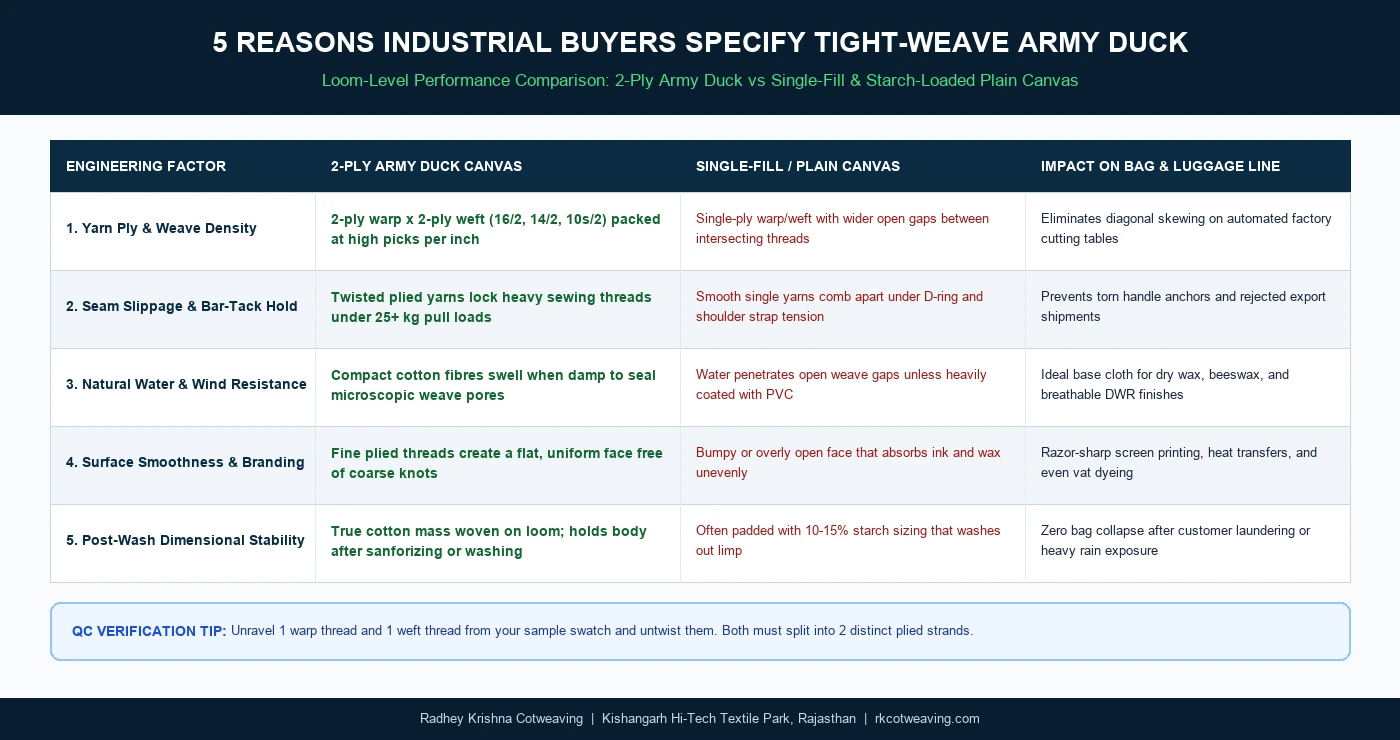
Here are the five mechanical reasons why the tight 2-ply weave of army duck outperforms standard plain canvas on your factory line.
1. Superior Seam Hold and Bar-Tack Retention Under Load
Army duck prevents seam slippage because its twisted two-ply warp and weft yarns create microscopic surface friction that locks intersecting threads in place. Under heavy pull loads at backpack straps, D-ring anchors, and zipper gussets, the tightly packed yarns resist combing apart, keeping bar-tack stitches intact up to 25+ kg payload stresses.
The number one cause of customer returns in heavy tote bags, rucksacks, and tool bags is not fabric tearing in the middle of a panel. It is seam slippage (also called yarn combing) along stitched load points.
When a user lifts a 20-kilogram tool bag by its webbing handle, the sewing thread pulls against the canvas yarns closest to the cut edge. In a loose single-yarn plain canvas, smooth single threads slide over one another like parallel wires, opening an unsightly gap along the stitch line until the seam pulls right off the edge. Because army duck uses 2-ply twisted yarns packed tightly under high loom tension, every warp and weft crossover interlocks with high mechanical friction. Your bar-tack stitches and box-X reinforcement seams stay locked in position even under repeated shock loading.
2. Natural Water and Wind Repellency Through Fibre Swelling
Army duck achieves natural water resistance through a physical mechanism where tightly packed 100% cotton fibres absorb initial surface moisture and swell radially by up to 20%. Because the loom leaves almost zero empty space between threads, this radial swelling seals microscopic weave pores, blocking rain and wind penetration while maintaining vapour breathability.
Long before synthetic polyurethane membranes existed, expedition tents and military packs relied on army duck to keep gear dry in torrential rain. This performance comes from the physics of cellulose fibres inside a high-density weave.
When raindrops hit a tightly woven army duck surface, the outer cotton fibres absorb a small amount of moisture and expand laterally. Because the 2-ply yarns are already beaten tightly together on the loom, the expanding fibres press against adjacent yarns and seal the microscopic interstices of the cloth. Water beads and runs off the exterior while the interior remains dry and breathable. When bag manufacturers apply secondary dry wax, beeswax, fluorocarbon-free DWR, or acrylic coatings to army duck, the tight weave prevents the finishing compound from bleeding through to the back of the cloth.
3. High Tensile and Tear Strength Without Excessive Bulk
By twisting two finer cotton strands into a balanced plied yarn, army duck achieves superior tensile breaking strength and tongue-tear resistance at moderate weights between 271 and 390 GSM. Bag factories gain heavy-duty load capacity without the extreme panel thickness that causes needle deflection, skipped stitches, and binding tape jams on curved corners.
Every production supervisor knows the headache of sewing ultra-heavy 18 oz or 24 oz numbered canvas on tight bag radii. When four layers of coarse numbered duck meet at a piped bottom gusset or a zippered pocket corner, the combined seam thickness exceeds 5 millimetres. Needles overheat, deflect against the throat plate, and snap.
Army duck solves this assembly bottleneck. Twisting two finer single yarns together equalises thin weak spots along the yarn length, increasing tensile breaking strength by 25% to 35% compared to a single yarn of equivalent linear mass. A 10.10 oz army duck fabric (~341 GSM) or 12 oz army duck fabric (~385 GSM) feeds smoothly under standard walking-foot industrial sewing machines (using Nm 110/18 to 130/21 needles), turns cleanly insideout without cracking, and accepts cotton herringbone binding tape without choking the folder attachment.
4. Smooth, Uniform Surface for Piece-Dyeing, Waxing and Branding
Unlike coarse numbered ducks or basket-weave canvases that exhibit pronounced surface ridges and yarn slubs, army duck presents a flat, fine-grained face. This smooth topology ensures uniform pigment uptake during reactive or vat dyeing, consistent wax absorption, and crisp edge definition for screen printing, woven patch stitching, and heat-transfer branding.
Premium lifestyle bag brands and corporate merchandise buyers judge fabric quality by visual and tactile refinement. Standard heavy canvas often shows prominent knuckles where thick single weft yarns ride over warp threads, causing screen-printed plastisol or water-based inks to skip in the valleys.
Because army duck is woven with fine plied counts (16/2, 14/2, or 10s/2), the crown of each thread intersection sits flat and even. When RK Cotweaving piece-dyes army duck using reactive or vat dyestuffs, the shade develops uniformly across the entire 150-centimetre or 213-centimetre width without blotchy cloudiness or white abrasion streaks on folded edges.
5. True Loom-State Density Versus Starch-Filled Trader Canvas
Unverified fabric traders frequently pad low-pick single-yarn canvas with 10% to 15% starch sizing to mimic the crisp handfeel and scale weight of heavy duck cloth. True mill-direct army duck derives its body and GSM strictly from tightly woven 2-ply cotton yarns, retaining its structural integrity after enzyme washing, dyeing, and sanforizing.
Here is an uncomfortable truth about domestic textile trading markets: if you buy unverified “10 oz canvas” from a middleman purely on price, you are often paying for cornstarch and china clay rather than cotton.
Traders take a loose 240 GSM single-yarn grey cloth, run it through a heavy starch padding mangle, and calender it flat so it weighs 290 GSM on a tabletop scale and feels board-stiff. The moment your factory washes the finished bag or your customer gets caught in the rain, the starch washes out and the bag collapses like a wet rag. When you source directly from a primary canvas fabric wholesale supplier in India, your army duck weight is woven permanently into the cloth via plied cotton yarns.
Army Duck vs Single Fill Duck vs Numbered Duck vs Plain Canvas: How Do They Compare?
Army duck, single fill duck, numbered duck, and standard plain canvas differ primarily in yarn ply construction, thread packing density, and surface texture. While plain canvas and single fill duck use economical single yarns for everyday totes, army duck uses fine 2-ply yarns for weatherproof durability, and numbered duck uses coarse multi-ply yarns for extreme rigidity.
B2B sourcing teams frequently ask how army duck fits alongside the other woven cotton fabrics in our mill catalogue. If you have read our detailed breakdown of the difference between regular canvas and duck canvas, you know that “duck” designates a tighter weave than standard plain canvas. Within that family, choosing the exact sub-type determines both your material cost per bag and your production line efficiency.
Use the technical comparison matrix below to match the right fabric architecture to your product engineering brief:
| Specification Parameter | Army Duck Canvas | Single Fill Duck | Numbered Duck (#1 to #12) | Standard Plain Cotton Canvas |
|---|---|---|---|---|
| Warp Yarn Construction | 2-Ply Twisted Cotton (16/2, 14/2, 10s/2) | Single-Ply Cotton (occasionally 2 ends woven as 1) | Multi-Ply Twisted Cotton (2-ply to 5-ply coarse yarns) | Single-Ply Cotton (10s, 12s, 16s, 20s) |
| Weft (Filling) Yarn Construction | 2-Ply Twisted Cotton (16/2, 14/2, 10s/2) | Single-Ply Cotton (1 or 2 picks per shed) | Multi-Ply Twisted Cotton (2-ply to 6-ply coarse yarns) | Single-Ply Cotton (6s, 10s, 16s) |
| RK Cotweaving Weight Range | 8 Oz, 10.10 Oz, 12 Oz (271 to 407 GSM) | 7 Oz, 10 Oz (237 to 339 GSM) | 15 Oz, 16 Oz, 18 Oz, 20 Oz, 24 Oz (500 to 810+ GSM) | 170, 200, 220, 290, 295, 315, 375, 390, 470 GSM |
| Weave Density & Porosity | Extremely tight; high picks per inch; minimal air permeability | Medium-tight; denser than plain canvas but more open than army duck | Ultra-dense, heavy-gauge structural grid | Balanced standard plain weave; moderate breathability |
| Surface Handfeel | Firm, smooth, fine-grained, crisp | Pliable, medium-textured, soft commercial hand | Board-stiff, pronounced coarse rib texture | Flexible, soft to medium-firm depending on GSM |
| Natural Water Resistance | High (fibres swell to seal tight interstices; ideal for waxing) | Moderate (requires coating for outdoor rain exposure) | High due to sheer thickness and yarn mass | Low to moderate (absorbs water unless treated with DWR/PU) |
| Industrial Sewing Ease | Excellent on standard walking-foot machines; clean corner turns | Very easy on standard lockstitch machines | Requires heavy-duty cylinder-bed or extra-heavy walking-foot machines | Very easy across all standard garment and bag machines |
| Ideal B2B Applications | Expedition duffels, heritage backpacks, waxed bags, tool rolls, military tents | Retail shopping totes, promotional bags, utility aprons, dust sheets | Heavy luggage bases, industrial machine covers, military kit bags, hammocks | Everyday fashion totes, shoe uppers, home cushion covers, painting canvas |
As this comparison shows, 100% cotton canvas fabric in standard single-yarn plain weave (such as 220 GSM or 290 GSM) is the right economic choice when you are manufacturing 50,000 promotional conference totes or retail shopper bags. However, when your product carries a premium retail price tag, holds heavy metal tools, or faces outdoor weather, upgrading to 2-ply army duck gives you a massive leap in structural performance without the sewing difficulty of 18 oz or 24 oz numbered duck.
Complete Weight and Yarn Breakdown: 8 Oz, 10.10 Oz, and 12 Oz Army Duck
Indian weaving mills manufacture army duck in three standard commercial weights: 8 oz (271 to 295 GSM, 16/2 x 16/2 yarn), 10.10 oz (325 to 342 GSM, 14/2 x 14/2 yarn), and 12 oz (385 to 407 GSM, 10s/2 x 10s/2 yarn). Bag designers match these three grades to linings, primary body shells, and reinforced abrasion bases.
When specifying duck fabrics, international and Indian buyers frequently encounter both imperial weights (ounces per square yard, Oz/Sq.Yd) and metric weights (grams per square metre, GSM). The mathematical conversion factor is 1 Oz/Sq.Yd = 33.906 GSM. However, in mill practice, nominal GSM varies slightly depending on whether the fabric is measured in loom-state greige, washed, or dyed-and-sanforized condition (within a standard commercial tolerance of plus or minus 4%).
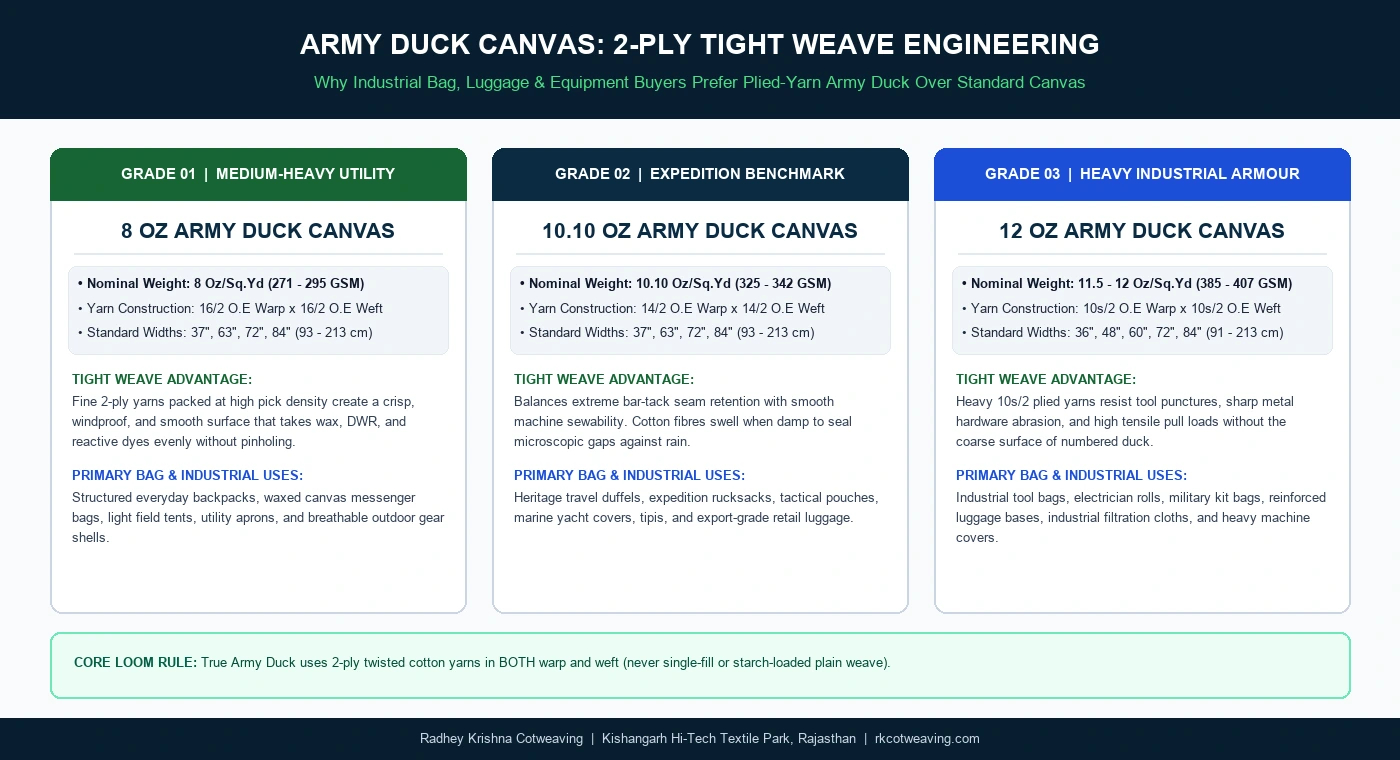
At Radhey Krishna Cotweaving, we weave three core army duck grades across narrow and wide-width looms. Below are the exact technical specifications from our Kishangarh mill floor:
| RK Cotweaving Article | Weight GLM (Oz/Sq.Yd) | Nominal GSM Range | Yarn Count (Warp x Weft) | Standard Loom Widths | Available Finishes & Fibres | Primary Bag & Industrial Use Cases |
|---|---|---|---|---|---|---|
| 8 Oz Army Duck Fabric | 8.0 Oz/Sq.Yd | 271 – 295 GSM | 16/2 O.E x 16/2 O.E (2-Ply Cotton) | 37″, 63″, 72″, 84″ (93 cm to 213 cm) | Natural Greige, Off-White, Beige, Reactive/Vat Dyed; Organic (GOTS), Recycled (GRS), BCI | Structured daypacks, waxed messenger bags, light outdoor tents, heavy workwear overshirts, internal bag dividers |
| 10.10 Oz Army Duck Fabric | 10.10 Oz/Sq.Yd | 325 – 342 GSM | 14/2 O.E x 14/2 O.E (also available in 16/2 high-pick) | 37″, 63″, 72″, 84″ (93 cm to 213 cm) | Natural Greige, Off-White, Beige, Reactive/Vat Dyed, Wax-Ready; GOTS, GRS, Oeko-Tex 100 | Heritage expedition duffel bags, rugged outdoor rucksacks, marine yacht covers, tipis, tactical pouches, artist canvas |
| 12 Oz Army Duck Fabric | 11.5 – 12.0 Oz/Sq.Yd | 385 – 407 GSM | 10s/2 O.E x 10s/2 O.E (2-Ply Heavy Cotton) | 36″, 48″, 60″, 72″, 84″ (91 cm to 213 cm) | Natural Greige, Off-White, Beige, Dyed, Water-Repellent; Conventional, Organic, Recycled | Industrial tool bags, electrician tool rolls, military kit bags, heavy tote bodies, luggage base panels, industrial filtration |
Why Is It Called “10.10 Oz” Army Duck?
Procurement managers new to military-specification textiles often ask why the industry standard middle weight is written as 10.10 oz rather than simply 10 oz. The designation dates back to early twentieth-century US Quartermaster military specifications (such as MIL-C-43627 and CCC-C-419). Historically, military tentage duck was woven to weigh 8 ounces per linear yard at a narrow 28.5-inch width, which mathematically converts to 10.10 ounces per square yard (342.4 GSM). This distinguised genuine 2-ply plied-yarn army duck (10.10 oz) from cheaper commercial 10 oz single-fill duck on government tender documents. Even today, specifying 10.10 oz army duck fabric immediately signals to an experienced weaving mill that you require true 2-ply warp and 2-ply weft construction rather than a 10 oz single-fill cloth.
Need a Custom Width or Dyed Shade in 8 Oz, 10.10 Oz or 12 Oz Army Duck?
Speak directly with our weaving engineers in Kishangarh. We weave custom widths from 28″ up to 148″ and match Pantone TCX shades with complete lab test reports.
How Industrial Bag, Luggage and Equipment Makers Use Army Duck Canvas
Manufacturers deploy army duck canvas across five core industrial categories: heritage backpacks and travel duffels, puncture-resistant tool rolls and mining bags, dry-waxed weatherproof gear, wide-width military tents and marine covers, and GOTS-certified sustainable retail bag lines exported to European and North American markets.
Because army duck bridges the gap between lightweight apparel cottons and ultra-stiff numbered industrial ducks, production engineers often combine multiple army duck weights within a single product line. Here is how our B2B buyers across India, Europe, and the United States apply these fabrics in commercial production.
1. Heritage Backpacks, Rucksacks and Expedition Duffel Bags
When engineering fabrics for bags and luggage manufacturing, smart pattern makers use a dual-weight architecture to balance ergonomics with abrasion survival:
- Main Body Panels & Gussets: Cut from 10.10 oz army duck fabric (341 GSM). It provides structured body that stands upright on a retail shelf while remaining supple enough for smooth zipper travel and comfortable shoulder carry.
- Bottom Boot & Stress Reinforcements: Cut from 12 oz army duck fabric (385–390 GSM) or paired with heavy numbered duck. Using 12 oz army duck for the base panel protects against concrete abrasion when travellers drop a loaded duffel on airport tarmac or railway platforms.
- Internal Laptop Sleeves & Pocket Organisers: Cut from 8 oz army duck fabric (271–295 GSM) in natural off-white, keeping internal compartments bright, structured, and tear-resistant without adding dead weight.
2. Industrial Tool Bags, Electrician Rolls and Mining Pouches
Metal wrenches, screwdrivers, drill bits, and plumbing fittings destroy standard single-fill canvas within weeks. Sharp tool tips wedge between loose single threads and pry the weave apart. For heavy-duty industrial fabric buyers producing contractor tool bags, linesman buckets, and roll-up wrench organisers, 12 oz army duck (10s/2 x 10s/2) provides exceptional puncture and snag resistance. Its tight 2-ply grid deflects pointed metal edges, while its flexibility allows a loaded tool roll to wrap tightly and cinch with webbing straps.
3. Waxed Canvas and Weatherproof Outdoor Gear
If your factory finishes fabric with paraffin wax, microcrystalline dry wax, or beeswax blends for heritage messenger bags, motorcycle panniers, and bushcraft packs, your base cloth must be army duck. If you attempt to wax a standard open-weave canvas, molten wax pours through the pinholes and coats the inside of the bag, leaving a sticky, uneven mess. The compact, fine-yarn face of 8 oz and 10.10 oz army duck holds wax uniformly inside the outer yarn crown, creating the iconic “pull-up” patina craze marks prized by global outdoor brands.
4. Military Tents, Glamping Tipis, Tarpaulins and Marine Covers
Outdoor shelter and marine canvas manufacturers cannot afford narrow 36-inch fabric rolls that require excessive vertical seams. Every extra seam on a bell tent, safari lodge canopy, or yacht cover is a potential leak path and labour cost. Because Radhey Krishna Cotweaving weaves 8 oz, 10.10 oz, and 12 oz army duck in wide widths including 63″ (160 cm), 72″ (183 cm), and 84″ (213 cm), tent makers drastically reduce panel seaming while leveraging the natural wet-swelling hydrostatic barrier of 2-ply cotton.
5. Export-Compliant Sustainable Retail Collections (EU & US Brands)
With the enforcement of strict European Union textile traceability and eco-design rules in 2026, international retail buyers demand verified organic or recycled content backed by chain-of-custody documentation. RK Cotweaving produces all three army duck weights in GOTS-certified organic cotton, GRS-certified recycled cotton, and Oeko-Tex Standard 100 certified variants, complete with Transaction Certificates (TC) and AWARE digital traceability records.
How to Specify and Test Army Duck Canvas When Ordering from an Indian Mill
When ordering from an army duck canvas fabric India supplier, buyers must lock down five purchase specifications: nominal Oz/GSM weight with a plus or minus 4% tolerance, 2-ply warp and weft yarn counts, cuttable width, finishing state, and roll length. Incoming lots should be verified using ASTM D3776, ASTM D3775, and ISO 13934-1 tests.
Ambiguous purchase orders invite costly production disputes. If your purchase order simply states “10 oz Cotton Duck Canvas, 5,000 metres”, a trader can legally ship single-fill duck and leave you with zero legal recourse when seams fail.
Whether you are requesting quotes from our Kishangarh mill or vetting vendors using our 3-point mill verification checklist, lock down these five technical parameters on your formal spec sheet:
- Dual Weight Specification & Tolerance: State both the imperial ounce rating and the nominal metric weight in Grams per Square Metre, along with an explicit tolerance (for example: 10.10 Oz/Sq.Yd / 341 GSM Nominal, allowable batch tolerance ±4%). Consult our fabric GSM and ounce weight guide if your design team needs help converting between linear yard weights and square metre weights.
- Explicit 2-Ply Yarn Count Declaration: Write the exact plied yarn construction on the proforma invoice:
16/2 O.E x 16/2 O.Efor 8 oz,14/2 O.E x 14/2 O.Efor 10.10 oz, or10s/2 O.E x 10s/2 O.Efor 12 oz. Specify “Zero starch filler sizing in finished state”. - Cuttable Width Between Selvedges: Specify the exact usable width your automated spreading table requires (such as 36″, 48″, 60″, 63″, 72″, or 84″). Choosing a width that nests your bag patterns at 88%+ marker efficiency can save 6% to 9% in raw fabric consumption.
- Processing & Finishing State: Clarify whether you require loom-state Greige (natural unbleached with cotton seed flecks), RFD / PFD (Scoured and Bleached, Ready for Dyeing), Piece-Dyed (specify Pantone TCX reference and reactive vs vat dye), Pre-Shrunk Sanforized (residual shrinkage controlled under 2% to 3%), or Water-Repellent / Rot-Proof treated.
- Bulk Roll Packaging & Core Standards: Request continuous roll packing (typically 50m, 100m, 200m, or up to 500m rolls) wound on heavy-duty rigid cores with flat-edged, air-tight poly wrapping to prevent moisture absorption during monsoon road transit or sea freight.
The 30-Second Factory Floor Ply Check (Plus 4 Lab Standards)
When your pre-production sample swatch arrives, your quality control manager can verify authentic army duck in 30 seconds before sending it to an NABL-accredited laboratory:
- The Unravel & Untwist Test: Pull one lengthwise warp yarn and one crosswise weft yarn out of the frayed edge of the swatch. Hold each yarn between your thumb and forefinger and twist it in the opposite direction of its spin (typically untwisting an S-twist). Both the warp thread and the weft thread must separate cleanly into two distinct, individual spun cotton strands. If either thread simply falls apart into loose raw cotton fibres when untwisted, it is a single-ply yarn, not true army duck.
- Mass Per Unit Area (ASTM D3776 / ISO 3801): Cut a 100 cm² disc using a circular GSM cutter and weigh it on a digital analytical balance before and after a hot enzyme wash. If the fabric loses more than 5% to 6% of its mass after washing, it was loaded with heavy starch sizing.
- Warp and Weft Thread Density (ASTM D3775): Place a calibrated 1-inch textile pick glass (counting loupe) on the fabric in three separate locations across the width to verify that ends per inch (EPI) and picks per inch (PPI) match the approved master sample.
- Tensile Breaking & Seam Slippage Strength (ISO 13934-1 & ISO 13936): Verify that warp and weft breaking loads and fixed-opening seam slippage meet your bag handle and strap safety margins.
- Dimensional Stability & Crocking Colourfastness (AATCC 135 & ISO 105-X12): For dyed army duck bags, always verify dry and wet rubbing (crocking) fastness so dark olive, navy, or black canvas does not transfer dye onto your customer’s white shirt.
Why Choose RK Cotweaving as Your Army Duck Canvas Fabric India Supplier?
Radhey Krishna Cotweaving is a primary mill-direct army duck canvas fabric India supplier located in Kishangarh, Rajasthan. Producing over 10 million metres annually on 100% renewable solar and wind energy, the mill supplies GOTS, Fairtrade, and Oeko-Tex certified 8 oz, 10.10 oz, and 12 oz army duck at direct wholesale pricing.
When your bag brand or industrial manufacturing unit partners with Radhey Krishna Cotweaving, you eliminate the trading middlemen, commission brokers, and anonymous marketplace aggregators that cause quality drift and delayed dispatches.
Here is why domestic luggage manufacturers across Delhi NCR, Mumbai, Kolkata, Ahmedabad, and Bangalore, alongside international importers in the EU, UK, and USA, rely on our Kishangarh weaving facility:
- Direct Mill Pricing (20% to 30% Cost Advantage): Because we warp, size, weave, and inspect your army duck under our own roof at Plot B-12, 13, Kishangarh Hi-Tech Textile Park (RIICO Industrial Area), you pay true ex-mill wholesale rates without trader markups.
- Unmatched Width & Volume Capacity: With an annual weaving capacity exceeding 10 million metres and a skilled workforce of 120+ textile specialists, we weave army duck in standard widths from 36″ and 37″ right up to wide 63″, 72″, and 84″ rolls (with special custom loom setups available up to 148″ / 376 cm). Standard wholesale MOQs start at 1,000 units or 5,000 metres for custom production runs.
- 100% Renewable Energy Manufacturing: Our entire weaving operation runs on 100% solar and wind energy, reducing carbon emissions by more than 450 tons annually. For global brands reporting Scope 3 supply chain emissions, sourcing from RK Cotweaving immediately lowers your product’s carbon footprint.
- 9 Global Certifications Under One Roof: We hold active credentials across GOTS (Global Organic Textile Standard), Oeko-Tex Standard 100, Fairtrade, GRS (Global Recycled Standard), OCS (Organic Content Standard), RCS (Recycled Claim Standard), BCI (Better Cotton Initiative), AWARE physical tracer traceability, and ISO 9001:2015 quality management. Every certified export order ships with verifiable Transaction Certificates.
- Pre-Dispatch Batch Testing: Every roll of 8 oz, 10.10 oz, and 12 oz army duck is inspected on lighted inspection frames and tested for GSM accuracy, reed-pick construction, shrinkage, and tear strength before leaving our dispatch bay.
Explore our complete bulk range and request custom quotations on our canvas fabric wholesale supplier in India hub page.
Frequently Asked Questions About Army Duck Canvas Fabric
These frequently asked questions provide direct engineering and procurement answers regarding army duck yarn construction, 10.10 oz to GSM conversions, natural water resistance, bag weight selection, quality control verification, minimum order quantities, and GOTS organic certifications when buying mill-direct from Radhey Krishna Cotweaving in India.
What makes army duck different from regular cotton canvas?
Army duck differs from regular cotton canvas in yarn ply construction and weave tightness. While regular canvas typically uses single-ply yarns in a standard plain weave, army duck uses two-ply twisted yarns in both warp and weft woven at high pick density, delivering superior tear strength, smoother texture, and natural water resistance.
Regular cotton canvas is a general plain-weave textile often woven with single yarns (10s or 16s) and moderate spacing between threads, making it economical for basic promotional totes and indoor covers. Army duck is engineered specifically with 2-ply twisted cotton yarns in both directions (16/2, 14/2, or 10s/2) and beaten tightly on the loom so almost no air space remains between threads. This gives army duck far higher seam retention, wind resistance, and abrasion durability without relying on coarse, bumpy yarns.
What does 10.10 oz mean in army duck canvas, and what is its GSM?
In textile specifications, 10.10 oz army duck refers to a fabric weight of 10.10 ounces per square yard, which converts to approximately 325 to 342 GSM in metric measurement. The designation originated from historical military specifications for 28.5-inch tentage duck and identifies authentic 2-ply army duck versus 10 oz single-fill duck.
One ounce per square yard equals 33.906 GSM, placing nominal 10.10 Oz/Sq.Yd army duck at approximately 341 GSM (with commercial production tolerances ranging between 325 and 342 GSM depending on finish). At Radhey Krishna Cotweaving, our 10.10 oz army duck fabric is woven using 14/2 O.E x 14/2 O.E 100% cotton yarns across widths from 37 inches to 84 inches, serving as the industry workhorse for heritage backpacks, duffels, and outdoor tents.
Is army duck canvas naturally waterproof or water-resistant?
Untreated 100% cotton army duck is naturally water-resistant rather than 100% hydrostatic waterproof. When wet, its tightly packed cotton fibres swell by up to 20%, closing microscopic weave gaps to shed rain while remaining breathable. For complete waterproofing, army duck can be finished with dry wax, paraffin, or fluorocarbon-free DWR coatings.
In its natural or dyed state, the high pick density of army duck allows cotton cellulose fibres to expand upon contact with water, sealing the fabric face against light-to-moderate rain and wind penetration. Because the weave is so compact, it also serves as the ideal substrate for wax, silicone, or polyurethane treatments when a bag or tarpaulin manufacturer requires total hydrostatic waterproofing.
Which army duck weight is best for backpacks, duffel bags, and tool rolls?
Bag manufacturers should specify 8 oz army duck (271 to 295 GSM) for lightweight daypacks, waxed messenger bags, and structured linings; 10.10 oz army duck (325 to 342 GSM) for primary backpack shells and expedition travel duffels; and 12 oz army duck (385 to 407 GSM) for industrial tool rolls and reinforced luggage bases.
Matching the weight to the mechanical stress of the bag ensures optimal sewing speed and product longevity. Many premium luggage factories combine two weights in one design: using 10.10 oz army duck fabric for the main body and gusset panels so zippers glide smoothly, and reinforcing the bottom boot and strap anchor panels with 12 oz army duck fabric for maximum puncture and abrasion protection.
How can my QC team verify true 2-ply army duck versus single-fill canvas?
Quality control teams can verify authentic 2-ply army duck in 30 seconds by pulling one warp yarn and one weft yarn from the fabric edge and untwisting each thread between their fingers. In genuine army duck, both the warp and weft yarns untwist into two distinct spun cotton strands rather than disintegrating into loose fibres.
In addition to the manual untwist test, your receiving inspection team should wash a 100 cm² GSM disc in hot water with mild detergent and re-weigh it after drying. Genuine mill-woven army duck maintains its thread density and mass, whereas cheap single-fill trader canvas padded with starch sizing will lose 10% to 15% of its weight and turn limp.
What is the MOQ and lead time for bulk army duck fabric from RK Cotweaving?
Radhey Krishna Cotweaving supplies mill-direct army duck canvas at a standard wholesale minimum order quantity (MOQ) of 1,000 units or 5,000 metres per custom weave construction, with typical production and dispatch lead times of 15 to 21 days from our Kishangarh, Rajasthan weaving facility.
For sampling and pilot production runs, our technical desk provides swatch cards and sample yardage from current running lots so your factory can validate cutting, sewing, and lab testing before releasing bulk purchase orders. Bulk rolls are packed up to 500 metres per roll in flat-edged, air-tight packaging for domestic and export transit.
Can RK Cotweaving supply GOTS-certified organic or dyed army duck for export?
Yes, Radhey Krishna Cotweaving manufactures 8 oz, 10.10 oz, and 12 oz army duck in GOTS-certified organic cotton, GRS-certified pre- and post-consumer recycled cotton, and BCI cotton. All export lots meet Oeko-Tex Standard 100 chemical safety limits and ship with full Transaction Certificates and AWARE traceability documentation.
Whether your brand exports sustainable backpacks to Germany, heritage workwear totes to the UK, or industrial tool bags to the United States, our Kishangarh mill provides complete batch traceability from raw cotton fibre to finished roll. We offer natural greige, bleached RFD, and custom piece-dyed finishes matched to your Pantone TCX standards.
How to Order Army Duck Swatches and Mill-Direct Wholesale Quotes
To source mill-direct army duck canvas, share your target ounce or GSM weight, required cuttable width, finish state, and order volume with Radhey Krishna Cotweaving’s technical desk. Our Kishangarh mill dispatches physical 2-ply reference swatches, accredited lab reports, and wholesale pricing within 24 hours.
Your bags, luggage, and industrial covers are only as reliable as the yarn geometry holding their seams together. Switching from inconsistent, starch-heavy trader canvas to true 2-ply army duck eliminates blown bar-tacks, uneven dye lots, and border compliance headaches while saving 20% to 30% through direct mill procurement.
Take three simple steps before placing your next bulk fabric order:
- Select Your Target Grade: Choose 8 oz army duck (295 GSM), 10.10 oz army duck (341 GSM), or 12 oz army duck (385 GSM) in widths from 36″ to 84″.
- Request Physical Swatches & Lab Reports: Test our 2-ply warp and weft construction on your own sewing line and verify our GOTS, Fairtrade, and Oeko-Tex credentials.
- Lock In Direct Mill Wholesale Pricing: Visit our canvas fabric wholesale supplier in India page or message our Kishangarh mill desk directly with your specification sheet.