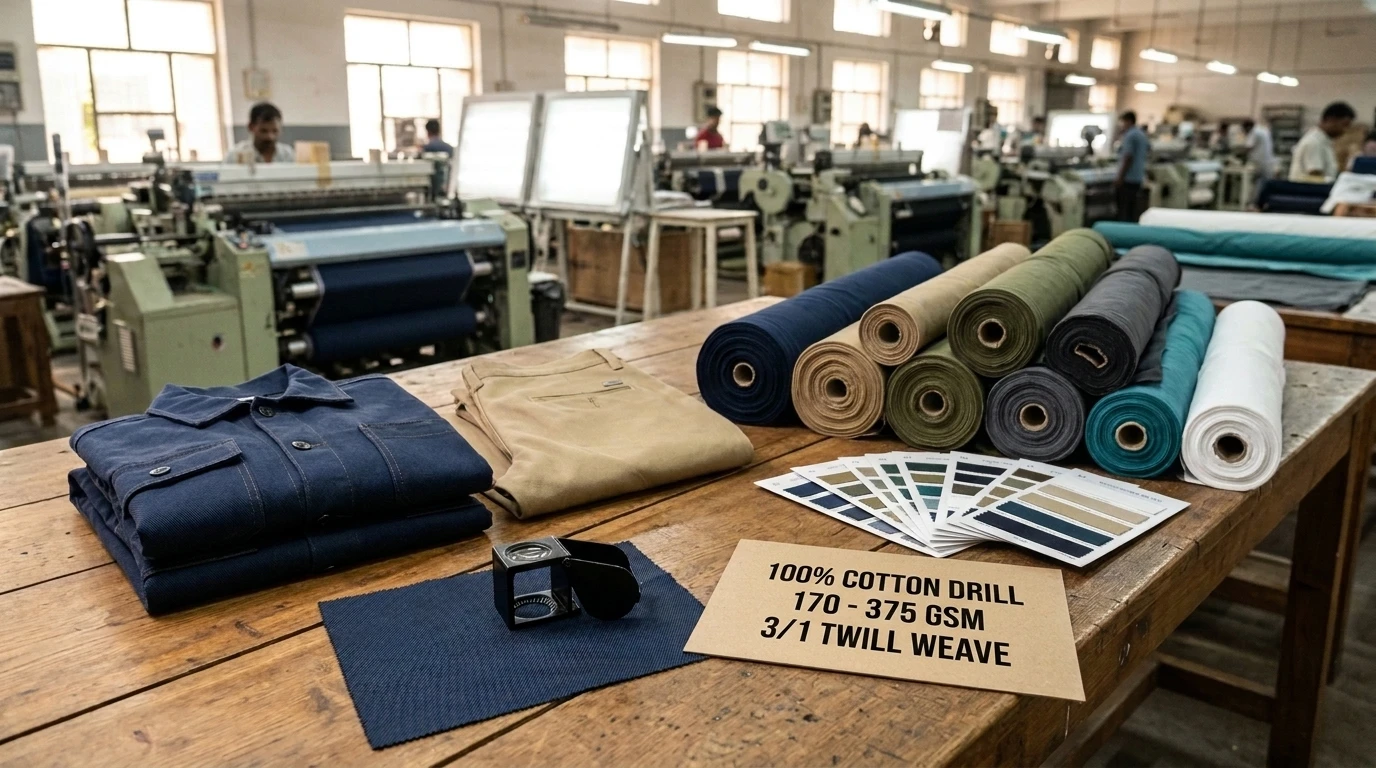
A uniform manufacturer in Bangalore or Okhla delivers 8,000 pairs of navy technician trousers and industrial work shirts to an automotive assembly plant. Within six weeks of commercial 60°C laundry cycles, trouser knees split open along the seams, the dark navy shade fades to a patchy slate grey, and trouser inseams shrink by two inches. The garment contractor loses an annual ₹45 lakh renewal contract because their local fabric broker supplied a low-pick, un-sanforized plain cotton cloth disguised as heavy workwear fabric.
Understanding what is drill fabric from a loom-engineering perspective protects garment manufacturers from costly quality failures in corporate, school, medical, and industrial uniform contracts. True cotton drill is not a generic plain weave; it is a high-density, warp-faced diagonal twill engineered to survive years of abrasion and harsh laundering while remaining breathable in Indian factory conditions. At Radhey Krishna Cotweaving, we operate as a primary drill fabric wholesale supplier in India, weaving over 10 million metres of textile annually at our Kishangarh mill in Rajasthan. This guide breaks down how drill fabric’s 3/1 twill structure works, how to match our nine stock GSM grades (170 GSM to 375 GSM) to specific uniform garments, and which laboratory tests guarantee lot-to-lot consistency.
Drill fabric is a durable, medium-to-heavyweight woven cotton textile constructed with a warp-faced diagonal twill weave, most commonly a 3/1 or 2/1 twill pattern. Characterised by distinct 45-degree diagonal wale lines and high thread density, cotton drill delivers exceptional abrasion resistance, tear strength, and breathability for uniforms, workwear, and industrial PPE.
Table of Contents (Click to Expand / Collapse)
- What Is Drill Fabric and How Does Its Diagonal Twill Weave Structure Work?
- Six Key Properties That Make Cotton Drill the Standard for Workwear and Uniforms
- 1. High Abrasion and Tear Resistance at Elbows, Knees and Pocket Corners
- 2. Structured Tailored Drape and Natural Crease Recovery
- 3. 100% Cotton Breathability and Spark Safety in High-Heat Factories
- 4. Superior Dye Affinity and Industrial Laundry Colourfastness
- 5. High Thread Density Blocks Industrial Dust, Wind and Shop Grease
- 6. Smooth High-Speed Garment Cutting and Lockstitch Sewing Performance
- Complete Cotton Drill GSM Guide: 170 GSM to 375 GSM Specifications and Uniform Uses
- How Does Drill Compare to Plain Cotton, Twill, Canvas, and Dull Denim?
- Quality Testing Protocols: Shrinkage, GSM, and Colourfastness Standards for Uniform Buyers
- Why Uniform and Workwear Manufacturers Source Cotton Drill Direct from RK Cotweaving
- Frequently Asked Questions About Drill Fabric (People Also Ask)
- Request 170 to 375 GSM Cotton Drill Swatch Cards from Our Kishangarh Mill
What Is Drill Fabric and How Does Its Diagonal Twill Weave Structure Work?
Drill fabric’s diagonal twill structure works by floating each lengthwise warp yarn over two or three crosswise weft picks before passing under one (a 2/1 or 3/1 warp-faced twill). Each adjacent warp thread shifts the interlacing point by one pick, forming prominent 45-degree diagonal ridges called wales across the fabric face.
When a garment production manager or textile technologist asks what is drill fabric, the answer lies entirely in the loom harness programming. Unlike standard plain cotton sheeting or poplin (where every warp thread crosses over and under every single weft thread in a 1/1 checkerboard grid), cotton drill belongs to the heavy warp-faced twill family.
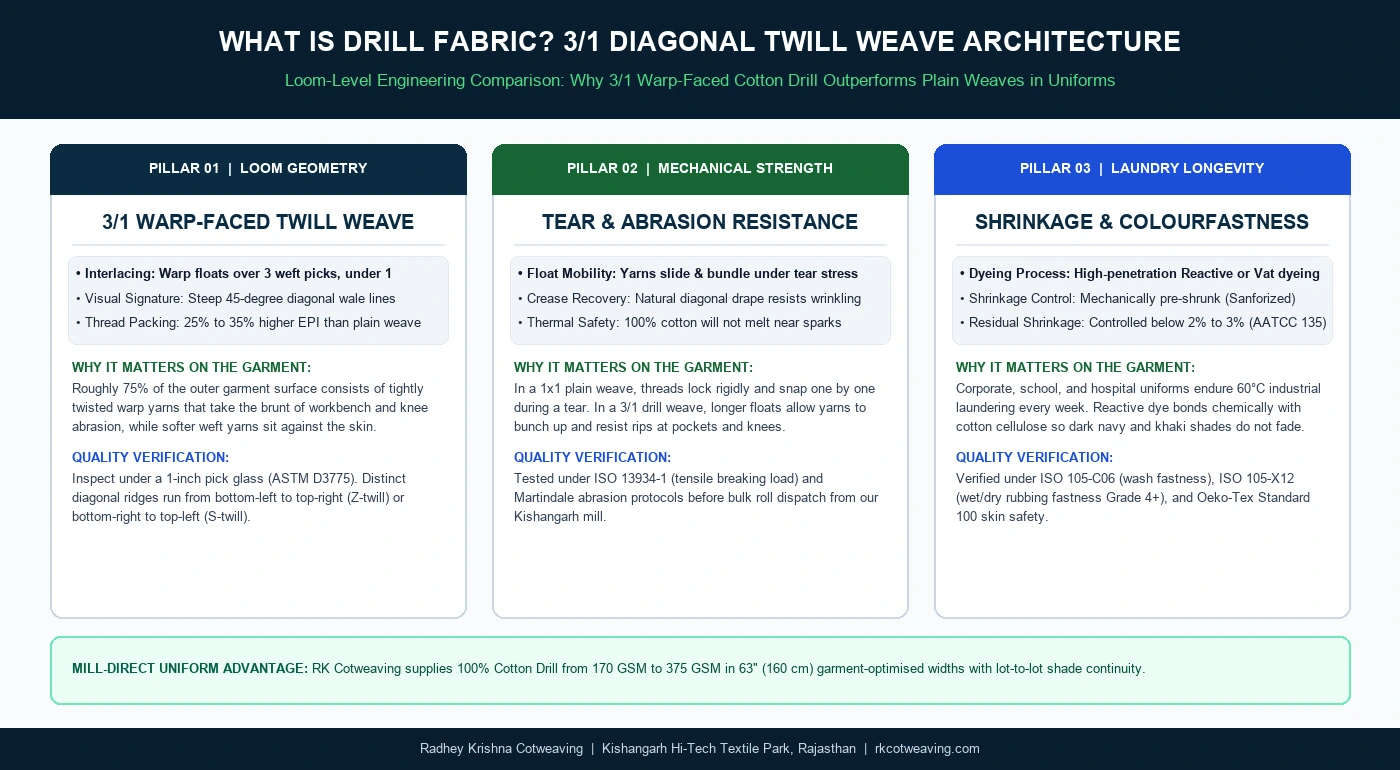
Here are the three structural engineering mechanisms that occur on the loom when weaving cotton drill:
1. The 3/1 (and 2/1) Warp-Faced Twill Interlacing Pattern
In classic industrial cotton drill (often referred to in export garment markets as heavy cotton gabardine or bull drill), the loom harnesses raise three warp threads over a weft insertion and drop one (3/1 twill, or 2/1 twill in lighter 170 GSM shirtings). On the very next shuttle or rapier insertion, the pattern steps one thread to the right (forming a right-hand Z-twill diagonal line running from bottom-left to top-right) or one thread to the left (forming a left-hand S-twill).
Because the warp threads float over three weft threads at a time, roughly 75% of the visible outer face of the fabric consists of lengthwise warp yarns, while 75% of the underside back consists of crosswise weft (filling) yarns.
2. Why Fewer Thread Intersections Pack 30% More Cotton Into Every Inch
Every time a warp thread bends over and under a weft thread, the yarn diameter takes up physical space (called crimp or take-up). In a 1/1 plain weave, threads intersect at every single crossing, limiting how tightly the loom reed can pack yarns together.
Because a 3/1 drill weave only bends the warp thread under the weft once every four picks, there are half as many yarn intersections per square inch as in a plain weave. This allows our Kishangarh loom masters to pack 25% to 35% more warp ends per inch (EPI) and weft picks per inch (PPI) into the exact same square metre area. The result is a remarkably dense, compact cloth that still bends and drapes smoothly over a worker’s knees and shoulders.
3. Why Warp-Faced Geometry Protects Both the Garment and the Wearer
In weaving mill yarn preparation, lengthwise warp yarns are spun with a higher twist multiplier and higher tensile breaking strength than crosswise weft yarns so they can withstand intense warp beam tension on the loom. By placing 75% of those high-tenacity warp yarns on the outer face of the uniform trouser or jacket, cotton drill puts its toughest armour directly against external workbench friction, metal tools, and concrete surfaces. Meanwhile, the slightly softer, lower-twist weft yarns sit on the inner face against the worker’s skin, preventing chafing during a 10-hour factory shift.
If your design team also manufactures lighter fashion chinos or casual jackets, you can compare this heavy workwear construction against our standard cotton twill fabric collection.
Six Key Properties That Make Cotton Drill the Standard for Workwear and Uniforms
Cotton drill dominates B2B uniform and workwear manufacturing due to six core properties: high Martindale abrasion resistance, natural diagonal crease recovery, 100% cotton breathability and spark resistance, deep reactive dye retention across industrial wash cycles, tight dust-blocking density, and jam-free high-speed sewing on garment assembly lines.
Uniform procurement is unlike fast fashion. Once a school chain, hospital network, logistics fleet, or heavy engineering company approves a uniform vendor, they reorder the exact same garment specification every quarter for years. However, if the fabric pills, fades, or tears within the first three months, the garment manufacturer faces immediate penalty clauses.
Here are the six technical properties that make 100% cotton drill the safest specification for high-reorder uniform contracts.
1. High Abrasion and Tear Resistance at Elbows, Knees and Pocket Corners
The floating warp architecture of cotton drill prevents catastrophic rips by allowing adjacent threads to slide together and bundle when snagged on sharp edges. Instead of snapping one thread at a time like plain weaves, bundled drill yarns distribute mechanical stress across multiple plies at pockets, knees, and belt loops.
When a warehouse technician kneels on rough concrete or catches a cargo pocket on a steel pallet rack, a plain-weave fabric fails because every thread is locked rigidly in place by its neighbours and breaks sequentially. In cotton drill, the 3/1 warp floats have microscopic lateral mobility. Under a sudden point load or tongue-tear force, three or four adjacent yarns slide together into a reinforced bundle that stops the rip from spreading.
2. Structured Tailored Drape and Natural Crease Recovery
Because diagonal twill wales introduce controlled bias flexibility into the woven grid, cotton drill hangs with a clean, tailored drape that follows human movement without bagging at the knees. The dense yarn packing also provides natural crease recovery, keeping corporate and school uniforms looking crisp throughout a full shift.
Heavy plain-weave fabrics (such as duck canvas) tend to stand stiffly away from the body like cardboard, making them uncomfortable for tailored trousers or fitted tunics. Drill fabric’s 45-degree diagonal wale structure acts as an internal hinge. It allows the fabric to contour smoothly around trouser pleats, waistbands, and jacket sleeves while recovering from sitting creases far better than plain cotton poplin.
3. 100% Cotton Breathability and Spark Safety in High-Heat Factories
Pure 100% cotton drill absorbs up to 27 times its own weight in moisture vapour and wicks sweat away from the body in 40°C+ Indian summers. Critically for industrial PPE, pure cotton cellulose does not melt or fuse onto human skin when exposed to welding sparks, grinding slag, or foundry heat.
Many low-cost uniform traders push cheap polyester-viscose or high-polyester blends because synthetic yarn is cheap. On an Indian factory floor in May or June, or inside an automotive welding bay, synthetic uniforms trap body heat and create a severe safety hazard. If a stray grinding spark or hot metal chip hits a polyester blend, the plastic fibre melts at ~250°C and sticks to the worker’s skin, causing severe deep-tissue burns. Pure 100% cotton drill chars cleanly without melting and serves as the mandatory base substrate for Flame Retardant (FR) chemical treatments.
4. Superior Dye Affinity and Industrial Laundry Colourfastness
Cotton drill’s mercerised and scoured cellulose fibres form covalent chemical bonds with reactive and vat dyestuffs, producing deep, uniform shades from khaki and olive to navy and royal blue. Properly dyed cotton drill withstands repeated 60°C industrial laundering and hot pressing without shade migration or crocking rub-off.
Uniforms are washed 50 to 100 times a year, often with harsh alkaline industrial detergents. Because cotton drill has a smooth, warp-dominant face, reactive and vat dyes penetrate deep into the yarn core and reflect light evenly across the diagonal wales. When dyed at mill level under ISO quality protocols, a batch of corporate navy trousers delivered in November will match a repeat reorder delivered the following July.
5. High Thread Density Blocks Industrial Dust, Wind and Shop Grease
With warp and weft threads packed tightly under high reed tension, cotton drill leaves almost zero open pinholes across the fabric face. This low air permeability prevents metal filings, cement dust, sawdust, and machine oil splashes from penetrating through coveralls to the worker’s undergarments.
In construction, mining, woodworking, and heavy machining environments, porous fabrics allow fine abrasive dust to pass straight through the cloth and irritate the wearer’s skin. The overlapping 3/1 warp floats of 265 GSM to 375 GSM cotton drill act like roof shingles, deflecting dust, wind, and grease splashes away from the body.
6. Smooth High-Speed Garment Cutting and Lockstitch Sewing Performance
On automated garment production lines, cotton drill lays flat on 100-ply spreading tables without curling at the selvedges and cuts cleanly with vertical reciprocating knives. During stitching, the diagonal twill weave guides sewing needles smoothly between yarn floats, reducing needle heating, skipped stitches, and seam pucker.
Garment factory owners measure profitability in Standard Allowed Minutes (SAM) per trouser or coverall. Because cotton drill has a balanced, compact structure, it feeds smoothly through double-needle feed-off-the-arm felled-seam machines, automated pocket-welting units, and bartackers without the needle deflection common in heavy plain canvas.
Complete Cotton Drill GSM Guide: 170 GSM to 375 GSM Specifications and Uniform Uses
Radhey Krishna Cotweaving manufactures nine standardised 100% cotton drill weights ranging from 170 GSM (5 oz) to 375 GSM (11 oz). Garment manufacturers select 170 to 200 GSM for medical scrubs and shirts, 210 to 265 GSM for school and corporate trousers, and 275 to 375 GSM for heavy industrial coveralls.
Choosing the wrong GSM for a uniform tender ruins garment ergonomics. A 290 GSM industrial drill is far too heavy for a hospital nurse’s scrub tunic, while a 170 GSM shirting drill will wear through at the knees if cut into mechanic trousers. For a cross-category comparison of how drill weights align with canvas and denim weights, consult our complete fabric GSM guide before locking down your tech pack.
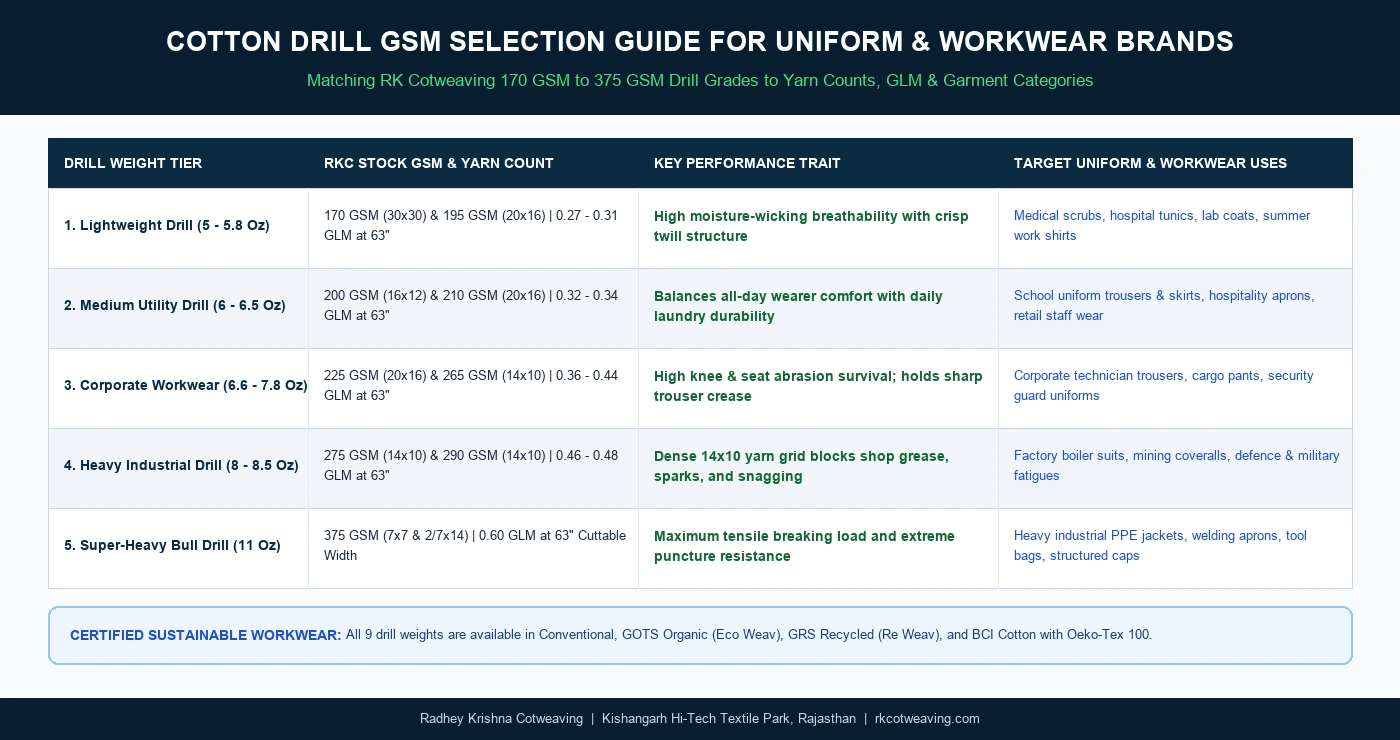
Below is the complete engineering specification table for all nine 100% cotton drill grades woven at our Kishangarh mill:
| RK Cotweaving Drill Article | Ounce Equiv. (Oz/Sq.Yd) | Weight GLM (kg/m at 63″) | Yarn Count (Warp × Weft) | Standard Width | Primary Uniform & Workwear Garment Applications |
|---|---|---|---|---|---|
| 170 GSM Cotton Drill | 5.0 Oz | 0.27 kg/m | 30s × 30s | 63″ (160 cm) | Medical scrubs, hospital tunics, summer industrial work shirts, light chef aprons |
| 195 GSM Cotton Drill | 5.8 Oz | 0.31 kg/m | 20s × 16s | 63″ (160 cm) | Pharmaceutical lab coats, hotel housekeeping uniforms, technician shirts, culinary jackets |
| 200 GSM Cotton Drill | 6.0 Oz | 0.32 kg/m | 16s × 12s | 63″ (160 cm) | Institutional uniform tops, food-processing coats, utility aprons, light promotional caps |
| 210 GSM Cotton Drill ★ | 6.5 Oz | 0.34 kg/m | 20s × 16s | 63″ (160 cm) | School uniform trousers, skirts & pinafores, retail staff bottoms, light summer cargo pants |
| 225 GSM Cotton Drill | 6.6 Oz | 0.36 kg/m | 20s × 16s (High Pick) | 63″ (160 cm) | Corporate facility management trousers, security guard uniforms, military summer dress trousers |
| 265 GSM Cotton Drill | 7.8 Oz | 0.44 kg/m | 14s × 10s | 63″ (160 cm) | Automotive assembly overalls, corporate chino bottoms, logistics & warehouse work trousers |
| 275 GSM Cotton Drill | 8.1 Oz | 0.46 kg/m | 14s × 10s (High Pick) | 63″ (160 cm) | Defence & paramilitary fatigue trousers, heavy maintenance boiler suits, construction work pants |
| 290 GSM Cotton Drill | 8.5 Oz | 0.48 kg/m | 14s × 10s (Dense Weave) | 63″ (160 cm) | Heavy industrial coveralls, oil & gas workwear, mining trousers, FR-treatment base fabric |
| 375 GSM Bull Drill ★ | 11.0 Oz | 0.60 kg/m | 7s × 7s & 2/7s × 14s | 63″ (160 cm) | Super-heavy PPE jackets, extreme abrasion work trousers, welding aprons, structured bags & caps |
Why Our 63-Inch (160 cm) Standard Loom Width Lowers Your Garment Costing
Most traditional domestic powerlooms weave uniform drill at a narrow 58-inch (147 cm) or 59-inch (150 cm) finished width. At Radhey Krishna Cotweaving, our modern industrial looms weave all nine cotton drill articles at a generous 63-inch (160 cm) width (with custom widths available from 28" up to 148"). That extra 10 to 13 centimetres of cuttable width allows your CAD marker room to nest trouser front/back legs, waistband facings, and pocket bags side-by-side at 89% to 91% marker efficiency, reducing fabric consumption per trouser from 1.25 metres down to 1.12 metres.
Need Custom Reactive Dyeing or Swatch Cards for an Upcoming Uniform Tender?
Speak directly with our weaving and dyeing engineers in Kishangarh. We match Pantone TCX corporate and school shades with ISO colourfastness and shrinkage test reports.
How Does Drill Compare to Plain Cotton, Twill, Canvas, and Dull Denim?
While drill, fashion twill, dull denim, and canvas can all be woven from 100% cotton in similar 200 to 375 GSM weights, they serve distinct garment roles. Drill uses a piece-dyed 3/1 diagonal twill for structured uniforms, canvas uses a stiff 1x1 plain weave for bags, and dull denim uses a matte yarn-dyed or washed construction.
Garment buyers developing multi-product collections often ask when to specify cotton drill versus fashion twill, plain-weave canvas, or modern matte workwear denim. If your factory also produces heavy utility aprons, tool pouches, or tote bags alongside garments, you can source heavy plain-weave textiles directly from our canvas fabric wholesale supplier in India production line.
Use this side-by-side matrix to match the right fabric family to your garment specification:
| Comparison Parameter | Cotton Drill Fabric (170 – 375 GSM) | Fashion Cotton Twill (210 – 265 GSM) | Cotton Canvas / Duck (170 – 470 GSM) | Matte Dull Denim |
|---|---|---|---|---|
| Weave Architecture | Heavy warp-faced 3/1 or 2/1 diagonal twill weave | Lighter 2/1 or 2/2 balanced diagonal twill weave | 1/1 plain weave or 2-ply Half-Panama / Duck weave | 3/1 twill weave engineered with a non-glossy matte finish |
| Dyeing & Visual Appearance | Piece-dyed (solid uniform colour across both warp and weft) | Piece-dyed with finer yarns and softer sheen | Natural greige, bleached RFD, or solid piece-dyed | Matte-washed, dark-neutral non-shiny surface (quiet luxury look) |
| Drape & Garment Comfort | Structured tailored drape; softens comfortably with washing | Supple, soft apparel drape for casual fashion | Firm, rigid, board-like structure; low diagonal give | Structured yet supple; bridges corporate fashion and workwear |
| Tear vs Puncture Strength | Superior tongue-tear resistance due to sliding twill floats | Moderate tear strength suited for everyday casual trousers | Superior puncture and seam-slippage resistance under static load | High tear and abrasion durability for daily apparel |
| Primary B2B End-Use | School uniforms, corporate workwear, medical scrubs, industrial coveralls | Casual fashion chinos, smart-casual jackets, retail apparel | Tote bags, backpacks, tool rolls, heavy carpenter aprons, tarpaulins | Contemporary corporate denim uniforms, indie fashion trousers & jackets |
Quality Testing Protocols: Shrinkage, GSM, and Colourfastness Standards for Uniform Buyers
Before cutting bulk uniform drill fabric, garment manufacturers must verify five laboratory standards: ASTM D3776 for GSM consistency (±4%), AATCC 135 for residual laundry shrinkage (under 2% to 3% via sanforizing), ISO 105-C06 for 60°C wash colourfastness, ISO 105-X12 for wet and dry crocking, and ISO 13934-1 for tensile strength.
In the uniform industry, a ₹10 saving per metre on untested fabric from an unverified trader can trigger a 100% garment rejection rate once employees wash their uniforms at home or in hospital autoclaves.
At Radhey Krishna Cotweaving, every production batch of cotton drill undergoes strict pre-dispatch quality verification against five international testing benchmarks:
- Mechanical Pre-Shrinking / Sanforizing (
AATCC 135/ISO 6330): Raw cotton drill taken straight off the loom and dyed without compressive shrinkage treatment will shrink 6% to 9% in length during its first hot wash. Imagine a 32-inch trouser inseam shrinking by nearly 3 inches after one laundry cycle! Our finished drill fabrics undergo mechanical compressive shrinkage (sanforizing) so residual warp and weft shrinkage stays strictly within 2% to 3% across repeated commercial washes. - Reactive & Vat Dye Colourfastness (
ISO 105-C06&ISO 105-X12): Cheap trading market drill is often dyed with low-cost direct dyes that bleed in the wash and rub off onto white collars or car seats. We use high-fixation Reactive Dyeing (and Vat Dyeing for defence/industrial tenders), achieving Grade 4.0 to 4.5 for washing fastness (ISO 105-C06) and Grade 4.0+ for dry rubbing / crocking fastness (ISO 105-X12). - Roll-to-Roll GSM & Reed-Pick Consistency (
ASTM D3776&ASTM D3775): We verify mass per unit area with calibrated 100 cm² circular GSM cutters (holding batches within a tight±4%contractual tolerance) and check warp ends (EPI) and weft picks (PPI) under 1-inch pick glasses across the left, centre, and right of the loom width. - Centre-to-Selvedge & Lot-to-Lot Shade Continuity (
CMC ΔE < 0.8): If the left selvedge of a fabric roll is slightly darker than the centre, a trouser sewn with panels from both sides will show a mismatched leg seam. Our continuous dyeing control ensures uniform shade across the entire 63-inch width and archives physical master shade standards for your seasonal reorders. - Certified Human-Ecological & Organic Safety: For schools, hospitals, and European workwear importers, our drill fabrics are available in GOTS-certified organic cotton and tested under Oeko-Tex Standard 100 to guarantee zero harmful azo dyes, formaldehyde, or heavy metals against the wearer’s skin.
Why Uniform and Workwear Manufacturers Source Cotton Drill Direct from RK Cotweaving
Radhey Krishna Cotweaving is a primary mill-direct cotton drill manufacturer in Kishangarh, Rajasthan, producing 10 million+ metres annually on 100% renewable solar and wind energy. Sourcing direct from our mill saves uniform brands 20% to 30% over traders while ensuring ISO 9001:2015 batch testing and 9 global sustainability certifications.
When you bid on a major corporate, institutional, school, or export workwear contract, your competitiveness depends on three pillars: ex-mill fabric pricing, guaranteed delivery timelines, and bulletproof compliance documentation. Before partnering with any new vendor, you can audit their manufacturing credentials using our 3-point mill verification checklist.
Here is why India’s leading uniform manufacturers and international workwear importers partner directly with Radhey Krishna Cotweaving:
- Direct Mill Pricing (20% to 30% Cost Advantage): Located at Plot B-12, 13, Kishangarh Hi-Tech Textile Park (RIICO Industrial Area, Silora, Rajasthan), we weave and supply direct to garment factories across Bangalore, Mumbai, Delhi NCR, Tirupur, Ahmedabad, Kolkata, and international export ports with zero middleman markups.
- Complete 170–375 GSM Stock Depth: Whether your contract requires 170 GSM medical scrub drill, 210 GSM school uniform drill, 265 GSM corporate work trousers, or 375 GSM bull drill for industrial PPE, all nine weights are woven in-house.
- 100% Renewable Energy & 9 Global Certifications: Our 10-million-metre facility runs on 100% solar and wind energy (reducing 450+ tons of CO₂ annually) and holds active certifications across GOTS, Oeko-Tex Standard 100, Fairtrade, GRS, OCS, RCS, BCI, AWARE Traceability, and ISO 9001:2015.
- 500-Metre Air-Tight Roll Packaging: Bulk orders (standard wholesale MOQ of 1,000 units or 5,000 metres) are supplied in continuous rolls up to 500 metres with flat-edged, air-tight poly packaging to prevent transit damage and streamline automated cutting.
Frequently Asked Questions About Drill Fabric (People Also Ask)
These frequently asked questions answer the top Google People Also Ask queries regarding what drill fabric is made of, how drill compares to twill and gabardine, breathability in hot climates, laundry shrinkage control, GSM selection for uniforms, custom organic dyeing, and wholesale minimum order quantities.
What is drill fabric made of, and what does it feel like?
Authentic drill fabric is made from 100% natural cotton fibres spun into high-tenacity yarns and woven in a tight 3/1 diagonal twill construction. To the touch, cotton drill feels firm, smooth, and substantial on the outer warp face with distinct 45-degree diagonal ridges, while feeling soft and breathable against the skin on the reverse side.
When new off the roll, mercerised and sanforized cotton drill has a crisp, structured handfeel that tailors cleanly into trousers, jackets, and aprons. Unlike stiff plain-weave duck canvas, cotton drill softens progressively with each wash while maintaining its tear strength and diagonal surface character.
Is drill fabric the same as twill or cotton gabardine?
All drill fabric is a twill weave, but not all twill fabric qualifies as drill. “Twill” is the broad family of diagonal-weave textiles, whereas “drill” specifically designates a sturdy, medium-to-heavyweight warp-faced cotton twill (170 to 375 GSM) engineered for uniforms and workwear. In Indian and export markets, finer-yarn cotton drill is also frequently called cotton gabardine.
Lightweight fashion twills often use fine yarns in a 2/1 or 2/2 weave for casual shirts and chinos. Cotton drill uses denser reed-pick settings and sturdier yarn counts (such as 20×16, 14×10, or 7×7) in a steep 3/1 warp-faced construction designed specifically to survive industrial abrasion and commercial laundering.
Is 100% cotton drill breathable enough for Indian summer uniforms and workwear?
Yes, 100% cotton drill is far more breathable and thermally comfortable in hot Indian climates than polyester-blended workwear. Natural cotton cellulose fibres absorb perspiration vapour and allow convective heat release, while weights between 170 GSM and 225 GSM provide lightweight air circulation for summer shifts.
For outdoor security personnel, hospital staff, school students, and factory workers operating in 35°C to 45°C ambient temperatures, 100% cotton drill prevents the heat rash and static build-up caused by synthetic polyester uniforms. Selecting 170 to 210 GSM for summer shirts/scrubs and 225 to 265 GSM for trousers delivers the ideal balance of airflow and durability.
Does cotton drill fabric shrink after industrial washing?
Untreated loom-state cotton drill can shrink by 6% to 9% during its first hot wash, which is why garment manufacturers must specify pre-shrunk sanforized cotton drill. At Radhey Krishna Cotweaving, our finished uniform drill is mechanically sanforized to keep residual laundry shrinkage strictly below 2% to 3% under AATCC 135 testing.
Always confirm on your proforma invoice that your cotton drill is supplied in a sanforized (pre-shrunk) finished state. Controlling shrinkage at the mill level allows your pattern makers to cut true garment sizes without adding excessive shrinkage allowances that distort fit prior to the first wash.
Which GSM drill fabric is best for school uniforms versus industrial coveralls?
For school uniform trousers, skirts, and pinafores, 210 GSM to 225 GSM (6.5 oz) cotton drill is the industry standard because it combines playground knee durability with soft all-day comfort. For heavy industrial coveralls, boiler suits, and mining workwear, specify 275 GSM, 290 GSM, or 375 GSM heavy cotton drill.
Medical scrubs and summer work shirts perform best in our lighter 170 GSM to 200 GSM grades, while corporate facility technicians and automotive assembly staff typically wear 225 GSM to 265 GSM cotton drill trousers.
Can RK Cotweaving supply organic or recycled cotton drill in custom corporate colours?
Yes, Radhey Krishna Cotweaving manufactures all nine cotton drill weights (170 to 375 GSM) in GOTS-certified organic cotton, GRS-certified pre- and post-consumer recycled cotton, and BCI cotton, custom piece-dyed to any Pantone TCX corporate or institutional shade with Oeko-Tex Standard 100 certification.
Global brands and ESG-focused corporations can source sustainable uniform fabrics through our Eco Weav sustainable organic fabric collection and our Re Weav recycled line, complete with Transaction Certificates (TC) and AWARE physical tracer documentation for EU and US export compliance.
What is the MOQ and standard roll width for wholesale drill fabric at RK Cotweaving?
Radhey Krishna Cotweaving’s standard wholesale minimum order quantity (MOQ) for mill-direct cotton drill is 1,000 units or 5,000 metres per custom weave and shade specification. Standard garment cutting width is 63 inches (160 cm), with custom loom widths available from 28 inches up to 148 inches.
For pre-tender sampling and garment line trials, our Kishangarh technical desk dispatches physical swatch cards and pilot sample yardage from running lots so your quality team can verify GSM, shade, and shrinkage before releasing bulk orders.
Request 170 to 375 GSM Cotton Drill Swatch Cards from Our Kishangarh Mill
To source shrinkage-tested, colourfast 100% cotton drill directly from the loom, share your target GSM weight, Pantone shade, width, and metre volume with Radhey Krishna Cotweaving. Our Kishangarh mill desk dispatches physical 170 to 375 GSM swatch cards, lab reports, and wholesale pricing within 24 hours.
Now that you know what is drill fabric and how its 3/1 diagonal twill construction protects uniform longevity, you can eliminate middleman quality risks and lock in direct mill pricing for your next uniform tender or workwear production run.
Take three simple steps with our Kishangarh weaving team:
- Select Your Target GSM Tier: Choose from 170–200 GSM (medical/shirting), 210–265 GSM (school/corporate uniforms), or 275–375 GSM (heavy industrial PPE and coveralls) in wide 63-inch rolls.
- Request Physical Swatches & Lab Reports: Test our reactive dye colourfastness and sanforized shrinkage stability in your own quality lab.
- Lock In Direct Mill Wholesale Pricing: Contact our B2B uniform desk below to receive ex-mill quotes and dispatch schedules.