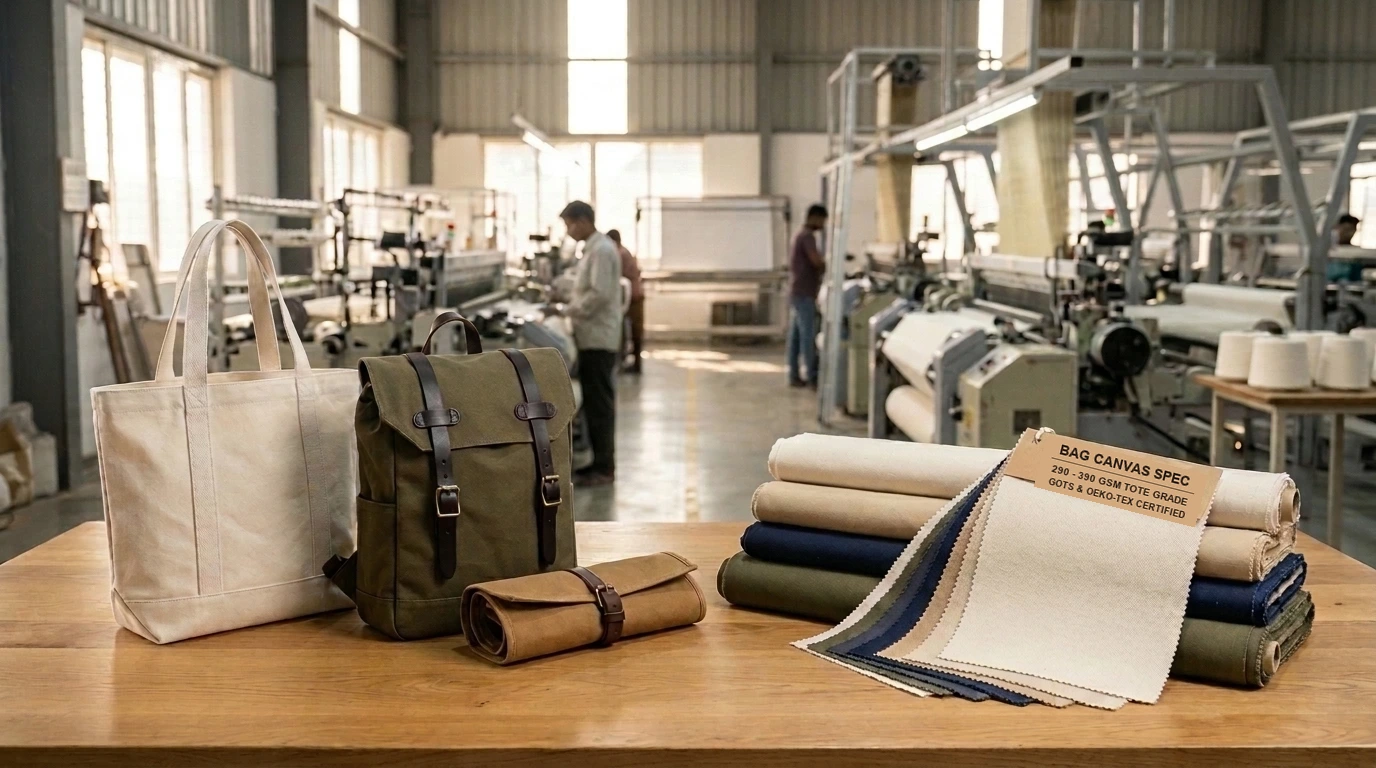
A lifestyle retail brand in Mumbai orders 15,000 gusseted shopper totes from a bag unit in Dharavi or Okhla. To save ₹14 per metre on raw material, the factory cuts the main panels from lightweight 180 GSM plain canvas instead of a structured 315 GSM quality. When the finished bags reach the brand’s warehouse, the side gussets collapse inward, laptop corners poke sharp bulges through the bottom panel, and dark screen-printing ink bleeds through to the inner pocket. Meanwhile, a competing factory cuts a fashion tote out of ultra-stiff 18 oz (610 GSM) numbered duck, snapping dozens of sewing needles per shift on the bottom corners and missing their export vessel cut-off.
Selecting the right canvas fabric for bags manufacturing wholesale India requires balancing structural silhouette, handle tear strength, screen-printing clarity, and industrial sewing machine speed. At Radhey Krishna Cotweaving, we weave over 10 million metres of certified cotton canvas, army duck, numbered duck, and recycled RPET canvas annually at our Kishangarh mill in Rajasthan. This engineering guide walks bag and luggage manufacturers through our three-tier GSM selection framework, explains why 290 to 390 GSM is the industry sweet spot for premium tote bags, and maps five distinct weave architectures to your factory floor.
For commercial bag manufacturing, choose 170 to 220 GSM plain canvas for foldable promotional totes and internal linings, 290 to 390 GSM canvas or Half-Panama weave for structured premium retail tote bags, and 470 GSM canvas or 8 to 24 oz plied duck weaves for heavy-duty backpacks, travel duffels, and industrial tool bags.
Table of Contents (Click to Expand / Collapse)
- How GSM Weight Controls Bag Structure, Sewability, and Cost Per Unit
- Why 290 to 390 GSM Is the Gold Standard for Premium Tote Bags
- Which Canvas Weave Should You Choose? Plain vs Half-Panama vs Single Fill vs Army Duck vs Numbered Duck
- Master Bag Category to GSM, Ounce and Weave Selection Matrix
- RK Cotweaving’s Complete Canvas and Duck Specifications for Bag Manufacturers
- Finishing, Dyeing, Shrinkage Control, and Export Certifications for Bag Brands
- Why Source Canvas Fabric for Bags Manufacturing Wholesale India from RK Cotweaving?
- Frequently Asked Questions About Canvas Fabric for Bag Manufacturing
- Order 290 to 390 GSM Tote Canvas and Duck Swatch Books from Our Kishangarh Mill
How GSM Weight Controls Bag Structure, Sewability, and Cost Per Unit
In bag manufacturing, canvas GSM (Grams per Square Metre) governs four critical production factors: whether a gusseted bag stands upright without interlining, how much payload the handle bar-tacks survive, whether standard lockstitch machines can sew corner seams without needle deflection, and the raw cotton cost per finished unit.
When a bag merchandiser or production head selects a canvas weight, that single number dictates how the fabric behaves across every department in the factory: from automated spreading and die-cutting to screen printing, lockstitch assembly, and final carton weight. If your sourcing team converts specifications between metric GSM and imperial ounces, keep our canvas fabric GSM vs ounce weight guide on hand alongside this production breakdown.
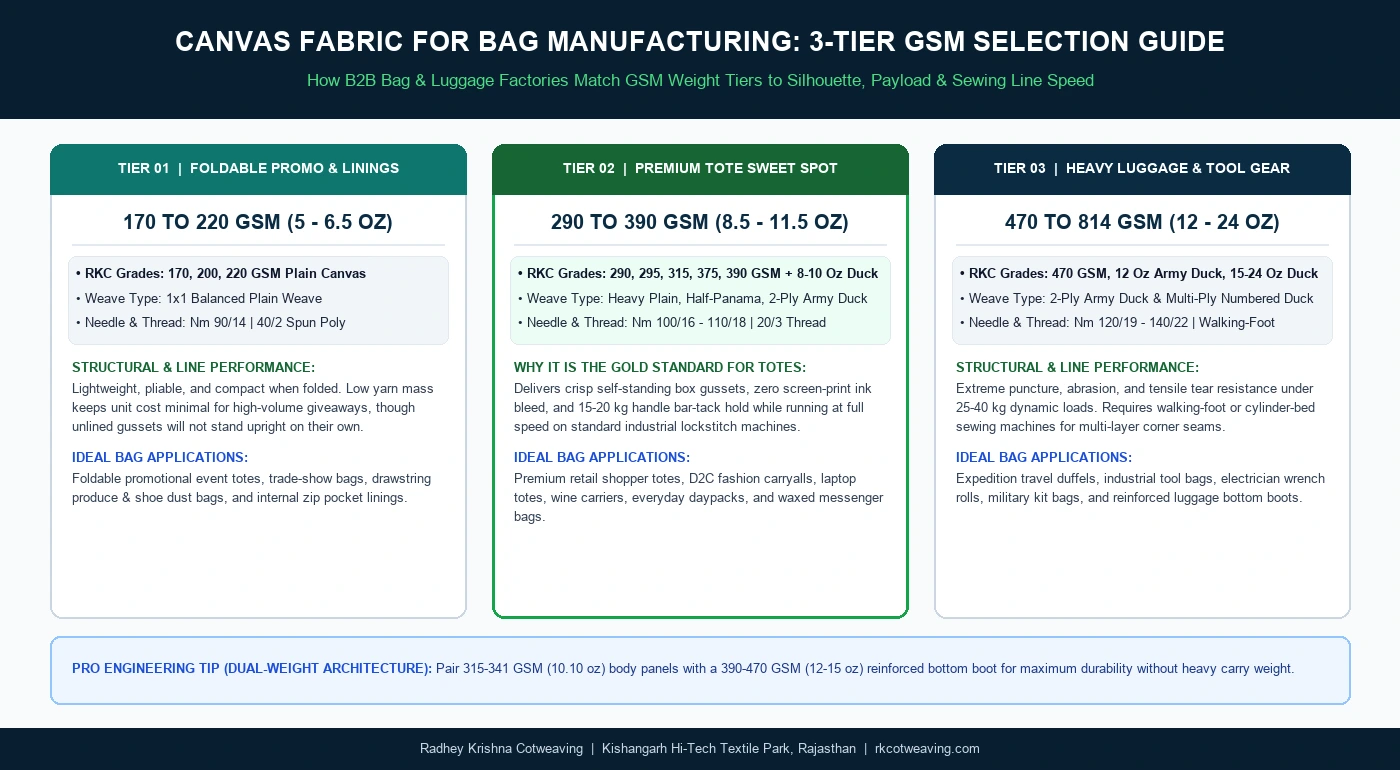
Across commercial bag and luggage production lines, woven cotton canvas divides into three functional weight tiers:
Tier 1: Lightweight Promotional & Lining Canvas (170 GSM to 220 GSM / 5.0 to 6.5 Oz)
- Core RKC Articles: 170 GSM, 200 GSM, and 220 GSM plain cotton canvas.
- Where It Excels: High-volume corporate conference giveaways, foldable pocket grocery bags, drawstring shoe and handbag dust bags, and structured internal zip pockets or laptop compartment linings inside heavier backpacks.
- Production Limit: At 170 to 220 GSM, unlined cotton canvas drapes softly like heavy shirting. If you cut a wide-bottom retail shopper tote out of 200 GSM canvas without adding LDPE foam or nonwoven interlining, the bag walls will sag the moment the customer sets it down.
Tier 2: The Structured Retail & Everyday Carry Tier (290 GSM to 390 GSM / 8.5 to 11.5 Oz)
- Core RKC Articles: 290 GSM, 295 GSM, 315 GSM, 375 GSM, and 390 GSM cotton canvas, plus 8 oz and 10.10 oz army duck.
- Where It Excels: This is the commercial workhorse tier for premium retail tote bags, D2C lifestyle carryalls, structured laptop bags, wine bottle carriers, everyday commuter backpacks, and waxed messenger bags.
- Why Factories Prefer It: It delivers natural board-like body that holds a box-gusset crease while remaining pliable enough to turn inside-out after stitching without cracking or breaking standard industrial sewing needles.
Tier 3: Heavy Luggage, Expedition & Industrial Tool Tier (470 GSM to 814 GSM / 12 to 24 Oz)
- Core RKC Articles: 470 GSM cotton canvas, 12 oz army duck (
385 to 407 GSM), and 15 oz, 16 oz, 18 oz, 20 oz, and 24 oz natural numbered duck. - Where It Excels: Heavy travel duffel bags, military kit bags, contractor tool buckets, electrician wrench rolls, and reinforced abrasion bottom boots on two-tone backpacks.
- Production Requirement: Multi-layer corner seams at 470 to 814 GSM require heavy-duty compound walking-foot or cylinder-bed machines fitted with
Nm 120/19toNm 140/22needles and heavy bonded nylon or20/4cotton-wrapped core thread.
Why 290 to 390 GSM Is the Gold Standard for Premium Tote Bags
Experienced bag manufacturers recommend 290 to 390 GSM cotton canvas (specifically 290, 295, 315, 375, and 390 GSM) for premium tote bags because it provides self-standing gusset structure, zero screen-printing ink bleed-through, 15 to 20 kg handle bar-tack retention, and fast assembly on standard lockstitch sewing lines.
As a leading tote bag fabric manufacturer in India, roughly 68% of all repeat container and truckload orders we dispatch to retail tote bag factories fall inside the 290 GSM to 390 GSM window.
If you are quoting on a branded merchandise contract, a European museum shop tote, or a D2C fashion handbag line, here are the five engineering reasons why 290 to 390 GSM outperforms lighter and heavier alternatives:
- Self-Standing Box Gusset Architecture (No Interlining Required): When a customer pays ₹800 to ₹2,500 (or €15 to €35 in European retail) for a canvas tote bag, they expect the bag to stand upright when placed on a table or cafe floor. Our 290 GSM, 295 GSM, and 315 GSM cotton canvas qualities provide enough intrinsic yarn rigidity to hold a crisp 10 cm to 15 cm bottom and side gusset without requiring costly PVC backing or fusible nonwoven buckram.
- Step-Up Luxury Feel at 375 GSM and 390 GSM:
For oversized beach totes, structured 16-inch laptop carryalls, and heavy six-bottle supermarket wine bags, stepping up to 375 GSM (
11 oz) or 390 GSM cotton canvas (11.5 oz) creates an unmistakable luxury handfeel. The thicker yarn diameter prevents hard items (like metal water bottles, hardcover books, or laptop chargers) from telegraphing sharp bulges through the outer bag wall. - Opaque, Flat Surface for Screen Printing, DTF & Heavy Embroidery: In 170 or 200 GSM fabrics, heavy squeegee pressure during automated carousel screen printing pushes plastisol or water-based ink straight through the open weave pinholes, staining the inside of the bag. Between 290 and 390 GSM, the yarn crown absorbs pigment cleanly on the outer face. When brands apply dense 10,000-to-15,000-stitch logo embroidery, a 315 or 375 GSM canvas resists puckering around the embroidery hoop without heavy tear-away backing.
- High-Speed Lockstitch Efficiency & Clean Inside-Out Turning:
Tote bags are sewn inside-out and then flipped right-side-out through the top opening. If you use a 540 GSM (
16 oz) or 610 GSM (18 oz) cloth, flipping the bag creates harsh white crease marks (chalking) on dark dyed fabrics and leaves lumpy, rounded bottom corners. A 290 to 390 GSM canvas turns cleanly inside-out in two seconds, presses flat under a steam iron, and runs at 2,500+ stitches per minute on standard single-needle lockstitch and 5-thread overlock machines. - Superior Margin Economics for Bag Makers:
A standard gusseted retail tote bag consumes approximately
0.55 linear metresof 60-inch (152 cm) fabric. Upgrading a bag from flimsy 200 GSM canvas to structured 315 GSM canvas adds only96 gramsof raw cotton per bag (roughly ₹20 to ₹28 in mill-direct material cost), yet allows the factory and retail brand to command double or triple the finished selling price.
Which Canvas Weave Should You Choose? Plain vs Half-Panama vs Single Fill vs Army Duck vs Numbered Duck
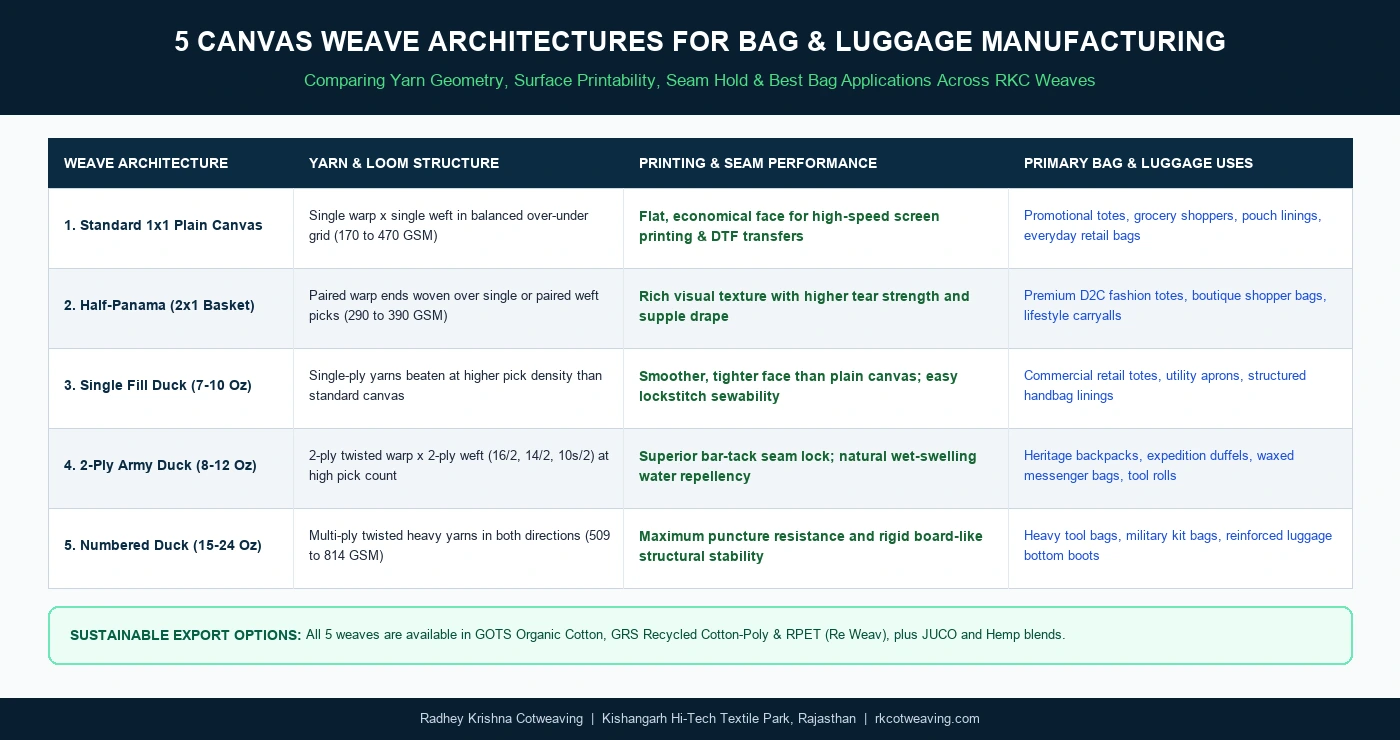
Bag manufacturers choose from five primary cotton weave constructions: 1x1 plain canvas for smooth screen printing, Half-Panama (2x1 basket weave) for tear-resistant fashion totes, single-fill duck for durable commercial bags, 2-ply army duck for weatherproof backpacks, and multi-ply numbered duck for rigid luggage bases and tool rolls.
Selecting your target GSM is only half of the specification. Two fabrics woven at 315 GSM or 340 GSM will exhibit completely different tear resistance, drape, and surface grain depending on how the warp and weft yarns interlace on the loom. For a foundational overview of how general canvas compares to duck cloth, review our canvas vs duck canvas difference guide.
Here is how to select the exact weave architecture for your bag production line.
1. Standard 1x1 Plain Weave Cotton Canvas
Standard 1x1 plain weave canvas interlaces one warp yarn over and under one weft yarn in a balanced grid. Spanning 170 to 470 GSM, it offers the flattest, most uniform surface for rotary screen printing, digital roll-to-roll printing, and economical high-speed cutting across promotional and retail tote bags.
In a 1x1 plain weave, every single warp thread crosses over and under every single weft pick. Because the thread intersections are evenly distributed across the surface, there are no long floating yarns to snag on zippers or velcro. This makes standard plain canvas the default choice for printed retail totes, book bags, cosmetic pouches, and drawstring backpacks where crisp typography and fine graphic artwork are priority number one.
2. Half-Panama (2x1) and Basket Weave (2x2) Canvas
Half-Panama canvas (a 2x1 basket weave variation) pairs two parallel warp yarns weaving together as one unit over and under single or paired weft picks. Popular in 290 to 390 GSM weights, it gives premium fashion tote bags a pronounced, tactile grain, softer handfeel, and higher tongue-tear strength than plain weave.
Why do European high-street fashion labels and Japanese lifestyle brands frequently specify Half-Panama cotton canvas for their 315 GSM and 375 GSM tote bags?
When two warp yarns sit side-by-side in the same reed dent and move together over the weft, they create a subtle, luxurious brick-like surface texture. More importantly, during a sudden tear stress (such as a bag catching on a sharp metal corner), the paired yarns slide together and bunch up, doubling the force required to propagate a rip compared to a single-thread plain weave. Half-Panama also drapes with a slightly softer, less “papery” handfeel after reactive dyeing and enzyme washing.
3. Single Fill Duck Canvas (7 Oz and 10 Oz)
Single fill duck is a tightly beaten plain weave constructed with single-ply warp yarns and one or two single-ply weft picks woven per shed. Produced in 7 oz (237 GSM) and 10 oz (339 GSM) grades, it provides higher wind and snag resistance than basic plain canvas at a competitive commercial price.
When your bag specification calls for a tighter, more compact surface than standard plain canvas without stepping up to the cost of two-ply twisted yarns, 7 oz and 10 oz single fill duck hit the mark. Because the loom beats the weft threads more densely per inch, single fill duck resists seam grinning along side seams and works exceptionally well for heavy supermarket totes, tool aprons, and structured handbag interlinings.
4. Two-Ply Army Duck Canvas (8 Oz, 10.10 Oz, and 12 Oz)
Army duck canvas is woven using two-ply twisted cotton yarns in both warp and weft directions (16/2, 14/2, or 10s/2) at a high picks-per-inch density. Available in 8 oz, 10.10 oz, and 12 oz weights, its tight weave locks heavy bar-tack stitches and naturally repels rain for backpacks and duffels.
As detailed in our dedicated army duck canvas technical guide, army duck is the premier specification for backpacks, heritage travel duffels, laptop briefcases, and dry-waxed outdoor messenger bags. Because both warp and weft consist of 2-ply twisted yarns (8 oz at 271–295 GSM, 10.10 oz at 325–342 GSM, and 12 oz at 385–407 GSM), D-ring webbing anchors and shoulder strap bar-tacks will not comb or pull out under 25-kilogram loads. Its compact face also prevents wax or DWR coatings from bleeding through to the interior lining.
5. Heavy Numbered Duck Canvas (15 Oz to 24 Oz)
Numbered duck is the heaviest class of woven cotton fabric, engineered with coarse multi-ply twisted yarns in both warp and filling directions across weights from 15 oz (509 GSM) to 24 oz (814 GSM). It provides armour-like puncture and abrasion resistance for tool bags, military kit bags, and luggage bottom boots.
When a bag must carry steel wrenches, masonry tools, or 40 kilograms of expedition hardware across rough concrete, standard canvas wears through at the base corners. Specifying 15 oz, 16 oz, 18 oz, 20 oz, or 24 oz natural numbered duck gives your product unmatched structural stiffness and puncture survival.
Master Bag Category to GSM, Ounce and Weave Selection Matrix
This production matching matrix pairs eight commercial bag and luggage categories with their optimal metric GSM range, imperial ounce equivalent, weave construction, recommended industrial sewing needle size, and corresponding Radhey Krishna Cotweaving stock article to prevent seam slippage and needle breakage on the factory floor.
Use this engineering table during product development and costing to select the exact fabric specification for each bag silhouette on your line:
| Bag / Luggage Category | Recommended GSM Range | Ounce Equivalent (Oz/Sq.Yd) | Best Weave Construction | Recommended Needle & Thread | Verified RK Cotweaving Article |
|---|---|---|---|---|---|
| 1. Foldable Promo Totes, Event Bags & Dust Pouches | 170 – 220 GSM | 5.0 – 6.5 Oz | 1x1 Balanced Plain Weave | Nm 90/14 | 40/2 Spun Poly / Cotton | 170 GSM / 200 GSM / 220 GSM Plain Canvas |
| 2. Everyday Retail Shoppers & Book Totes | 290 – 295 GSM | 8.5 – 8.7 Oz | Heavy Plain Weave or Half-Panama (2x1) | Nm 100/16 | 30/3 or 20/3 Thread | 290 GSM / 295 GSM Cotton Canvas |
| 3. Premium Structured Gusset Totes & Laptop Shoppers ★ | 315 – 390 GSM | 9.3 – 11.5 Oz | Half-Panama, Heavy Plain, or 10 Oz Duck | Nm 110/18 | 20/3 Core-Spun Thread | 315 GSM Cotton Canvas / 375 GSM / 390 GSM |
| 4. Commuter Backpacks & Waxed Messenger Bags | 271 – 342 GSM | 8.0 – 10.10 Oz | 2-Ply Army Duck (16/2 or 14/2 Plied) | Nm 110/18 | Bonded Nylon T70 / 20/3 | 8 Oz / 10.10 Oz Army Duck Fabric |
| 5. Expedition Travel Duffels & Weekender Holdalls | 341 – 470 GSM | 10.10 – 13.8 Oz | 10.10–12 Oz Army Duck or 470 GSM Canvas | Nm 120/19 | Bonded Nylon T70 / T90 | 10.10 Oz Army Duck / 470 GSM Canvas |
| 6. Industrial Tool Bags, Wrench Rolls & Electrician Pouches | 385 – 610 GSM | 11.5 – 18.0 Oz | 12 Oz 2-Ply Army Duck or Numbered Duck | Nm 130/21 | Heavy Bonded Nylon T90 | 12 Oz Army Duck / 18 Oz Natural Canvas |
| 7. Luggage Bottom Boots & Military Kit Bags | 509 – 814 GSM | 15.0 – 24.0 Oz | Multi-Ply Heavy Numbered Duck | Nm 140/22 | Extra-Heavy Walking-Foot | 15 Oz / 20 Oz / 24 Oz Natural Canvas |
| 8. Circular Fashion & ESG Supermarket Eco-Bags | 200 – 470 GSM | 6.0 – 13.8 Oz | GRS Recycled RPET / Cotton-Poly / JUCO | Nm 100/16 – 110/18 | Recycled Poly | Re Weav RPET Canvas / Recycled Cotton-Poly / JUCO |
Want to Test 290 GSM, 315 GSM, and 375 GSM Tote Canvas on Your Sewing Line?
Request our Bag Manufacturer Swatch Pack or order 15-to-20-metre pilot rolls in natural greige, bleached RFD, or custom Pantone-matched dyed finishes.
RK Cotweaving’s Complete Canvas and Duck Specifications for Bag Manufacturers
Radhey Krishna Cotweaving manufactures a complete B2B bag textile portfolio in Kishangarh, Rajasthan, covering 100% cotton canvas (170 to 470 GSM), single-fill duck (7 to 10 oz), 2-ply army duck (8 to 12 oz), numbered duck (15 to 24 oz), recycled Re Weav RPET canvas, JUCO, and hemp across widths from 28 to 148 inches.
When you partner directly with a primary weaving mill rather than buying piecemeal stock lots from city market traders, you gain access to consistent loom constructions, custom cuttable widths, and verifiable chain-of-custody certifications.
Below is the master technical specification summary of all bag and luggage fabrics woven at Radhey Krishna Cotweaving:
| RKC Product Line | Stock GSM / Ounce Grades | Fibre & Yarn Options | Loom Width Range | Finishes Available | Certifications | Wholesale MOQ & Packing |
|---|---|---|---|---|---|---|
| 100% Cotton Canvas (Plain & Half-Panama) | 170, 200, 220, 290, 295, 315, 375, 390, 470 GSM (5 Oz to 14 Oz) | 100% Cotton (Conventional, Organic, BCI, Pre- & Post-Consumer Recycled) | 28″ (71 cm) to 148″ (376 cm); popular bag widths: 48″, 58″, 60″, 63″, 72″ | Natural Greige (with cotton flecks), Bleached RFD/PFD, Reactive/Vat Dyed, Sanforized | GOTS, Oeko-Tex 100, Fairtrade, OCS, GRS, BCI, ISO 9001:2015 | 1,000 Units / 5,000 Metres | Air-tight rolls up to 500m |
| Single Fill Duck Fabric | 7 Oz (~237 GSM), 10 Oz (~339 GSM) | 100% Cotton High-Pick Single Fill Construction | 36″, 48″, 60″, 72″, 84″ (custom up to 144″) | Greige, Bleached, Piece-Dyed, Starch-Free Calendered | GOTS, Oeko-Tex 100, BCI, OCS, GRS | 1,000 Units / 5,000 Metres | Flat-edged roll packing |
| 2-Ply Army Duck Canvas | 8 Oz (271–295 GSM, 16/2×16/2), 10.10 Oz (325–342 GSM, 14/2×14/2), 12 Oz (385–407 GSM, 10s/2×10s/2) | 100% Cotton 2-Ply Twisted Warp & Weft | 36″, 37″, 48″, 60″, 63″, 72″, 84″ (91 cm to 213 cm) | Natural Off-White/Beige, Vat/Reactive Dyed, Wax-Ready, Water-Repellent (DWR) | GOTS, Fairtrade, Oeko-Tex 100, GRS, AWARE Traceability | 1,000 Units / 5,000 Metres | Up to 500m rolls on rigid cores |
| Numbered Duck (Heavy Natural Canvas) | 15 Oz (509 GSM), 16 Oz (542 GSM), 18 Oz (610 GSM), 20 Oz (678 GSM), 24 Oz (814 GSM) | 100% Cotton Multi-Ply Heavy Twisted Yarns | 36″, 48″, 60″, 72″, 84″ | Natural Unbleached Greige, Heavy Industrial Dyed, Rot-Proof / Mildew-Resistant | Oeko-Tex 100, GOTS, GRS, BCI, ISO 9001:2015 | 1,000 Units / 5,000 Metres | Heavy-duty export roll wrap |
| Re Weav Recycled Bag Canvas | 200, 220, 290, 295, 315, 375, 390, 470 GSM | 100% RPET Recycled Polyester or Recycled Cotton-Poly Blends | 48″, 58″, 60″, 63″, 72″ | Natural Recycled Melange, RFD, Disperse/Reactive Dyed, PU/Waterproof Coating Ready | GRS (Global Recycled Standard), RCS, Oeko-Tex 100, AWARE Digital Passport | 5,000 Metres per construction | Full Transaction Certificates |
| Specialty Eco Bag Weaves (JUCO & Hemp) | JUCO Standard Retail Weights; Hemp 150 GSM & 190 GSM | 75% Jute / 25% Cotton Blend (JUCO); 100% Pure Hemp or Hemp-Cotton | JUCO: 48″, 51″, 65″, 69″; Hemp: 58″ – 63″ | Natural Golden/Ecru, Laminated/Stiffened for Supermarket & Wine Bags | Oeko-Tex 100, Organic & Sustainable Fibre Traceability | 5,000 Metres | Custom roll lengths for automated cutting |
How Custom Mill Widths Save 6% to 9% on Your Cutting Table
One of the biggest hidden profit leaks in a bag factory is edge marker waste.
Suppose your standard retail tote pattern requires two cut panels measuring 40 cm × 44 cm plus two self-fabric shoulder straps. If you buy standard off-the-shelf 142 cm (56-inch) trader fabric, three panels side-by-side (120 cm) leave a 22 cm leftover strip along the selvedge that often exceeds your handle consumption, dropping marker efficiency to 79%. Because Radhey Krishna Cotweaving weaves custom widths from 28 inches (71 cm) right up to 148 inches (376 cm), our weaving engineers can set your loom width to 63 inches (160 cm) or 65 inches (165 cm) so four 40 cm panels nest edge-to-edge across the table at 92%+ CAD marker efficiency.
Finishing, Dyeing, Shrinkage Control, and Export Certifications for Bag Brands
Bag manufacturers must specify the correct post-loom finishing state: unbleached greige with natural cotton seed flecks for eco-totes, bleached RFD for rotary printing, or sanforized reactive/vat dyed cloth with ISO 105-X12 Level 4+ rubbing fastness to prevent dark dye transfer onto customers’ clothing.
Even the finest 315 GSM or 375 GSM canvas will trigger customer complaints if the wet-processing specification does not match how the bag will be decorated and carried. Lock down these four finishing and compliance criteria on every purchase order:
1. Greige (“Kora” Natural with Cotton Flecks) vs Bleached RFD
- Unbleached Loom-State Greige: Retains its warm natural ecru/ivory tone and tiny organic brown cotton-husk flecks. This is the single most popular finish for sustainable D2C tote bags and European supermarket bags because it requires zero chemical bleaching, lowers water consumption, and visually communicates raw eco-authenticity.
- RFD / PFD (Ready for Dyeing / Printing): Scoured and peroxide-bleached to a clean, uniform white free of seed husks and natural cotton oils. Specify RFD whenever your bags undergo full-coverage digital pigment printing, discharge printing, or pastel piece-dyeing.
2. Crocking (Rubbing) Colourfastness on Dark Dyed Bags (ISO 105-X12 / AATCC 8)
Imagine a customer carrying a dark navy, forest green, black, or burgundy canvas tote bag against a white linen summer shirt. As the bag swings against their hip, cheap direct-dyed canvas rubs off dark pigment onto their clothes.
Always specify Reactive Dyeing or Vat Dyeing with a contractual Dry Crocking rating of Grade 4.0 to 4.5 and Wet Crocking rating of Grade 3.5 to 4.0 under ISO 105-X12 (or AATCC 8). At RK Cotweaving, our dyed bag canvas undergoes thorough washing-off and cationic fixing treatments so dark shades stay locked inside the cotton fibre.
3. Sanforizing & Heat-Press Dimensional Stability (AATCC 135)
Before a cut tote panel is stitched, it often passes through a 160°C conveyor tunnel dryer (to cure screen-printing ink) or a high-pressure heat-transfer clam press (to apply DTF or vinyl logos). If your canvas has not been properly relaxed or mechanically sanforized, one panel will shrink 5% to 7% under the heat press while the unprinted back panel remains full size, causing twisted side seams during sewing. Specify sanforized or pre-shrunk finishing (controlling residual shrinkage below 2% to 3%) whenever heat-curing is part of your decoration line.
4. Global Sustainability Certifications (Eco Weav & Re Weav)
For Indian export houses shipping to Germany, France, the UK, Scandinavia, the USA, or Australia, global retail chains now mandate verifiable supply chain certificates before issuing vendor codes:
- GOTS (Global Organic Textile Standard) & OCS: Required for any bag marketed as certified organic cotton.
- GRS (Global Recycled Standard) & RCS: Required for circular bags made from our Re Weav recycled cotton-poly or RPET canvas.
- Oeko-Tex Standard 100: Certifies that the finished bag fabric is completely free of harmful azo dyes, formaldehyde, pentachlorophenol, and heavy metals (REACH compliant).
- Fairtrade & AWARE Traceability: Proves ethical labour standards and embeds verifiable physical tracers into the yarn for digital product passports.
Why Source Canvas Fabric for Bags Manufacturing Wholesale India from RK Cotweaving?
Radhey Krishna Cotweaving is India’s premier mill-direct supplier of canvas fabric for bag manufacturing, operating a 10M+ metre, 100% solar-and-wind-powered weaving facility in Kishangarh, Rajasthan. Buying direct from our mill eliminates 20% to 30% trader markups while guaranteeing roll-to-roll GSM consistency and 9 global certifications.
Before issuing a purchase advance to any fabric vendor, we encourage sourcing directors to audit suppliers using our 3-point mill verification checklist to ensure genuine loom ownership and batch test consistency.
When you source canvas fabric for bags manufacturing wholesale India directly from Radhey Krishna Cotweaving, your factory gains four decisive operational advantages:
- Direct Loom-to-Factory Economics: Located at Plot B-12, 13, Kishangarh Hi-Tech Textile Park (RIICO Industrial Area, Silora, Rajasthan), we supply directly to bag factories across Delhi NCR, Mumbai, Kolkata, Ahmedabad, Tirupur, Bangalore, and international export ports with zero broker commissions.
- Complete 290–390 GSM Tote Specialisation: We maintain continuous loom production across 290, 295, 315, 375, and 390 GSM plain and Half-Panama canvas, ensuring rapid 15-to-21-day dispatch windows for large seasonal retail programmes.
- 100% Renewable Energy Footprint: Our entire 10-million-metre annual weaving operation runs on 100% solar and wind power, cutting 450+ tons of carbon emissions every year.
- Zero-Splice Continuous Roll Packing: Every bulk roll is inspected on lighted tables, wound on crush-proof cores in continuous lengths up to 500 metres, and sealed in flat-edged, air-tight poly packaging so rolls feed straight onto your automated spreading tables.
Frequently Asked Questions About Canvas Fabric for Bag Manufacturing
These frequently asked questions answer the most common engineering and procurement queries from bag manufacturers regarding the ideal 290 to 390 GSM range for tote bags, fabric consumption per 100 metres, plain versus duck weave selection, dye crocking prevention, recycled RPET options, and mill-direct MOQs.
What is the best GSM canvas for premium tote bags?
The best GSM range for premium retail tote bags is 290 GSM to 390 GSM (8.5 oz to 11.5 oz), with 315 GSM and 375 GSM serving as the most popular industry benchmarks. This weight tier provides self-standing gusset structure, opaque screen-printing surfaces, and high handle pull strength while sewing easily on standard lockstitch machines.
Lightweight 170 to 220 GSM canvas is suitable for foldable promotional giveaways, but it lacks the body required for retail fashion totes. Specifying 290 GSM, 315 GSM, 375 GSM, or 390 GSM cotton canvas ensures your tote bags stand upright on retail shelves, carry 15+ kg of groceries or laptops without handle tear-out, and command premium retail pricing.
How many standard tote bags can a factory cut from 100 metres of 60-inch canvas?
From a 100-metre roll of 60-inch (152 cm) wide cotton canvas, a bag factory can typically cut between 180 and 210 standard gusseted retail tote bags (measuring 38 cm x 42 cm x 10 cm with self-fabric handles), or roughly 240 to 260 flat non-gusseted promotional totes.
Exact yield depends on whether the shoulder handles are cut from the same self-fabric canvas or constructed using pre-woven cotton webbing tape. If you use separate cotton webbing for the handles, a standard flat tote consumes roughly 0.38 to 0.42 linear metres per bag on a 60-inch width, while a full box-gusseted shopper with self-fabric straps consumes 0.48 to 0.55 linear metres per bag. Ordering custom widths (such as 63″) from RK Cotweaving improves marker yield by 6% to 9%.
Should I choose plain canvas or duck canvas for backpacks and duffels?
For backpacks, travel duffel bags, and outdoor messenger bags, choose tightly woven 2-ply army duck canvas (such as 10.10 oz / 341 GSM or 12 oz / 385 GSM) rather than standard single-yarn plain canvas. Army duck’s plied yarns prevent seam slippage at shoulder strap bar-tacks and provide natural water resistance.
Backpacks and duffels experience concentrated dynamic shock loads at the top haul loop, lower shoulder-strap triangles, and zipper gussets. While standard plain canvas works well for tote bags, our 10.10 oz (14/2 × 14/2) and 12 oz (10s/2 × 10s/2) army duck fabrics interlock tightly around sewing threads to eliminate yarn combing and seam failure.
How do you prevent dye rub-off (crocking) on dark-coloured canvas bags?
To prevent dye rub-off (crocking) on black, navy, olive, or red canvas bags, specify reactive dyeing or vat dyeing rather than low-cost direct dyeing, and mandate an ISO 105-X12 (or AATCC 8) dry rubbing fastness of Grade 4+ and wet rubbing fastness of Grade 3.5 to 4.
Direct dyes sit loosely on the cotton surface and rub off easily onto light clothing. At Radhey Krishna Cotweaving, our piece-dyed bag canvas is processed with high-fixation reactive or vat dyestuffs followed by multi-stage soaping and cationic dye-fixing baths, verified by pre-dispatch laboratory crocking tests.
Does RK Cotweaving supply RPET recycled and GOTS organic canvas for export bags?
Yes, Radhey Krishna Cotweaving supplies both GOTS-certified 100% organic cotton canvas (Eco Weav line) and GRS-certified recycled RPET and recycled cotton-polyester canvas (Re Weav line) across 200 to 470 GSM weights, complete with Transaction Certificates and AWARE traceability for EU and US bag exporters.
International bag buyers can order our Re Weav recycled RPET and cotton-poly canvas in the exact same 290, 295, 315, 375, and 390 GSM weights as our virgin cotton line, allowing brands to launch circular collections without changing their bag patterns or sewing machines.
What is the minimum order quantity (MOQ) for wholesale bag canvas at RK Cotweaving?
Radhey Krishna Cotweaving’s standard wholesale minimum order quantity (MOQ) for mill-direct bag canvas and duck fabric is 1,000 units or 5,000 metres per custom weave and shade specification, supplying bag manufacturers at direct ex-mill pricing that saves 20% to 30% over trading middlemen.
For pre-production sampling and line trials, our Kishangarh mill desk supplies swatch headers and pilot sample yardage from running lots so your design and quality assurance teams can test printing, washing, and seam strength prior to bulk release.
Can I order custom fabric widths to reduce cutting wastage on my bag line?
Yes, Radhey Krishna Cotweaving weaves custom canvas and duck widths ranging from 28 inches (71 cm) up to 148 inches (376 cm). Matching your roll width to your CAD cutting marker eliminates selvedge offcut waste and reduces raw fabric consumption per bag by 6% to 9%.
Simply share your finished bag panel dimensions or CAD marker width with our weaving engineers. We will recommend the optimal reed width (whether 48″, 58″, 60″, 63″, 72″, or 84″) to maximise square-metre utilisation on your cutting table.
Order 290 to 390 GSM Tote Canvas and Duck Swatch Books from Our Kishangarh Mill
To upgrade your bag manufacturing line with consistent, certified mill-direct textiles, send your target GSM weight, weave preference, width, and order volume to Radhey Krishna Cotweaving. Our Kishangarh technical desk dispatches physical swatch cards and wholesale quotes within 24 hours.
Whether your factory is cutting 25,000 structured 315 GSM retail shopper totes, stitching waxed 10.10 oz army duck commuter backpacks, or exporting GOTS and GRS certified sustainable bags to Europe, sourcing canvas fabric for bags manufacturing wholesale India directly from the loom guarantees your margins and your quality reputation.
Take the next step with our Kishangarh weaving team:
- Request Our Bag & Luggage Swatch Book: Compare our 170–220 GSM promo canvas, 290–390 GSM premium tote canvas, 8–12 oz army duck, 15–24 oz numbered duck, and
Re Weavrecycled RPET grades side by side. - Share Your CAD Marker & Dye Spec: Let our engineers optimise your cuttable roll width and match your Pantone TCX shades.
- Lock In Direct Mill Wholesale Pricing: Contact our B2B desk below to receive ex-mill pricing and sample dispatch details.