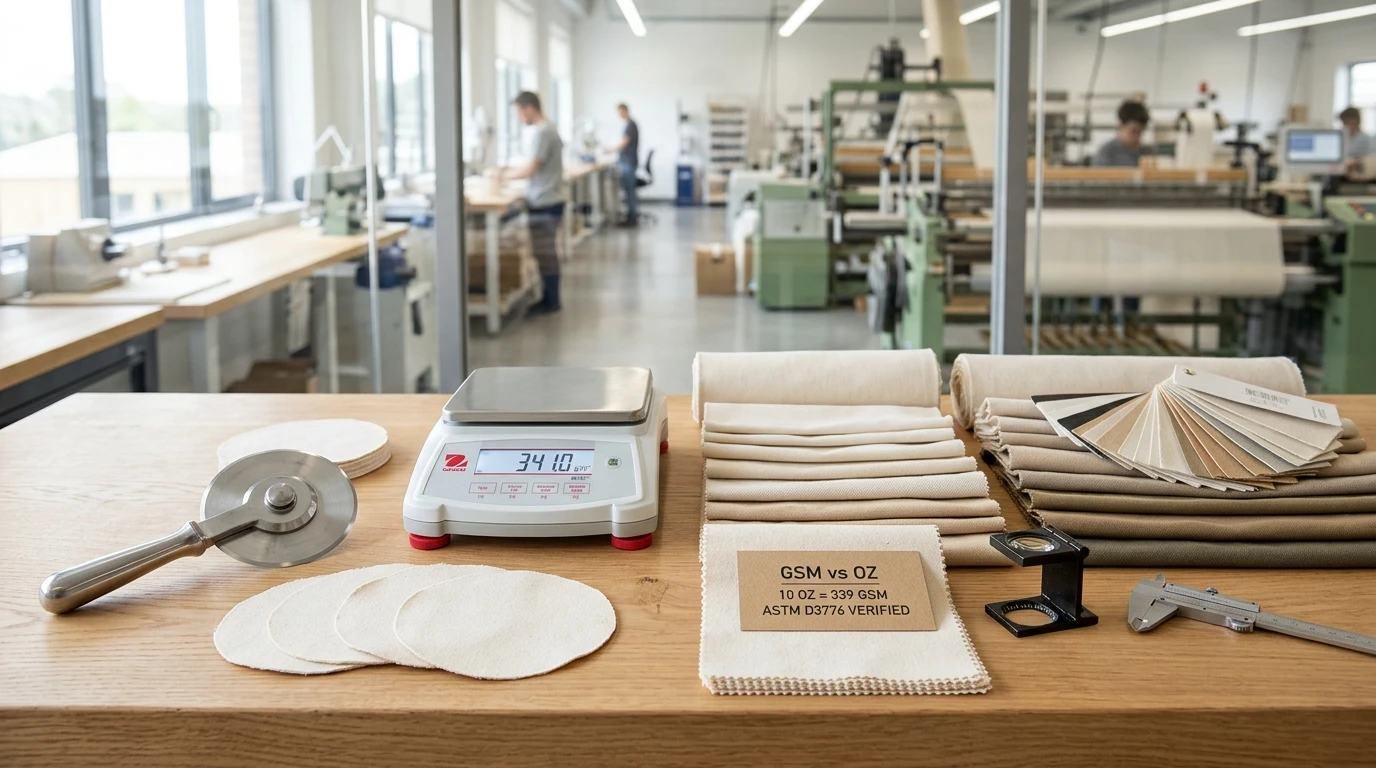
A sourcing director in Manchester or Chicago emails a technical pack to three fabric vendors in India requesting “10 oz cotton canvas, 60-inch width, 10,000 metres”. Vendor A quotes on a 340 GSM fabric (10 oz per square yard). Vendor B quotes 22% lower because they calculated 10 oz per linear yard on a 60-inch width, which is actually a thin 203 GSM cloth. Vendor C quotes on a loose 280 GSM plain weave loaded with 15% cornstarch sizing. Eight weeks later, when the 20-foot container clears customs in Rotterdam or Felixstowe, the bags fail seam-pull testing and the importer absorbs a $28,000 loss.
Using an accurate canvas fabric GSM ounce weight guide eliminates costly specification mismatches between international buyers and Indian weaving mills. While North American and UK hardware, workwear, and bag buyers traditionally specify canvas in imperial ounces (oz/yd²), Indian textile mills and European testing laboratories engineer and test fabrics in metric Grams per Square Metre (GSM). At Radhey Krishna Cotweaving, our Kishangarh weaving mill exports cotton canvas, duck, and dust sheets to over 40 countries. This guide gives you the exact mathematical conversion formulas, a master 4 oz to 24 oz conversion table, and a step-by-step decoder for reading mill specification sheets like a textile engineer.
To convert canvas fabric weights between metric GSM and imperial ounces per square yard, use the conversion factor 33.906. Multiply ounces per square yard by 33.906 to calculate GSM, or divide GSM by 33.906 to determine ounces per square yard. Always specify square-yard weight rather than linear-yard weight on purchase orders.
Table of Contents (Click to Expand / Collapse)
- What Do GSM and Ounce (oz/yd²) Actually Measure in Canvas Fabric?
- The Exact Conversion Formula Between GSM and Ounces for B2B Buyers
- The Costly Sourcing Trap: Ounces per Square Yard vs Ounces per Linear Yard (GLM)
- Master Canvas Fabric GSM to Ounce Conversion Table (4 Oz to 24 Oz)
- How to Read an Indian Mill’s Canvas Specification Sheet (Step-by-Step)
- Regional Spec Differences (US vs UK/EU) and Container Roll-Weight Math
- Why International Importers Source GSM-Verified Canvas from RK Cotweaving
- Frequently Asked Questions About Canvas GSM vs Ounce Specifications
- Request Verified GSM and Ounce Canvas Swatch Cards from Our Kishangarh Mill
What Do GSM and Ounce (oz/yd²) Actually Measure in Canvas Fabric?
In textile manufacturing, GSM (Grams per Square Metre) measures the metric mass in grams of a one-metre by one-metre square of fabric, while Ounce (oz/yd²) measures the imperial mass in ounces of a one-yard by one-yard (36-inch by 36-inch) square. Both metrics measure areal density independent of roll width.
Before comparing supplier quotations or approving pre-production swatches, procurement teams must separate fabric areal weight from fabric thickness and weave density.
1. Metric GSM (g/m²: Grams per Square Metre)
GSM is the universal metric standard used by Indian spinning and weaving mills, European Union fashion and industrial brands, customs tariff authorities, and accredited laboratories testing under ISO 3801 and ASTM D3776.
On our quality control floor in Kishangarh, technicians do not cut an entire square metre of cloth to measure GSM. Instead, we place the fabric flat on a rubber cutting mat and use a calibrated 100 cm² circular GSM cutter (which has a diameter of approximately 112.8 millimetres). We weigh that circular disc on a digital analytical balance accurate to 0.01 grams and multiply the reading by 100:
- If the 100 cm² cotton canvas disc weighs
3.15 grams, the fabric is 315 GSM. - If the disc weighs
3.85 grams, the fabric is 385 GSM.
2. Imperial Ounces (oz/yd²: Ounces per Square Yard)
Ounces per square yard is the traditional imperial specification used across the United States, Canada, and the UK hardware and industrial sectors. Whenever a North American bag brand specifies 10.10 oz army duck, a workwear buyer specifies 12 oz cotton duck, or a hardware chain orders 8 oz canvas drop cloths, they are referring to the weight in avoirdupois ounces of a 36-inch by 36-inch (1,296 square inches) piece of cloth.
3. Why Weight Alone Does Not Equal Weave Tightness or Thickness
Here is where inexperienced buyers get caught out: two fabrics can share the exact same 340 GSM (10 oz/yd²) weight while performing completely differently on a sewing line.
- Fabric A (340 GSM Loose Plain Canvas): Woven with thick, coarse single-ply
8syarns at a low pick count. The fabric feels thick and spongy, but light passes through the gaps between threads and seams pull apart under load. - Fabric B (341 GSM / 10.10 Oz Army Duck): Woven with fine two-ply
14/2 O.Eyarns beaten together at high reed-pick density. It feels firmer, flatter, and slightly thinner on a caliper gauge, yet delivers 35% higher tear strength and natural water resistance.
To specify fabric accurately, you must pair your GSM or ounce weight with yarn ply and thread count, as detailed in our complete fabric GSM guide for garment and bag manufacturers.
The Exact Conversion Formula Between GSM and Ounces for B2B Buyers
The exact mathematical conversion constant between imperial ounces per square yard and metric grams per square metre is 33.9057 (rounded to 33.906 in commercial textile trade). Multiply ounces per square yard by 33.906 to obtain GSM, and divide GSM by 33.906 to obtain ounces per square yard.
Where does the number 33.906 come from? Understanding the first-principles physics ensures your sourcing team never uses the wrong conversion constant on a commercial proforma invoice:
- Mass Conversion:
1 avoirdupois ounce = 28.3495231 grams - Area Conversion:
1 yard = 0.9144 metres, so1 square yard = 0.9144 m × 0.9144 m = 0.83612736 square metres - Combined Ratio:
28.3495231 grams ÷ 0.83612736 m² = 33.905747 g/m²
In international textile trade, mills and testing labs round this constant to 33.906 (or use 34 for quick mental estimates on the factory floor).
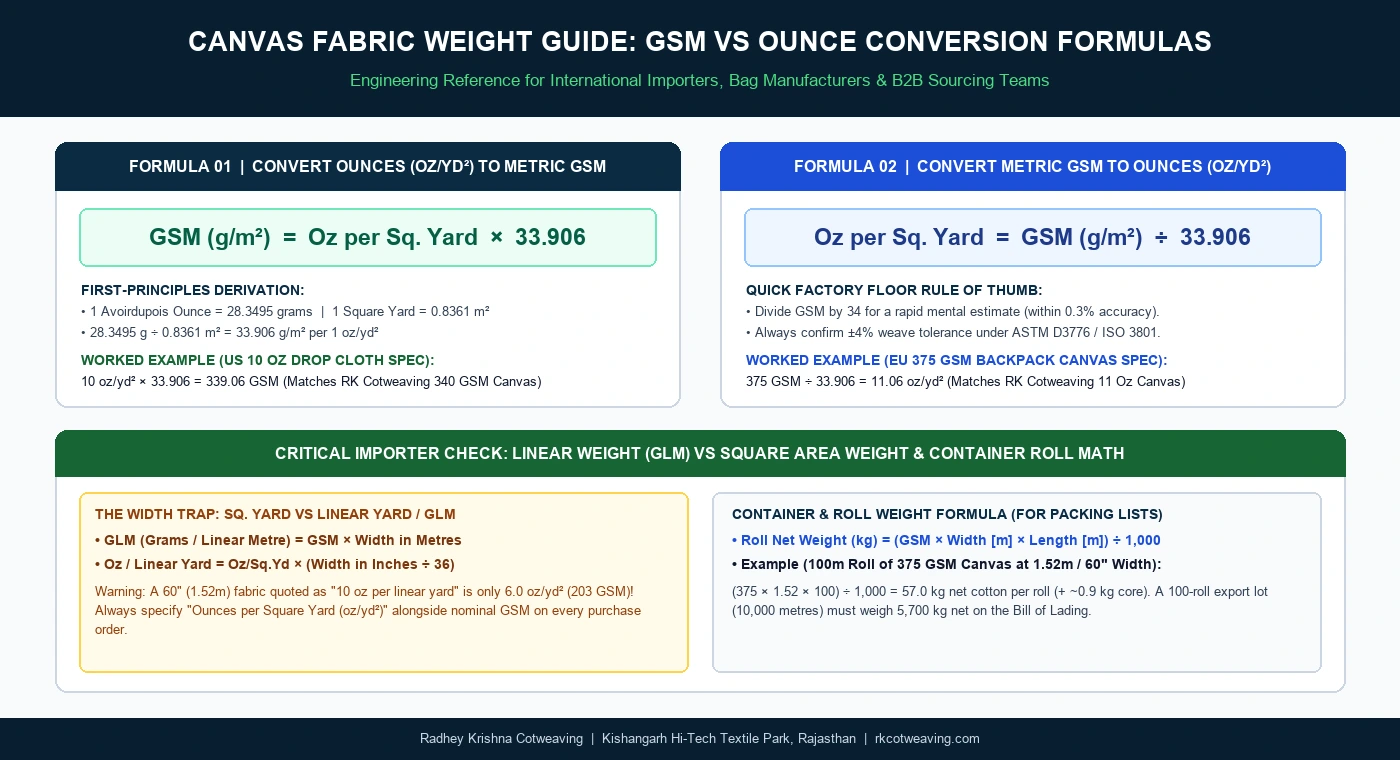
Formula 1: How to Convert Ounces (oz/yd²) to Metric GSM
To convert fabric weight from ounces per square yard to metric GSM, multiply the ounce figure by 33.906. For example, a standard 8 oz canvas converts to 271.25 GSM, a 10 oz canvas converts to 339.06 GSM, and a heavy 12 oz duck canvas converts to 406.87 GSM.
Use this equation when a US, UK, or Australian buyer sends an enquiry written in ounces and you need to match it to an Indian mill’s metric production line:
GSM (g/m²) = Weight in Ounces (oz/yd²) × 33.906
Three Real-World Export Examples:
- 6 Oz Canvas Drop Cloth / Dust Sheet:
6 × 33.906 = 203.4 GSM(Matched commercially to our 200 GSM cotton canvas fabric or 6 oz canvas drop cloth). - 10.10 Oz Army Duck Backpack Shell:
10.10 × 33.906 = 342.4 GSM(Matched to our 10.10 oz army duck fabric woven at 325 to 342 GSM). - 18 Oz Heavy Numbered Duck Tool Bag Base:
18 × 33.906 = 610.3 GSM(Matched to our 18 oz natural canvas fabric).
Formula 2: How to Convert Metric GSM to Ounces (oz/yd²)
To convert fabric weight from metric GSM to imperial ounces per square yard, divide the GSM value by 33.906. For a fast mental calculation during supplier negotiations, dividing GSM by 34 yields an estimate accurate to within 0.3% of the laboratory value.
Use this equation when your Indian weaving mill provides a metric test report and your retail client in New York, Toronto, or London requires product hangtags or customs paperwork listed in ounces:
Weight in Ounces (oz/yd²) = GSM (g/m²) ÷ 33.906
Three Real-World Export Examples:
- 170 GSM Lightweight Bag Lining Canvas:
170 ÷ 33.906 = 5.01 oz/yd²(Listed in US catalogues as 5 oz canvas; see our 170 GSM cotton canvas fabric). - 315 GSM Premium Retail Shopper Tote Canvas:
315 ÷ 33.906 = 9.29 oz/yd²(Listed commercially as 9.3 oz canvas; see our 315 GSM cotton canvas fabric). - 470 GSM Heavy Industrial Luggage Canvas:
470 ÷ 33.906 = 13.86 oz/yd²(Listed commercially as 14 oz canvas; see our 470 GSM cotton canvas fabric).
The Costly Sourcing Trap: Ounces per Square Yard vs Ounces per Linear Yard (GLM)
Importers frequently lose money by confusing Ounces per Square Yard (oz/yd²) with Ounces per Linear Yard or Grams per Linear Metre (GLM). Linear weight changes whenever roll width changes, whereas GSM and oz/yd² remain constant across all widths. Always mandate square-area weight on purchase contracts.
Why do experienced importers still receive underweight canvas shipments when ordering from unverified brokers? Nine times out of ten, the culprit is the Linear Yard vs Square Yard trap (or its metric cousin, GLM vs GSM).
In historic British and American powerloom weaving, narrow shuttle looms commonly wove canvas at a base width of 28.5 inches, 36 inches, or 40 inches. Textile merchants in domestic wholesale markets began quoting the weight of a running linear yard (or running linear metre) off the roll rather than a square yard.
Here is how the math works when width enters the equation:
- Grams per Linear Metre (
GLM):GLM (g/m) = GSM × (Fabric Width in cm ÷ 100) - Ounces per Linear Yard (
oz/linear yd):Oz per Linear Yard = Oz per Sq.Yd × (Fabric Width in inches ÷ 36)
How Unscrupulous Traders Exploit This Confusion
Suppose you request a price quote for “10 Oz Cotton Canvas in 60-Inch (152 cm) Width”.
- What you actually want (
10 oz/yd²): A fabric weighing339 GSMacross every square metre. At a 60-inch (1.524m) width, one running linear yard of this cloth weighs10 × (60 ÷ 36) = 16.67 ounces per linear yard(516.6 GLM). - What a dishonest broker ships (
10 oz per linear yard): They weave a thin6.0 oz/yd²(203 GSM) fabric at a 60-inch width. Because6.0 oz/yd² × (60 ÷ 36) = 10.0 ounces per linear yard, they claim the roll technically weighs “10 ounces per yard”! You receive a flimsy 203 GSM cloth instead of a 339 GSM heavy bag canvas, representing a 40% theft of raw cotton fibre.
The Golden Rule for Importers: Never write “10 oz canvas” alone on a purchase order. Always write 10.0 Oz/Sq.Yd (339 GSM Nominal ±4%) at 60" Cuttable Width.
Master Canvas Fabric GSM to Ounce Conversion Table (4 Oz to 24 Oz)
This master canvas fabric GSM ounce weight guide table maps imperial weights from 4 oz to 24 oz against exact metric GSM equivalents (135 GSM to 814 GSM), commercial tolerance bands, yarn architectures, and verified Radhey Krishna Cotweaving product lines for global bag, workwear, and industrial buyers.
Bookmark this reference chart for your procurement and product development teams. Every row reflects active production qualities woven at our Kishangarh mill across 100% cotton canvas fabric, cotton duck fabric, and cotton dust sheet and canvas drop cloth lines:
| Imperial Weight (Oz/Sq.Yd) | Exact Math GSM (g/m²) | Commercial Mill GSM Spec | ±4% QC Tolerance Band (GSM) | Fabric Category & Weave Type | RK Cotweaving Live Product Link | Primary B2B & Export Applications |
|---|---|---|---|---|---|---|
| 4.0 Oz | 135.6 GSM | 135 GSM | 130 – 140 GSM | Light Calico / Plain Dust Sheet | 4 Oz Canvas Drop Cloth | UK/EU decorator calico dust sheets, bag pocket linings, dust covers |
| 5.0 Oz | 169.5 GSM | 170 GSM | 163 – 177 GSM | Light Plain Cotton Canvas | 170 GSM Cotton Canvas | Foldable promotional totes, drawcord produce pouches, shoe linings |
| 6.0 Oz | 203.4 GSM | 200 GSM | 192 – 208 GSM | Light-Medium Canvas & Drop Cloth | 200 GSM Cotton Canvas / 6 Oz Drop Cloth | Conference giveaway bags, light painter drop cloths, summer aprons |
| 6.5 Oz | 220.4 GSM | 220 GSM | 211 – 229 GSM | Medium Plain Cotton Canvas | 220 GSM Cotton Canvas | High-volume retail grocery totes, branded packaging bags, cushion shells |
| 7.0 Oz | 237.3 GSM | 237 – 240 GSM | 228 – 249 GSM | Single Fill Duck Canvas | 7 Oz Cotton Canvas | Everyday retail shopping bags, utility aprons, structured jacket interlinings |
| 8.0 Oz | 271.2 GSM | 271 – 295 GSM | 260 – 306 GSM | 2-Ply Army Duck (16/2×16/2) / 8 Oz Drop Cloth | 8 Oz Army Duck / 8 Oz Drop Cloth | Structured daypacks, waxed messenger bags, field tent walls, painter drop cloths |
| 8.5 – 8.7 Oz | 288 – 295 GSM | 290 / 295 GSM | 278 – 307 GSM | Medium-Heavy Plain Canvas | 290 GSM / 295 GSM Canvas | Fashion tote bags, hospitality aprons, printed home furnishing fabrics |
| 9.3 Oz | 315.3 GSM | 315 GSM | 302 – 328 GSM | Heavy Retail Plain Canvas | 315 GSM Cotton Canvas | Premium department store shopper totes, structured wine bags, shoe uppers |
| 10.0 Oz | 339.1 GSM | 339 – 340 GSM | 325 – 353 GSM | Single Fill Duck / Heavy Drop Cloth | 10 Oz Canvas / 10 Oz Drop Cloth | Commercial contractor drop cloths, heavy promotional bags, slipcovers |
| 10.10 Oz | 342.4 GSM | 325 – 342 GSM | 312 – 355 GSM | 2-Ply Army Duck (14/2×14/2) | 10.10 Oz Army Duck Fabric | Expedition travel duffels, heritage rucksacks, marine covers, glamping tipis |
| 11.0 Oz | 373.0 GSM | 375 GSM | 360 – 390 GSM | Heavy Industrial Plain Canvas | 375 GSM Cotton Canvas | Heavy-duty backpacks, workwear jackets, structured tool pouches |
| 11.5 – 12.0 Oz | 389.9 – 406.9 GSM | 385 – 407 GSM | 370 – 423 GSM | 2-Ply Army Duck (10s/2×10s/2) / 390 GSM Canvas | 12 Oz Army Duck / 390 GSM Canvas | Electrician tool rolls, military kit bags, heavy drop cloths, industrial filtration |
| 13.8 – 14.0 Oz | 469.9 GSM | 470 GSM | 451 – 489 GSM | Extra-Heavy Plain Canvas | 470 GSM Cotton Canvas | Rugged luggage shells, heavy upholstery, gym sandbags, machinery covers |
| 15.0 Oz & 16.0 Oz | 508.6 – 542.5 GSM | 510 – 545 GSM | 490 – 566 GSM | Multi-Ply Numbered Duck (#10 / #8 equiv.) | 15 Oz / 16 Oz Natural Canvas | Heavy luggage bottom boots, welding curtains, military Cots, boat tarpaulins |
| 18.0 Oz & 20.0 Oz | 610.3 – 678.1 GSM | 610 – 680 GSM | 586 – 707 GSM | Heavy Numbered Duck (#6 / #4 equiv.) | 18 Oz / 20 Oz Natural Canvas | Mining tool buckets, linesman rigging bags, heavy artist stretched canvas |
| 24.0 Oz | 813.7 GSM | 810 – 815 GSM | 778 – 848 GSM | Ultra-Heavy Numbered Duck (#2 equiv.) | 24 Oz Natural Canvas | Extreme industrial belting, heavy marine fenders, military ordnance covers |
Note on Sustainable & Recycled Equivalents: For eco-conscious European and US brands, Radhey Krishna Cotweaving also manufactures our Re Weav recycled RPET and cotton-poly canvas collection across the exact metric weights of 200, 220, 290, 295, 315, 375, 390, and 470 GSM, certified under the Global Recycled Standard (GRS).
Need Help Matching a US Ounce Sample to an Indian Mill GSM Spec?
Courier your physical reference swatch to our Kishangarh textile lab or message our weaving engineers on WhatsApp. We will analyse the GSM, yarn count, and reed-pick density free of charge.
How to Read an Indian Mill’s Canvas Specification Sheet (Step-by-Step)
An Indian textile mill specification sheet follows a standardized engineering format: Warp Yarn Count x Weft Yarn Count / Ends Per Inch (EPI) x Picks Per Inch (PPI) - Width - GSM. Decoding each segment lets B2B buyers verify yarn thickness, ply count, weave density, and shrinkage before releasing purchase advances.
When you request a formal quotation from a primary weaving mill in Rajasthan, Gujarat, or Tamil Nadu, the technical manager will reply with a condensed specification line that looks like a mathematical code:
10s/2 O.E × 10s/2 O.E / 46 × 32 - 63" (160 cm) - 385 GSM (±4%) - GOTS RFD Sanforized
If you only read the 385 GSM at the end and ignore the numbers before it, you leave your supply chain vulnerable to yarn substitutions. If you have read our army duck canvas technical guide, you know that yarn ply and thread density govern tear strength.
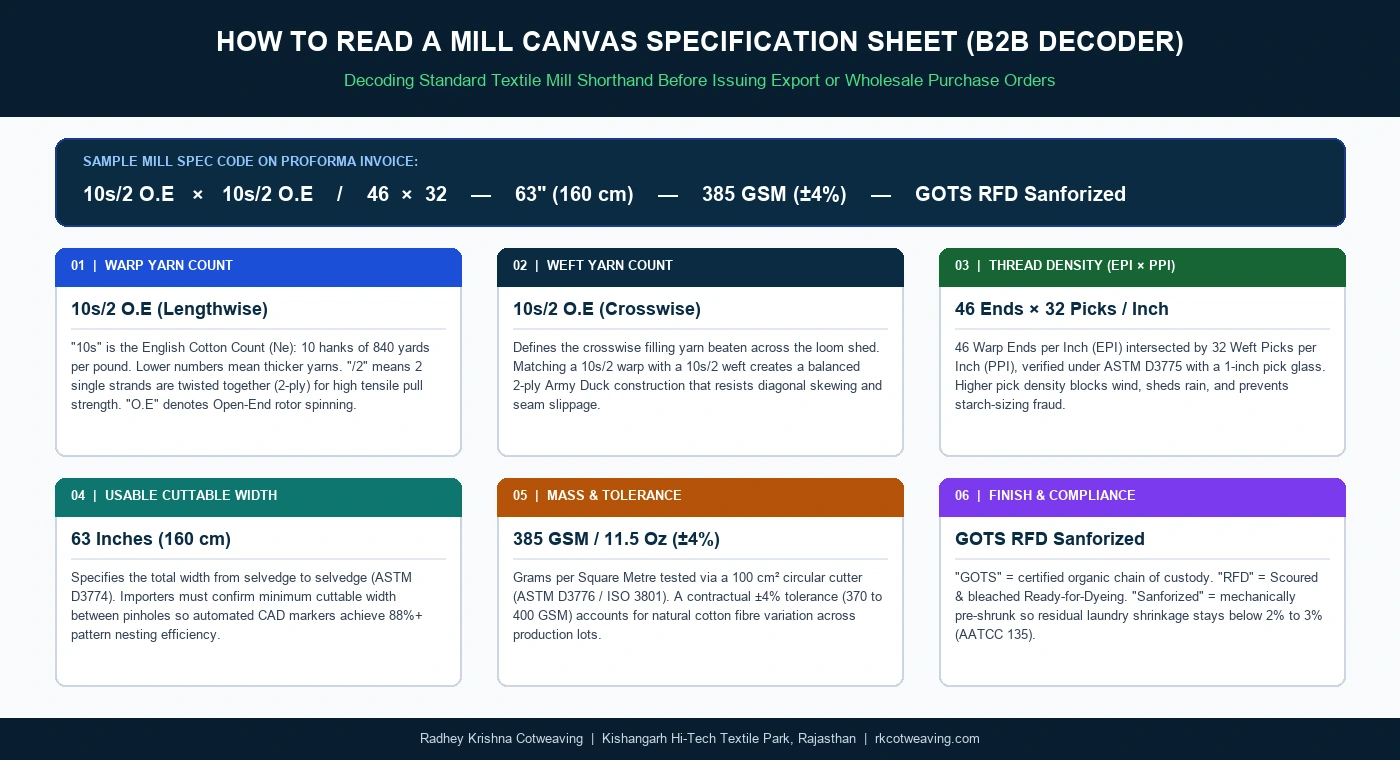
Use the step-by-step engineering breakdown below to decode every symbol on an Indian mill’s proforma invoice:
| Spec Segment | What It Stands For | How to Read It as a B2B Buyer | Verification Lab Standard |
|---|---|---|---|
10s/2 O.E (First Number) | Warp Yarn Count & Ply (Lengthwise threads) | 10s is the English Cotton Count (Ne), indicating how many 840-yard hanks of yarn weigh 1 pound. Inverse rule: Lower numbers mean thicker yarns (10s is much thicker than 20s). /2 means two single 10s strands are twisted together into a 2-ply yarn (resultant thickness equals a single 5s yarn, with 30% higher breaking strength). O.E means Open-End rotor-spun yarn ( prized in canvas for uniform abrasion resistance). | ASTM D1059 / ISO 7211-5 (Yarn Linear Density Test) |
10s/2 O.E (Second Number) | Weft / Filling Yarn Count & Ply (Crosswise threads) | Defines the yarn beaten horizontally across the loom shed. When both warp and weft are 2-ply (e.g., 10s/2 × 10s/2 or 14/2 × 14/2), the fabric is a true balanced plied duck. In cheaper canvas, mills use a plied warp with a coarse single weft (e.g., 20s/2 × 10s). | ASTM D1059 + Manual Unravel & Untwist Ply Check |
46 × 32 | Reed × Pick Density (EPI × PPI) | 46 is Ends Per Inch (EPI, warp threads per inch). 32 is Picks Per Inch (PPI, weft threads per inch). Together, they define weave tightness. A higher pick count means a tighter, smoother, more water-resistant cloth that will not suffer seam slippage. | ASTM D3775 / ISO 7211-2 (1-Inch Pick Glass Count) |
63” (160 cm) | Total vs Cuttable Fabric Width | Indicates the finished width from outer selvedge to outer selvedge. Always specify whether 63” is the minimum cuttable width inside pinholes so your automated CAD cutting markers do not clip the selvedge fringe. | ASTM D3774 / ISO 3932 (Fabric Width Measurement) |
385 GSM (±4%) | Nominal Mass & Contractual Tolerance | Target mass of 385 Grams per Square Metre (11.5 oz/yd²). Because cotton is a natural agricultural fibre affected by ambient humidity, international standards permit a ±3% to ±5% roll-to-roll tolerance (370 to 400 GSM). | ASTM D3776 / ISO 3801 (100 cm² GSM Cutter & Balance) |
GOTS RFD Sanforized | Certification & Finishing State | GOTS = Certified organic chain of custody. RFD = Scoured and bleached Ready-for-Dyeing (vs Greige loom-state). Sanforized = Mechanically pre-shrunk on a rubber-belt compressive shrinkage machine so residual laundry shrinkage stays under 2% to 3%. | AATCC 135 / ISO 6330 (Dimensional Stability / Shrinkage) |
How to Catch the “Cheap Pick Reduction” Trick on Spec Sheets
Suppose two suppliers both quote you on a 340 GSM (10 Oz) cotton canvas.
- Mill Quote 1 (Authentic Duck Construction):
14/2 × 14/2 / 52 × 36 - 341 GSM - Broker Quote 2 (Cost-Cut Construction):
10s × 6s / 36 × 22 - 340 GSM
Both weigh ~340 GSM on a scale! However, Broker Quote 2 replaced the fine 2-ply yarns with thick, low-twist single 6s weft yarns and slashed the weft pick count from 36 picks per inch down to 22 picks per inch (because fewer picks per inch allows a loom to run 40% faster and cheaper). On your factory floor, Quote 2 will fray violently during cutting and fail bar-tack pull tests. Always check the Warp × Weft / EPI × PPI block alongside the GSM.
Regional Spec Differences (US vs UK/EU) and Container Roll-Weight Math
International sourcing teams must account for regional terminology differences between US “Drop Cloths” (specified in ounces) and UK/EU “Cotton Dust Sheets” (often specified in GSM or calico weights), as well as how wet finishing alters base GSM and how to calculate total container payload weight.
When Radhey Krishna Cotweaving dispatches export containers to North America, the United Kingdom, and mainland Europe, our export desk bridges three critical regional and logistical variables.
1. US “Drop Cloth” vs UK & European “Dust Sheet” Specifications
In the protective decorating and hardware textile trade, terminology splits sharply across the Atlantic:
- United States & Canada: Buyers specify “Canvas Drop Cloth” or “Cotton Drop Cloth” strictly by imperial weight:
6 oz,8 oz,10 oz, and12 ozin standard imperial cut sizes (4'x12',4'x15',6'x9',9'x12',12'x15'). - United Kingdom, Germany & EU: Buyers specify “Cotton Dust Sheet”, “Cotton Canvas Dust Sheet”, or “Cotton Calico Dust Sheet” (
4 ozto6 ozplain-woven unbleached calico at 135 to 200 GSM) using metric conversions (1.22m x 3.65m,2.74m x 3.66m,3.66m x 4.57m).
Whether your purchase order uses US drop cloth ounces or UK/EU dust sheet GSM, RK Cotweaving manufactures both cut-and-hemmed retail units (MOQ 1,000 units) and bulk rolls in widths of 48", 60", 72", 80", and 144" across lengths of 50' (15m), 100' (30m), 200' (60m), and 400' (120m).
2. How Wet Processing, Dyeing and Waxing Shift Fabric GSM
Importers must specify whether their target GSM or ounce weight applies to the loom-state greige cloth or the finished cloth:
- Scouring & Bleaching (RFD / PFD): Boiling off natural cotton pectins, seed husks, and warp sizing reduces initial greige weight by 3% to 5%, though widthwise relaxation often offsets this change.
- Reactive / Vat Dyeing & Sanforizing: Compressive shrinkage (sanforizing) pushes warp and weft threads closer together, typically increasing finished GSM by 5% to 8% compared to loom-state greige.
- Waxed & Coated Canvas (“Dry Base Weight” vs “Finished Wet Weight”): In the waxed canvas trade, a US or UK heritage bag brand may ask for “14 oz waxed army duck”. In textile engineering, that starts as a 10.10 oz (341 GSM) dry base army duck that absorbs 35% to 40% paraffin or dry wax compound to reach a 14 oz (475 GSM) finished waxed weight. Always clarify Dry Base Fabric Weight versus Coated Finished Weight on your tech pack.
3. Container Load & Roll Weight Formula for Importers
When booking sea freight (FCL 20-foot or 40-foot containers from Mundra or Nhava Sheva port) and verifying commercial packing lists, you can calculate the exact net weight of any fabric roll or shipment using this metric equation:
Single Roll Net Weight (kg) = (GSM × Roll Width in Metres × Roll Length in Metres) ÷ 1,000
Worked Importer Container Calculation:
Suppose your Hamburg bag factory orders 12,000 linear metres of our 375 GSM cotton canvas fabric (11 oz/yd²) at a 60-inch (1.524 m) width, packed in 120 rolls of 100 metres each:
- Net Cotton Weight per 100m Roll:
(375 × 1.524 × 100) ÷ 1,000 = 57.15 kg - Gross Weight per Roll (adding ~0.95 kg for heavy-duty inner cardboard core & air-tight poly wrap):
58.10 kg - Total Consignment Net Weight (120 Rolls):
120 × 57.15 kg = 6,858 kg(6.86 Metric Tons) - Total Consignment Gross Weight on Bill of Lading:
120 × 58.10 kg = 6,972 kg
If a supplier’s packing list for that exact order declares a net weight of only 5,900 kg, you know before the vessel even sails that the fabric was woven underweight at ~322 GSM instead of 375 GSM! Pair this math check with our 3-point mill verification checklist to protect every import letter of credit.
Why International Importers Source GSM-Verified Canvas from RK Cotweaving
Radhey Krishna Cotweaving supplies international importers and domestic bag manufacturers with mill-direct cotton canvas from 135 GSM (4 oz) to 814 GSM (24 oz). Operating on 100% renewable energy in Kishangarh, Rajasthan, the mill provides 9 global certifications, custom widths up to 148 inches, and ASTM/ISO batch test reports.
For international sourcing directors in the European Union, the United Kingdom, North America, and Australia, 2026 supply chain compliance demands more than a competitive price per metre. You need documented fiber origin traceability, verified GSM accuracy, and zero middleman communication delays.
At Radhey Krishna Cotweaving, our Digital Factory and physical weaving facility in Kishangarh Hi-Tech Textile Park (RIICO Industrial Area, Rajasthan) are engineered specifically for export and B2B industrial procurement:
- 10 Million+ Metres Annual Capacity Across All GSM & Ounce Grades: From lightweight 100–180 GSM plain cottons and 170–470 GSM plain canvas to 7–10 oz single fill duck, 8–12 oz 2-ply army duck, and 15–24 oz heavy numbered ducks, we weave the complete weight spectrum under one roof.
- Ultra-Wide Loom Capabilities (28″ to 148″): We weave narrow 36″ and 37″ vintage duck widths alongside 48″, 60″, 63″, 72″, 84″, and extra-wide 144″ and 148″ (
376 cm) industrial rolls. - 9 Global Certifications & EU 2026 Traceability: We hold active certifications across GOTS (Global Organic Textile Standard), Oeko-Tex Standard 100, Fairtrade, OCS (Organic Content Standard), GRS (Global Recycled Standard), RCS (Recycled Claim Standard), BCI (Better Cotton Initiative), AWARE physical tracer verification, and ISO 9001:2015. We issue full Transaction Certificates (TC) for every certified shipment.
- 100% Solar & Wind Powered Mill: All weaving operations run on 100% renewable energy, cutting 450+ tons of CO₂ emissions annually and strengthening your brand’s ESG reporting.
- Direct Mill Pricing (20% to 30% Savings): By contracting directly with our Kishangarh mill (MOQ 1,000 units or 5,000 metres), you bypass export trading houses and lock in consistent loom settings across repeat seasonal reorders.
Frequently Asked Questions About Canvas GSM vs Ounce Specifications
These frequently asked questions provide direct mathematical formulas, GSM-to-ounce conversions for 8 oz, 10 oz, and 12 oz canvas, GLM versus GSM distinctions, commercial tolerance standards, and export ordering procedures for B2B buyers sourcing from Radhey Krishna Cotweaving in India.
How do you convert canvas fabric ounces to GSM?
To convert canvas fabric weight from ounces per square yard (oz/yd²) to metric Grams per Square Metre (GSM), multiply the ounce value by the constant 33.906. Conversely, to convert metric GSM into imperial ounces per square yard, divide the GSM figure by 33.906.
This conversion factor comes from dividing 28.3495 grams (one avoirdupois ounce) by 0.8361 square metres (one square yard). For example, if a US tech pack specifies 10 oz/yd² canvas, multiplying 10 × 33.906 gives 339.06 GSM (commercially ordered as 340 GSM). If an Indian mill offers a 315 GSM canvas, dividing 315 ÷ 33.906 gives 9.29 oz/yd².
How many GSM is 8 oz, 10 oz, and 12 oz canvas fabric?
Based on the standard 33.906 conversion factor, 8 oz canvas equals approximately 271 GSM (ranging up to 295 GSM in finished army duck), 10 oz canvas equals approximately 339 GSM (342 GSM for 10.10 oz army duck), and 12 oz canvas equals approximately 385 to 407 GSM.
In commercial mill production at Radhey Krishna Cotweaving, 8 oz army duck fabric is woven between 271 and 295 GSM (16/2 × 16/2 yarn), 10 oz cotton canvas and 10.10 oz army duck sit at 325 to 342 GSM, and 12 oz army duck fabric (10s/2 × 10s/2 yarn) sits between 385 and 407 GSM depending on whether the fabric is supplied in greige, bleached, or dyed condition.
What is the difference between GSM and GLM in fabric specifications?
GSM (Grams per Square Metre) measures the weight of a one-metre by one-metre square of fabric regardless of roll width, whereas GLM (Grams per Linear Metre) measures the weight of a one-metre running length across the full roll width. Calculate GLM by multiplying GSM by the roll width in metres.
Because GLM changes whenever fabric width changes, quoting in GLM or ounces per linear yard without stating width can mislead buyers. For example, a 300 GSM canvas woven at a 1.50-metre (59-inch) width has a GLM of 300 × 1.50 = 450 GLM. Always anchor your purchase contracts to GSM (g/m²) or ounces per square yard (oz/yd²).
What is an acceptable GSM tolerance for wholesale cotton canvas orders?
In international B2B textile manufacturing, the standard acceptable GSM tolerance for 100% cotton canvas and duck fabric is plus or minus 3% to 5% (typically ±4% contractual tolerance) when tested under ASTM D3776 or ISO 3801 protocols across a production batch.
Because natural cotton fibres vary slightly in micronaire and moisture regain (7% to 8.5% standard atmospheric moisture regain), minor weight fluctuations occur naturally on the loom. On a 375 GSM canvas order with a ±4% tolerance, rolls measuring between 360 GSM and 390 GSM pass quality inspection. Any lot falling outside that band should be flagged during pre-dispatch inspection.
Does a higher GSM always mean a stronger canvas fabric?
No, a higher GSM does not automatically guarantee a stronger canvas fabric. Tensile breaking strength, tear resistance, and seam hold depend heavily on yarn ply construction (2-ply versus single-ply), spinning method, and reed-pick weave density rather than raw square-metre weight alone.
A 341 GSM (10.10 oz) army duck woven with tightly packed 14/2 two-ply twisted yarns in both warp and weft will significantly outperform a 375 GSM loose plain-weave canvas made from coarse, low-twist single yarns. For a full structural comparison, read our guide on the canvas vs duck canvas difference.
Why does dyed or sanforized canvas have a different GSM than greige canvas?
Wet processing alters fabric dimensions and fibre mass. Scouring and bleaching remove 3% to 5% of natural cotton waxes and sizing, while reactive dyeing and mechanical sanforizing compact the warp and weft threads closer together, typically increasing finished GSM by 5% to 8% over greige weight.
When ordering custom-dyed or pre-shrunk canvas, always specify on your tech pack whether the stated GSM is the Greige Loom-State Weight or the Finished Dispatched Weight. At Radhey Krishna Cotweaving, our technical team engineers the greige loom reed-pick construction specifically so your fabric hits the exact target GSM after dyeing and sanforizing.
Can RK Cotweaving custom-weave specific GSM or ounce weights for international buyers?
Yes, Radhey Krishna Cotweaving custom-engineers cotton canvas, army duck, numbered duck, and drill fabrics to exact buyer GSM or ounce specifications across widths from 28 inches to 148 inches, starting at a standard wholesale MOQ of 5,000 metres per custom weave construction.
Our Kishangarh weaving mill exports container loads and custom bulk orders worldwide with full GOTS, GRS, Fairtrade, and Oeko-Tex Standard 100 documentation. You can select from our 30+ stock GSM and ounce articles or send us a physical reference swatch for custom loom matching.
Request Verified GSM and Ounce Canvas Swatch Cards from Our Kishangarh Mill
To eliminate specification guesswork on your next import or domestic production run, send your target GSM or ounce weight, width, and finish requirements to Radhey Krishna Cotweaving. Our Kishangarh technical desk dispatches lab-tested swatch books and mill-direct FOB or ex-works quotes within 24 hours.
Mastering this canvas fabric GSM ounce weight guide gives your procurement team total control over vendor quotes, laboratory testing, and container payload costs. When both your tech pack and your weaving mill speak the exact same engineering language (GSM, Oz/Sq.Yd, Warp × Weft, and EPI × PPI), quality surprises disappear.
Ready to benchmark your current canvas supply against direct Indian mill pricing?
- Compare Our Full Weight Range: Browse our complete fabric GSM guide for garment and bag manufacturers or our canvas fabric wholesale supplier in India hub.
- Order Lab-Verified Swatches: Request physical swatch cards marked with exact GSM, ounce weight, yarn count, and width.
- Send Your Spec Sheet via WhatsApp or Email: Connect directly with our Kishangarh export and wholesale desk below.